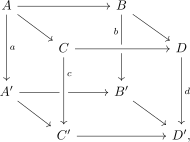
We first reformulate conditions (2) and (3). Let
\(X_{\bullet}\colon I \to T\) be a diagram with colimit
\(X\). Descent identifies
\(T_{/X}\) with
\(\lim_{i \in I\catop}T_{/X_i}\), and it identifies their cores after applying
\((-)^{\simeq}\). Since
\(\Sigma\) is stable under base change, conditions (2) and (3) are therefore both equivalent to the following detection property:
\[f\colon Y \to X \text{ lies in }\Sigma
\quad\Longleftrightarrow\quad
f_i\colon Y \times_X X_i \to X_i \text{ lies in }\Sigma\text{ for every }i \in I.\]
(1)Assume (1). The reverse implication in
Equation (1) follows by forming the coproduct
\(\bigsqcup_i f_i\). This morphism lies in
\(\Sigma\), and it is the base change of
\(f\) along the effective epimorphism
\(\bigsqcup_i X_i \twoheadrightarrow X\). The forward implication is simply stability under base change. Thus (1) implies both (2) and (3).
Conversely, assume the detection property. Applied to a coproduct diagram, it shows that
\(\Sigma\) is closed under small coproducts. Now let
\(g\colon X' \twoheadrightarrow X\) be an effective epimorphism and suppose that the pullback
\(f'\) of
\(f\colon Y \to X\) along
\(g\) lies in
\(\Sigma\). The Čech nerve of
\(g\) has colimit
\(X\), and every pullback of
\(f\) to a term of this Čech nerve is a further base change of
\(f'\). The detection property therefore implies that
\(f\) lies in
\(\Sigma\). Hence
\(\Sigma\) is local, proving the equivalence of (1), (2), and (3).
We next compare this with (4). A diagram in
\(\Ar^{\pb}(T)\) is the same thing as a cartesian natural transformation
\(Y_{\bullet} \to X_{\bullet}\). By
Proposition 2.16, its colimit in
\(\Ar^{\pb}(T)\) is represented by
\[\colim_i Y_i \longrightarrow \colim_i X_i,\]
and its pullback to each
\(X_i\) recovers
\(Y_i \to X_i\). Consequently, closure of the arrows in
\(\Sigma\) under colimits in
\(\Ar^{\pb}(T)\) is equivalent to the detection property
Equation (1). This proves the equivalence with (4).
Finally, small colimits are generated by small coproducts and pushouts. A pushout diagram in
\(\Ar^{\pb}(T)\) is precisely a cube of the form displayed in (5): the top and bottom faces express the pushout in the source and target, while the remaining vertical faces express that the morphisms in the span lie in
\(\Ar^{\pb}(T)\). Thus closure under coproducts and the cube condition is equivalent to closure under all small colimits, proving the equivalence of (4) and (5).