2.3. Characterizations and consequences

The descent definition is intrinsic, but it is not always the most convenient way to recognize a topos or to prove exactness results inside one. We first compare it with the Giraud axioms, object classifiers, and presentations by presheaves. We then extract several exactness properties that are useful in practice and study the classification of local classes of morphisms.

2.3.1. Characterizations of topoi

We now provide various alternative characterizations of topoi. Throughout this section, we fix a presentable category \(T\).

Definition 2.41.

An object classifier is an object \(U \in \widehat{T} := \Fun^{\mathrm{lim}}(T\catop,\widehat{\An})\) such that \(\Hom(X,U) \simeq (T_{/X})^{\simeq}\). Note that \(T\) admits an object classifier if and only if the assignment \(X \mapsto (T_{/X})^{\simeq}\) preserves limits.

Theorem 2.42.

Let \(T\) be a presentable category. Then the following are equivalent:

  1. The category \(T\) is a topos.

  2. Colimits are universal and there exists an object classifier.

  3. The Giraud axioms are satisfied:

  4. There exists a small category \(C\) and a left exact localization \(\PSh(C) \to T\).

Proof
(1) \(\implies\) (2): Clear, since \((-)^{\simeq}\colon \Cat \to \An\) preserves limits.(2) \(\implies\) (1): Assume (2), and let \(X_{\bullet}\colon I \to T\) be a diagram with colimit \(X\). By universality of colimits, the comparison functor
\[T_{/X} \longrightarrow \lim_{i \in I\catop}T_{/X_i}\]
is fully faithful by Lemma 2.8. To prove essential surjectivity, let \(U\) be an object classifier and choose an object of the limit on the right. Passing to cores and using the classifying property of \(U\), this object determines a point of
\[\lim_{i \in I\catop}(T_{/X_i})^{\simeq} \iso \lim_{i \in I\catop}\Hom(X_i,U) \iso \Hom(X,U).\]
The final isomorphism follows because \(U\colon T\catop \to \widehat{\An}\) preserves limits. The resulting map \(X \to U\) classifies an object over \(X\) whose pullback to every \(X_i\) is isomorphic to the prescribed object. Thus the comparison functor is essentially surjective and hence an equivalence.(1) \(\implies\) (3): We verify the three conditions:
  • Universality of colimits holds by definition of a topos.
  • Coproducts are disjoint by Example 2.12.
  • All groupoids are effective by Corollary 2.23.
(4) \(\implies\) (1): Since \(\An\) is a topos, it follows that \(\PSh(C) = \Fun(C\catop,\An)\) is a topos, and hence so is any left exact localization of \(\PSh(C)\) by Corollary 2.17.(3) \(\implies\) (4): We use the proposition below. Choose a sufficiently large regular cardinal \(\kappa\) such that \(T\) is generated under colimits by a small full subcategory \(C\) of \(\kappa\)-compact objects and such that \(C\) is closed under finite limits. Such a choice is possible because finite limits in a presentable category are accessible. The inclusion \(C \hookrightarrow T\) is then left exact, so the proposition shows that its colimit-preserving extension
\[F\colon \PSh(C) \longrightarrow T\]
is left exact. Its right adjoint is the restricted Yoneda functor \(X\mapsto\Hom_T(-,X)|_C\), which is fully faithful because \(C\) generates \(T\) under colimits. Thus \(F\) is a left exact localization, giving (4).

Proposition 2.43.

Let \(C\) be a category which has finite limits, and let \(T\) be a presentable category satisfying the Giraud axioms. Let \(f\colon C \to T\) be a left exact functor. Then the unique colimit-preserving extension \(F\colon \PSh(C) \to T\) of \(f\) is left exact.

Proof
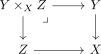
We say that a presheaf \(X \in \PSh(C)\) is good if the functor \(F\) preserves every pullback square of the form
Commutative diagram generated from the LaTeX source
By universality of colimits, \(X\) is good if and only if \(F\) preserves all such pullback squares where \(Y\) and \(Z\) are representable. In particular, since \(f\) preserves pullbacks, every representable presheaf is good. Since coproducts are universal and disjoint in \(T\), they are van Kampen by Example 2.12; it follows that coproducts of good objects are good.Every presheaf admits an effective epimorphism from a coproduct of representables. Indeed, one may choose a representative of every connected component of every anima \(X(c)\), and the resulting map
\[\coprod_{(c,x)} h_c \longrightarrow X\]
is pointwise surjective on \(\pi_0\). It therefore remains to prove the following descent statement: if \(X_0 \twoheadrightarrow X\) is an effective epimorphism and \(X_0\) is good, then \(X\) is good.Let \(X_{\bullet} \to X\) be the augmented Čech nerve of \(p\colon X_0 \to X\). The pullback identities expressing that \(X_{\bullet}\) is a groupoid object are pullback squares over \(X_0\), so goodness of \(X_0\) implies that \(F(X_{\bullet})\) is a groupoid object. Since \(F\) preserves colimits, \(F(X_{\bullet}) \to F(X)\) is a colimit diagram. Effectivity of groupoids in \(T\) therefore identifies it with the augmented Čech nerve of \(F(p)\colon F(X_0) \to F(X)\). In particular, \(F(p)\) is an effective epimorphism.We record one consequence. Suppose that a map \(W \to X\) admits a lift \(W \to X_0\). Using either projection \(X_0\times_XX_0\to X_0\) as appropriate, there is a pullback square over \(X_0\) identifying
\[W\times_XX_0 \iso W\times_{X_0}(X_0\times_XX_0).\]
Goodness of \(X_0\), together with the degree-one identification
\[F(X_0\times_XX_0)\iso F(X_0)\times_{F(X)}F(X_0),\]
therefore gives
\[F(W\times_XX_0)\iso F(W)\times_{F(X)}F(X_0).\]
(1)
To test that \(X\) is good, we may take \(Y\) and \(Z\) to be representable. Since \(p\) is pointwise surjective on \(\pi_0\), the maps \(Y \to X\) and \(Z \to X\) admit lifts through \(X_0\) in the corresponding mapping animae. The same is then true of \(Y\times_XZ\to X\). Applying Equation (1) to these three objects, and using goodness of \(X_0\) for the pullback square
\[(Y\times_XZ)\times_XX_0 \iso (Y\times_XX_0)\times_{X_0}(Z\times_XX_0),\]
shows that the comparison map
\[F(Y\times_XZ)\longrightarrow F(Y)\times_{F(X)}F(Z)\]
becomes an isomorphism after pullback along \(F(X_0)\to F(X)\). This map is an effective epimorphism, so the corresponding pullback functor is conservative. The comparison map is therefore itself an isomorphism. Thus \(X\) is good, completing the proof.

Remark 2.44.

Marc mentioned he did not yet manage to find a direct proof that (3) implies (1) that does not go through the presentation of a topos as a left exact localization of a presheaf topos.

2.3.2. Exactness in topoi

Presenting a topos as a left exact localization of a presheaf topos allows many exactness questions to be reduced to the corresponding statements in \(\An\). We record four useful instances. The last one is more specialized, but it is a convenient criterion in calculations with simplicial objects.

Proposition 2.45. ({cf. [Lurie 2009, Proposition 6.4.5.9]})

The following statements hold true in a topos:

  1. Filtered colimits commute with finite limits.

  2. Sifted colimits commute with finite products.

  3. For every anima \(A\), the colimit functor \(\colim_A\colon \Fun(A,T) \to T\) preserves limits indexed by weakly contractible categories. For example, every \(G\)-equivariant pullback diagram induces an isomorphism

    \[(X \times_Z Y)/G \iso X/G \times_{Z/G} Y/G .\]
  4. Given a diagram of simplicial objects

    Commutative diagram generated from the LaTeX source

    such that \(\tau_0 Z_{\bullet}\) is constant, we get an isomorphism

    \[\colim_n (X_n \times_{Z_n} Y_n) \iso (\colim_n X_n) \times_{\colim_n Z_n} (\colim_n Y_n) .\]
Proof
(1) Writing \(T\) as a left exact localization of a presheaf topos, this follows from the analogous statement in \(\An\), where it is a classical fact. (A model-independent argument for this may be found in [Sattler and Wärn 2025].)(2) Given two diagrams \(X_{\bullet},Y_{\bullet}\colon I \to T\), with \(I\) sifted, we need to show that the canonical map
\[\colim_{i \in I} (X_i \times Y_i) \to (\colim_{i \in I} X_i) \times (\colim_{i \in I} Y_i)\]
induced by the projections is an isomorphism. We may factor this map as a composite
\[\colim_{i \in I} (X_i \times Y_i) \to \colim_{i \in I} \colim_{j \in I} (X_i \times Y_j) \to (\colim_{i \in I} X_i) \times (\colim_{j \in I} Y_j),\]
where the first map is induced by the diagonal functor \(I \to I \times I\). Since \(I\) is sifted, this map is final by definition, so the first map is an isomorphism. Moreover, it follows from descent that the functor \(- \times -\colon T \times T \to T\) preserves colimits in both variables separately, so that also the second map is an isomorphism.(3) Given \(A \in \An\), descent gives an equivalence
\[\Fun(A,T) \simeq T_{/\,\colim_A *}.\]
Under this equivalence, the colimit functor \(\colim_A\colon \Fun(A,T) \to T\) corresponds to the forgetful functor \(T_{/\,\colim_A *} \to T\). Limits in a slice are computed in the underlying category whenever the indexing category is nonempty. In particular, this forgetful functor preserves limits indexed by weakly contractible categories, which proves the claim.(4) Let \(P\) denote the constant value of \(\tau_0 Z_{\bullet}\). The comparison map in the statement is a morphism over \(P\). Since \(Z_0 \to P\) is an effective epimorphism, it is enough by Lemma 2.29 to prove that this map becomes an isomorphism after base change along \(Z_0 \to P\).We therefore work in the slice \(T_{/Z_0}\) and suppress this base change from the notation. Each \(Z_n\) is now connected over \(Z_0\), and the degeneracy map \(Z_0 \to Z_n\) supplies a point. Thus \(Z_{\bullet}\) is a simplicial object in the category of pointed connected objects of \(T_{/Z_0}\). Applying the delooping equivalence from Proposition 2.35 degreewise, and using its naturality, we may write
\[Z_{\bullet} \simeq \bB G_{\bullet}\]
for a simplicial group object \(G_{\bullet}\) in \(T_{/Z_0}\). Under the equivalence between objects over \(\bB G_n\) and \(G_n\)-objects from Example 2.13, the simplicial objects \(X_{\bullet}\) and \(Y_{\bullet}\) correspond to simplicial \(G_{\bullet}\)-objects \(X'_{\bullet}\) and \(Y'_{\bullet}\). Degreewise, we then have
\[X_n \times_{\bB G_n}Y_n \iso (X'_n \times Y'_n)/G_n.\]
The quotient on the right is itself a simplicial colimit, namely the realization of the action groupoid. The desired comparison therefore compares the two possible orders of realization of the resulting bisimplicial object. These orders agree by the Fubini theorem for colimits. Moreover, finite products commute with simplicial colimits by part (2), so the products occurring in the action groupoids may also be formed before or after realization. Both sides are consequently identified with the same total colimit, proving the claim after base change and hence in \(T\).

2.3.3. The subobject classifier

The object classifier of a topos is generally a large object. Nevertheless, many suitably small families of morphisms are represented by objects of the topos itself. The relevant hypothesis is locality: membership in the family must be stable under base change and detectable after passing to a cover. We develop this general classification result before specializing it to monomorphisms and the subobject classifier.

Definition 2.46.

Let \(\Sigma\) be a class of morphisms in a topos \(T\). We say that \(\Sigma\) is a local class if the following conditions are satisfied:

  1. It is closed under base change;

  2. It is closed under small coproducts;

  3. Given a pullback square in \(T\) of the form

    Commutative diagram generated from the LaTeX source

    in which \(f' \in \Sigma\) and \(g\) is an effective epimorphism, we also have \(f \in \Sigma\).

Proposition 2.47.

Let \(\Sigma\) be a class of morphisms in a topos \(T\) which is stable under base change. The following conditions are equivalent:

  1. The class \(\Sigma\) is a local class;

  2. The functor \(T\catop \to \widehat{\Cat}\) given by sending \(X \in T\) to the full subcategory of \(T_{/X}\) spanned by the morphisms in \(\Sigma\) preserves limits;

  3. The functor \(T\catop \to \widehat{\An}\) given by sending \(X \in T\) to the full subanima of \((T_{/X})^{\simeq}\) spanned by the morphisms in \(\Sigma\) preserves limits;

  4. The full subcategory of \(\Ar^{\pb}(T)\) spanned by the morphisms in \(\Sigma\) is closed under colimits;

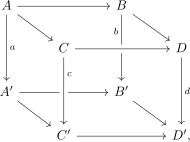
  5. The class \(\Sigma\) is closed under coproducts, and for every commutative cube in \(T\) of the form
    Commutative diagram generated from the LaTeX source

    if the top and bottom squares are pushout squares, the left and back squares are pullback squares, and \(a,b,c \in \Sigma\), then also \(d \in \Sigma\).

Proof
We first reformulate conditions (2) and (3). Let \(X_{\bullet}\colon I \to T\) be a diagram with colimit \(X\). Descent identifies \(T_{/X}\) with \(\lim_{i \in I\catop}T_{/X_i}\), and it identifies their cores after applying \((-)^{\simeq}\). Since \(\Sigma\) is stable under base change, conditions (2) and (3) are therefore both equivalent to the following detection property:
\[f\colon Y \to X \text{ lies in }\Sigma \quad\Longleftrightarrow\quad f_i\colon Y \times_X X_i \to X_i \text{ lies in }\Sigma\text{ for every }i \in I.\]
(2)
Assume (1). The reverse implication in Equation (2) follows by forming the coproduct \(\bigsqcup_i f_i\). This morphism lies in \(\Sigma\), and it is the base change of \(f\) along the effective epimorphism \(\bigsqcup_i X_i \twoheadrightarrow X\). The forward implication is simply stability under base change. Thus (1) implies both (2) and (3).Conversely, assume the detection property. Applied to a coproduct diagram, it shows that \(\Sigma\) is closed under small coproducts. Now let \(g\colon X' \twoheadrightarrow X\) be an effective epimorphism and suppose that the pullback \(f'\) of \(f\colon Y \to X\) along \(g\) lies in \(\Sigma\). The Čech nerve of \(g\) has colimit \(X\), and every pullback of \(f\) to a term of this Čech nerve is a further base change of \(f'\). The detection property therefore implies that \(f\) lies in \(\Sigma\). Hence \(\Sigma\) is local, proving the equivalence of (1), (2), and (3).We next compare this with (4). A diagram in \(\Ar^{\pb}(T)\) is the same thing as a cartesian natural transformation \(Y_{\bullet} \to X_{\bullet}\). By Proposition 2.16, its colimit in \(\Ar^{\pb}(T)\) is represented by
\[\colim_i Y_i \longrightarrow \colim_i X_i,\]
and its pullback to each \(X_i\) recovers \(Y_i \to X_i\). Consequently, closure of the arrows in \(\Sigma\) under colimits in \(\Ar^{\pb}(T)\) is equivalent to the detection property Equation (2). This proves the equivalence with (4).Finally, small colimits are generated by small coproducts and pushouts. A pushout diagram in \(\Ar^{\pb}(T)\) is precisely a cube of the form displayed in (5): the top and bottom faces express the pushout in the source and target, while the remaining vertical faces express that the morphisms in the span lie in \(\Ar^{\pb}(T)\). Thus closure under coproducts and the cube condition is equivalent to closure under all small colimits, proving the equivalence of (4) and (5).

Definition 2.48.

Let \(\Sigma\) be a local class in \(T\). We say that a morphism \(f_{\Sigma}\colon Y_{\Sigma} \to X_{\Sigma}\) classifies \(\Sigma\) if for every object \(X \in T\) the map

\[\Hom_T(X,X_{\Sigma}) \to (T_{/X})^{\simeq}, \qquad g \mapsto g^*(f_{\Sigma})\]

is a monomorphism of animae whose image is given by the full subanima spanned by the morphisms in \(\Sigma\). In this situation, we also say that the object \(X_{\Sigma}\) classifies \(\Sigma\).

By the Yoneda lemma, a classifying object is unique if it exists.

Corollary 2.49.

Let \(\Sigma\) be a local class in \(T\). Then there exists a classifying object for \(\Sigma\) if and only if for every object \(X \in T\) the full subanima of \((T_{/X})^{\simeq}\) spanned by the morphisms in \(\Sigma\) is small.

Proof
If a classifying object exists, then for every object \(X \in T\) the subanima of \((T_{/X})^{\simeq}\) spanned by the morphisms in \(\Sigma\) is equivalent to the small anima \(\Hom_T(X,X_{\Sigma})\), hence is itself small.Conversely, if for every object \(X \in T\) the subanima of \((T_{/X})^{\simeq}\) spanned by the morphisms in \(\Sigma\) is small, then these subanimae determine a functor \(T\catop \to \An\). By Proposition 2.47, this functor preserves limits. The adjoint functor theorem then implies it is represented by some object \(X_{\Sigma}\) of \(T\).

The class of monomorphisms in a topos is local. Stability under base change is immediate, coproducts of monomorphisms are monomorphisms by disjointness and universality of coproducts, and locality follows by testing the diagonal after pullback along an effective epimorphism. Moreover, presentable categories are well-powered, so for every \(X \in T\) the subanima of \((T_{/X})^{\simeq}\) spanned by the monomorphisms is small. The preceding corollary therefore applies.

Definition 2.50.

For a topos \(T\), we denote by \(\Omega\) the classifying object for the class of monomorphisms, and call it the subobject classifier.

Lemma 2.51.

The subobject classifier is \(0\)-truncated. That is, for every object \(X \in T\), the anima \(\Hom_T(X,\Omega)\) is 0-truncated.

Proof
By definition, \(\Hom_T(X,\Omega)\) is the full subanima of \((T_{/X})^{\simeq}\) spanned by the monomorphisms \(U \hookrightarrow X\). If \(U \hookrightarrow X\) is a monomorphism, then its anima of automorphisms in \(T_{/X}\) is contractible. Thus this full subanima has no nontrivial self-identifications and is therefore \(0\)-truncated.

Lemma 2.52.

Let \(Y \to \Omega\) be the universal monomorphism. Then \(Y\) is the terminal object.

Proof
Write \(p\colon Y \to \Omega\) for the universal monomorphism, and let \(t\colon * \to \Omega\) be the map classifying the identity \(\id_*\colon * \to *\), exhibited by a pullback square of the form
Commutative diagram generated from the LaTeX source
We claim \(s\) is an inverse to the canonical map \(q\colon Y \to *\), showing \(Y\) is terminal. Since \(q \circ s\) is homotopic to \(\id_*\), it remains to show that \(s \circ q\) is homotopic to \(\id_Y\).To this end, observe that we have two pullback diagrams of the following form:
Commutative diagram generated from the LaTeX source
In particular, both bottom maps \(Y \to \Omega\) are classifying maps for \(\id_Y\), and it follows that \(p\) is homotopic to \(t \circ q\). We then get the chain of homotopies
\[p \circ (s \circ q) \simeq (p \circ s)\circ q \simeq t \circ q \simeq p \circ \id_Y,\]
so \(s \circ q\) defines an endomorphism of \(p\) in the slice category \(T_{/\Omega}\). Since \(p\) is a monomorphism, the anima of endomorphisms of \(p\) in \(T_{/\Omega}\) is \((-1)\)-truncated and nonempty (it contains \(\id_Y\)), hence contractible. Therefore \(s \circ q\) is homotopic to \(\id_Y\), as desired.

References

  1. Jacob Lurie. Higher topos theory. Ann. Math. Stud. 170, Princeton, NJ: Princeton University Press. 2009.
  2. Christian Sattler, David Wärn. Note on confluent colimits. 2025.
