2.2. Effective epimorphisms

We will now introduce an important class of morphisms \(X \twoheadrightarrow Y\) in a topos, known as the effective epimorphisms. There are various ways of thinking about such morphisms:

  1. They are higher categorical analogues of the effective epimorphisms from 1-category theory, i.e. those morphisms that exhibit \(Y\) as the quotient of \(X\) at the equivalence relation \(X \times_Y X \subseteq X \times X\);

  2. They are those morphisms for which the pullback functor \(T_{/Y} \to T_{/X}\) is conservative, allowing us to check various conditions of maps in \(T_{/X}\) after pulling back to \(Y\);

  3. They are the topos-theoretic analogues of the covers in a Grothendieck site.

Following Lurie, we take perspective (1) as our definition. To make this precise, we first recall the notion of groupoid objects.

2.2.1. Groupoid objects

Recall that a (classical) groupoid is a classical category \(\Gg\) in which all morphisms are invertible. Concretely, it consists of a set \(\Gg_0\) of objects, a set \(\Gg_1\) of morphisms, source/target maps \(s,t\colon \Gg_1 \to \Gg_0\), unit and inverse maps \(e\colon \Gg_0 \to \Gg_1\) and \(i\colon \Gg_1 \to \Gg_1\), and a composition map \(m\colon \Gg_1 \times_{s,\Gg_0,t} \Gg_1 \to \Gg_1\), satisfying the expected relations.

The higher categorical analogue is the following:

Definition 2.18.

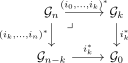
Let \(C\) be a category. A simplicial object \(\Gg\colon\simp\catop \to C\) is called a groupoid object if for every \([n] \in \simp\) and every (not necessarily order-preserving) partition \begin{align*} [n] \simeq \{i_0,\dots ,i_k\} \sqcup_{\{i_k\}} \{i_k,\dots,i_n\}, \end{align*} the induced diagram
Commutative diagram generated from the LaTeX source

is a pullback square in \(C\). We let \(\Grpd(C) \subseteq \Fun(\simp\catop,C)\) denote the full subcategory spanned by the groupoid objects in \(C\).

Exercise 2.19.

Show that a groupoid object in \(\Set\) is nothing but a classical groupoid.

For the purposes of topos theory, we may think of groupoid objects as higher categorical analogues of equivalence relations. Given a groupoid \(\Gg\) in the category of sets, the image of the map \((s,t)\colon \Gg_1 \to \Gg_0 \times \Gg_0\) is an equivalence relation on \(\Gg_0\). Indeed, reflexivity follows from the identity maps, transitivity follows from composition of morphisms, and symmetry follows by inverting morphisms. Conversely, equivalence relations \(R \subseteq X \times X\) on a set \(X\) correspond bijectively to groupoids in sets \(\Gg\) such that \(\Gg_0 = X\) and the map \((s,t)\colon \Gg_1 \hookrightarrow \Gg_0 \times \Gg_0\) is injective. Under this correspondence, the colimit \(\abs{\Gg}\) of the groupoid corresponds to the quotient \(X / R\).

Given a groupoid object \(\Gg_{\bullet}\) in \(C\) with \(X = \Gg_0\), we similarly think of the colimit \(\abs{\Gg_{\bullet}}\) as a “quotient of \(X\) by the relations contained in \(\Gg\)”. Unlike an equivalence relation, a groupoid may have several morphisms between two objects, as well as nontrivial automorphisms. This additional structure contributes nontrivially to the quotient object.

Lemma 2.20. ([Lurie 2009, Proposition 6.1.2.11])

Let \(C\) be a category and consider an augmented simplicial object \(U_{\bullet}^+\colon\simp\catop_+ \to C\). The following conditions are equivalent:

  1. The diagram \(U_{\bullet}^+\) is right Kan extended from \((\simp_+^{\leq 0})\catop \subseteq \simp\catop_+\);

  2. The simplicial object \(U_{\bullet} := U_{\bullet}^+\vert_{\simp}\) is a groupoid object and the square

    Commutative diagram generated from the LaTeX source

    is a pullback square.

Proof
Assume first that \(U_{\bullet}^+\) is right Kan extended from \((\simp_+^{\leq 0})\catop\). The pointwise formula for right Kan extension gives canonical isomorphisms
\[U_n \iso \underbrace{U_0 \times_{U_{-1}} \dots \times_{U_{-1}} U_0}_{n+1\text{ factors}}\]
for every \(n \geq 0\). Thus \(U_{\bullet}\) is the Čech nerve of \(U_0 \to U_{-1}\). The displayed square in the statement is the case \(n=1\), and the remaining pullback identities show that \(U_{\bullet}\) is a groupoid object.Conversely, assume that \(U_{\bullet}\) is a groupoid object and that the displayed square is a pullback square. The latter identifies
\[U_1 \iso U_0 \times_{U_{-1}} U_0.\]
Applying the groupoid condition successively to the ordered decompositions of \([n]\) into adjacent intervals gives
\[U_n \iso \underbrace{U_1 \times_{U_0} \dots \times_{U_0} U_1}_{n\text{ factors}} \iso \underbrace{U_0 \times_{U_{-1}} \dots \times_{U_{-1}} U_0}_{n+1\text{ factors}}.\]
These isomorphisms are induced by the vertex maps \([0] \to [n]\) and are therefore compatible with the simplicial structure. Hence \(U_{\bullet}^+\) agrees with the Čech nerve of \(U_0 \to U_{-1}\), which is precisely the right Kan extension of its restriction to \((\simp_+^{\leq 0})\catop\).

The definitions of universal/effective colimits specialize to groupoids as follows:

Definition 2.21.

Let \(C\) be a category with pullbacks and geometric realizations.

  1. A geometric realization \(X = \abs{X_{\bullet}} := \colim_{n} X_n\) is called a groupoid colimit if the simplicial object \(X_{\bullet}\colon \simp\catop \to C\) is a groupoid.

  2. We say groupoid colimits are effective in \(C\) if for every cartesian transformation \(Y_{\bullet} \to X_{\bullet}\) of groupoid objects, the commutative square

    Commutative diagram generated from the LaTeX source

    is a pullback square.

  3. We say that groupoid colimits are universal if for every morphism \(f\colon A \to B\) in \(C\), the pullback functor \(f^*\colon C_{/B} \to C_{/A}\) preserves groupoid colimits.

Lemma 2.22.

Let \(C\) be a category with pullbacks and geometric realizations. Then \(C\) satisfies descent for groupoid colimits if and only if groupoid colimits are universal and effective.

Proof
This follows as in Corollary 2.9.

Corollary 2.23.

Groupoid colimits are effective in a topos.

2.2.2. Effective epimorphisms and Čech nerves

In 1-category theory, a morphism \(f\colon U \to X\) is called an effective epimorphism if it exhibits its target as the quotient of its source at the equivalence relation \(U \times_X U\) determined by \(f\). Equivalently, \(X\) is the coequalizer of the two projection maps \(U \times_X U \rightrightarrows U\).

The definition in the higher categorical setting is similar. We replace the equivalence relation \(U \times_X U\) by a certain groupoid object \(\check{C}_{\bullet}(f)\) called the Čech nerve of \(f\). In degrees \(\leq 1\), this groupoid is given by the two projection maps \(U \times_X U \rightrightarrows U\).

Construction 2.24. (Čech nerve)

Let \(C\) be a category with pullbacks. For a morphism \(f\colon U \to X\) in \(C\), we define its Čech nerve \(\check{C}_{\bullet}(f) \in \Fun(\simp\catop,C)\) as the image of \(f \in \Ar(C)\) under the following functor:

\[\Fun([1],C) \simeq \Fun((\simp^{\leq 0}_+)\catop,C) \xrightarrow{j_*} \Fun(\simp\catop_+,C) \xrightarrow{i^*} \Fun(\simp\catop,C).\]

Here \(\simp_+\) is the augmented simplex category, \(i\colon \simp \hookrightarrow \simp_+\) is the canonical inclusion, \(j\colon \simp_+^{\leq 0} \hookrightarrow \simp_+\) is the inclusion of the objects \([-1]\) and \([0]\), and \([1] \simeq (\simp^{\leq 0}_+)\catop\) is the canonical equivalence sending \(0\) to \([0]\) and \(1\) to \([-1]\). The pointwise formula for the right Kan extension \(j_*\) shows that the Čech nerve is given by

\[\check{C}_n(f) \, \iso \, U^{\times^{n+1}_X} \, = \, \underbrace{U \times_{X} U \times_X \dots \times_X U}_{n + 1 \text{ times}}.\]

This computation also shows that the right Kan extension functor \(j_*\) exists.

Notation 2.25.

Given a morphism \(f\colon U \to X\), we will write \(\check{C}^+_{\bullet}(f)\) for the augmented simplicial diagram \(j_*(f) \colon \simp_+\catop \to C\), and refer to this as the augmented Čech nerve of \(f\). Under the canonical equivalence between \(\simp_+\catop\) and \((\simp\catop)^{\triangleright}\), we may think of \(\check{C}^+_{\bullet}(f)\) as encoding a cocone on \(\check{C}_{\bullet}(f)\) with cone point \(X\).

Lemma 2.26.

Let \(C\) be a category with pullbacks. Then the Čech nerve \(\check{C}_{\bullet}(f)\) of any morphism \(f\) is a groupoid object.

Proof
This is immediate from Lemma 2.20, since the augmented Čech nerve \(\check{C}^+_{\bullet}(f)\) of \(f\) is by definition right Kan extended from \((\simp_+^{\leq 0})\catop \subseteq \simp\catop_+\).

Definition 2.27.

Let \(C\) be a category with pullbacks. A morphism \(f\colon U \to X\) is called an effective epimorphism if the cocone \(\check{C}^+_{\bullet}(f)\) is a colimit diagram, exhibiting \(X\) as the geometric realization \(\abs{\check{C}_{\bullet}(f)}\) of its Čech nerve. We denote by

\[\EffEpi(C) \, \subseteq \, \Ar(C)\]

the full subcategory spanned by the effective epimorphisms.

Warning 2.28.

This terminology is standard but rather unfortunate: not every effective epimorphism is an epimorphism in the categorical sense, see Example 5.8 below for a counterexample. The terminology is a historical accident. In a 1-category, effective epimorphisms are always epimorphisms, but this fails in higher categories.

Lemma 2.29.

Let \(C\) be a category with pullbacks such that groupoid colimits are universal in \(C\) (e.g. \(C\) is a topos).

  1. A morphism \(f\colon U \to X\) in \(C\) is an effective epimorphism if and only if the functor \(f^*\colon C_{/X} \to C_{/U}\) is conservative.

  2. Effective epimorphisms are closed under base change.

Proof
(1) Assume first that \(f\) is an effective epimorphism. By Lemma 2.26, \(X \simeq \colim_n \check{C}_n(f)\) is a groupoid colimit. By our assumption on \(C\), the functor \(C_{/X} \hookrightarrow \lim_n C_{/\check{C}_n(f)}\) is fully faithful, hence conservative. In particular, the functors \(C_{/X} \to C_{/\check{C}_n(f)}\) for \([n] \in \simp\catop\) are jointly conservative. Since each of these functors factors through \(C_{/U}\), we conclude that \(f^*\) itself must be conservative.Conversely, assume that \(f^*\) is conservative. We must show that the map \(\colim_n \check{C}_n(f) \to X\) is an isomorphism in \(C\). Since \(f^*\) is conservative and preserves groupoid colimits, it suffices to show that \(\colim_n \check{C}_n(f) \times_X U \to U\) is an isomorphism. This follows from the fact that the simplicial diagram \([n] \mapsto U^{\times^{(n+1)}_{/X}} \times_X U \iso U^{\times^{(n+2)}_{/X}}\) admits an extra degeneracy.(2) Consider a pullback square
Commutative diagram generated from the LaTeX source
such that \(f\) is an effective epimorphism. Since the functor \(g^*\colon C_{/X} \to C_{/X'}\) preserves pullbacks, it sends \(\check{C}_{\bullet}(f)\) to \(\check{C}_{\bullet}(f')\). By assumption on \(C\), it also preserves groupoid colimits, hence we see that the map \(\colim_{n} \check{C}_n(f') \simeq (\colim_n \check{C}_n(f)) \times_X X' \to X \times_X X' = X'\) is an equivalence, implying that also \(f'\) is an effective epimorphism.

Corollary 2.30.

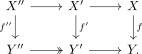
Let \(C\) be a category with pullbacks such that groupoid colimits are universal in \(C\) (e.g. \(C\) is a topos). Consider a commutative diagram in \(C\) as follows:
Commutative diagram generated from the LaTeX source

Assume that the map \(Y'' \to Y'\) is an effective epimorphism. If both the left-hand square and the outer rectangle are pullback squares, then so is the right-hand square.

Proof
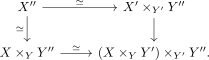
We need to show that the map \(X'\to X \times_Y Y'\) is an isomorphism. By the previous lemma, this may be tested after pullback along the effective epimorphism \(Y'' \twoheadrightarrow Y'\). The claim now follows by applying the 2-out-of-3 property to the following commutative diagram:
Commutative diagram generated from the LaTeX source

We now show that the category of effective epimorphisms in a topos is equivalent to the category of groupoids, via passage to the Čech nerve. We start with the following simple observation:

Lemma 2.31.

Let \(C\) be a category with pullbacks and geometric realizations. Then the functor \(\check{C}_{\bullet}\colon \Ar(C) \to \Fun(\simp\catop,C)\) admits a left adjoint

\[\Fun(\simp\catop,C) \xrightarrow{i_!} \Fun(\simp\catop_+,C) \xrightarrow{j^*} \Fun((\simp_+^{\leq 0})\catop,C) \simeq \Fun([1],C),\]

sending a simplicial object \(X_{\bullet}\) to the map \(X_0 \to \colim_{[n] \in \simp\catop} X_n\).

Proof
We have \(\check{C}_{\bullet}(-) = i^*j_*\). The functor \(i^*\) has a left adjoint given by left Kan extension along \(i\colon \simp\catop \hookrightarrow \simp\catop_+\), and the functor \(j_*\) has a left adjoint given by the restriction functor \(j^*\).

We may use this adjunction to reformulate the condition of effectivity of groupoids from Definition 2.21:

Lemma 2.32.

Let \(C\) be a category with pullbacks and geometric realizations, and assume that groupoid colimits are universal. Then the following three conditions are equivalent:

  1. The category \(C\) satisfies descent for groupoid colimits;

  2. Groupoid colimits are effective in \(C\);

  3. For every groupoid object \(\Gg\) the unit \(\Gg \to \check{C}_{\bullet}(\Gg_0 \to \abs{\Gg})\) of the adjunction from Lemma 2.31 is an isomorphism.

Proof
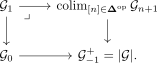
The equivalence between (1) and (2) is Lemma 2.22.From effectivity to the Čech nerve condition. Assume (2), and consider a groupoid object \(\Gg\). By setting \(\Gg^{+}_{-1} := \abs{\Gg} = \colim_{[n] \in \simp\catop} \Gg_n\), we extend \(\Gg\) to an augmented simplicial object \(\Gg^+_{\bullet}\). More precisely, this is the left Kan extension of \(\Gg\) along \(\simp\catop \hookrightarrow \simp\catop_+\). The first face maps define a transformation \(\Gg^+_{\bullet+1} \to \Gg^+_{\bullet}\) whose restriction to \(\simp\catop\) is cartesian by the groupoid condition. Effectivity therefore implies that the extended transformation is cartesian at the cone point. In particular, we obtain a pullback square
Commutative diagram generated from the LaTeX source
The top right corner is isomorphic to \(\Gg_0\), since the augmented simplicial object \([n] \mapsto \Gg_{n+1}\) over \(\Gg_0\) admits extra degeneracies. By Lemma 2.20, the augmented object \(\Gg^+_{\bullet}\) is therefore the Čech nerve of \(\Gg_0 \to \abs{\Gg}\), proving (3).From the Čech nerve condition to effectivity. Assume (3). The map \(\Gg_0 \to \abs{\Gg}\) is then an effective epimorphism for every groupoid object \(\Gg\), since its Čech nerve is \(\Gg\) and its geometric realization is \(\abs{\Gg}\).Consider a cartesian transformation \(X_{\bullet} \to Y_{\bullet}\) of groupoid objects, and set \(A:=\abs{X_{\bullet}}\) and \(B:=\abs{Y_{\bullet}}\). We must prove that the canonical map
\[u\colon X_0 \longrightarrow A \times_B Y_0\]
is an isomorphism. The map \(X_0 \to A\) is an effective epimorphism, so pullback along it is conservative by Lemma 2.29. After this base change, the map \(u\) becomes
\[X_0 \times_A X_0 \longrightarrow X_0 \times_B Y_0.\]
Condition (3) identifies the source with \(X_1\) and identifies \(Y_1\) with \(Y_0 \times_B Y_0\). Cartesianness of \(X_{\bullet} \to Y_{\bullet}\) then gives
\[X_1 \iso X_0 \times_{Y_0} Y_1 \iso X_0 \times_B Y_0.\]
Thus the base change of \(u\) is an isomorphism, and conservativity implies that \(u\) is an isomorphism. This proves effectivity of groupoid colimits.

Lemma 2.33.

Let \(C\) be a category satisfying descent for groupoid colimits (e.g. a topos). Then the Čech nerve functor restricts to an equivalence

\[\check{C}_{\bullet}\colon \EffEpi(C) \iso \Grpd(C)\]

The inverse sends \(\Gg\) to the map \(\Gg_0 \to \abs{\Gg}\).

Proof
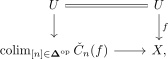
Consider the adjunction \(\Fun(\simp\catop,C) \rightleftarrows \Ar(C)\) from Lemma 2.31. By Lemma 2.32, the unit transformation is an isomorphism on groupoid objects. Consequently, the restriction of the realization functor to \(\Grpd(C)\) is fully faithful.Its essential image consists precisely of those morphisms \(f\colon U \to X\) for which the counit of the adjunction is an isomorphism. This counit takes the form of a commutative square
Commutative diagram generated from the LaTeX source
and by definition this is an isomorphism if and only if \(f\) is an effective epimorphism in \(C\).

Definition 2.34.

Let \(T\) be a topos. A pointed connected object is an object \(X\) equipped with an effective epimorphism \(* \twoheadrightarrow X\). We denote by \(T^{\geq 1}_* \subseteq T_*\) the subcategory of pointed connected objects.

Proposition 2.35. (Delooping principle)

Let \(T\) be a topos. Then there is an equivalence of categories

\[\bB \colon \Grp(T) \quad\rightleftarrows \quad T^{\geq 1}_* \noloc \bOmega.\]
Proof
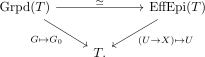
The equivalence \(\Grpd(T) \simeq \mathrm{EffEpi}(T)\) from Lemma 2.33 sits in a commutative triangle
Commutative diagram generated from the LaTeX source
Taking fibers over \(* \in T\) gives the claim.

2.2.3. The epi-mono factorization system

In a topos, every morphism can be factored into an effective epimorphism followed by a monomorphism. This factorization is in fact unique. We formulate this precisely using factorization systems, which are recalled in Chapter A.

Proposition 2.36.

Let \(C\) be a category, and assume that groupoids are effective and universal. Then \(C\) admits a factorization system \((E,M)\) with \(E\) given by the effective epimorphisms and \(M\) given by the monomorphisms in \(C\).

Proof
Existence of factorizations. Consider an arbitrary morphism \(f\colon U \to X\). Define \(V := \colim_{[n] \in \simp\catop} \check{C}_n(f)\). The augmentation of the Čech nerve gives a factorization
\[U \xrightarrow{e} V \xrightarrow{m} X.\]
By Lemma 2.32, the groupoid object \(\check{C}_{\bullet}(f)\) is the Čech nerve of its realization map \(e\). Hence \(e\) is an effective epimorphism and \(\check{C}_{\bullet}(e)\iso\check{C}_{\bullet}(f)\).The second map is a monomorphism. It suffices to show that the first projection \(p_1\colon V \times_X V \to V\) is an isomorphism, since the diagonal is a section of \(p_1\). Pullback along the effective epimorphism \(e\colon U \to V\) is conservative by Lemma 2.29(1). We may therefore test \(p_1\) after this pullback. Universality of groupoid colimits gives
\[V \times_X U \iso \colim_{[n] \in \simp\catop} \check{C}_{n+1}(f).\]
The augmented simplicial object \([n] \mapsto \check{C}_{n+1}(f)\) over \(U\) admits extra degeneracies, starting with the diagonal \(U \to U \times_X U = \check{C}_1(f)\). Its realization is therefore \(U\), so \(V \times_X U \to U\) is an isomorphism. Conservativity now implies that \(p_1\) is an isomorphism and hence that \(m\) is a monomorphism.Orthogonality. Consider a solid commutative diagram
Commutative diagram generated from the LaTeX source
where \(f\) is an effective epimorphism and \(i\colon A \hookrightarrow B\) is a monomorphism. Because \(i\) is a monomorphism, the anima of fillers is \((-1)\)-truncated. It remains only to prove that it is nonempty.Work in the slice \(C_{/B}\). Composition with \(i\) defines a fully faithful functor \(C_{/A}\hookrightarrow C_{/B}\), and this functor preserves colimits. The given map \(U\to A\) shows that every term \(\check{C}_n(f)=U^{\times^{n+1}_X}\) of the Čech nerve belongs to its essential image. Since \(X\) is the colimit of this Čech nerve in \(C_{/B}\), the object \(X\to B\) also belongs to the essential image. Thus there exists a map \(X\to A\) giving a filler. The anima of fillers is consequently contractible, proving orthogonality.

2.2.4. Properties of effective epimorphisms

We now prove some basic properties of effective epimorphisms. Throughout this subsection, we fix a category \(C\) in which groupoids are effective and universal.

Lemma 2.37.

Effective epimorphisms are closed under composition.

Proof
The effective epimorphisms are the left class of a factorization system, which is closed under composition by Proposition A.3.

Lemma 2.38.

Any morphism which has a section is an effective epimorphism.

Proof
Assume \(f\colon X \to Y\) admits a section \(s\colon Y \to X\). Then the augmented Čech nerve \(\check{C}^+_{\bullet}(f)\colon \simp\catop_+ \to C\) admits an extra degeneracy, hence is a colimit diagram.

Corollary 2.39.

Any morphism which is both a monomorphism and an effective epimorphism is an isomorphism. In particular, every monomorphism with a section is an isomorphism.

Proof
For the first claim, recall that if a category \(C\) is equipped with a factorization system \((L,R)\), then any morphism \(f\colon X \to Y\) in both \(L\) and \(R\) is an isomorphism (see Lemma A.4). The second claim follows immediately from the first combined with Lemma 2.38.

Lemma 2.40.

Given a commutative triangle

Commutative diagram generated from the LaTeX source

if \(gf\) is an effective epimorphism then so is \(g\).

Proof
We may factor the map \(g\) as
\[Y \xhookrightarrow{i_Y} Y \sqcup_{X} Z \xrightarrow{\lra{g,\id_Z}} Z,\]
where the first map is the inclusion of the \(Y\)-component and the second map is induced by the maps \(g\colon Y \to Z\) and \(\id_Z \colon Z \to Z\). The first map is an effective epimorphism, since it is a cobase change of the effective epimorphism \(gf\colon X \to Z\). The second map is an effective epimorphism by Lemma 2.38 since the canonical map \(Z \to Y \sqcup_X Z\) is a section. Their composite is \(g\), so \(g\) is an effective epimorphism by Lemma 2.37.

References

  1. Jacob Lurie. Higher topos theory. Ann. Math. Stud. 170, Princeton, NJ: Princeton University Press. 2009.