5.1. Epimorphisms and acyclic maps

In this section, we discuss in detail the example of a modality given by the epimorphisms in a topos. For \(\An\), this recovers the acyclic maps: those that induce isomorphisms on cohomology with local coefficients.

5.1.1. Cotruncated maps and epimorphisms

We first construct the modality of cotruncated maps and establish the perhaps surprising fact that every epimorphism of a topos is already \(0\)-connected.

Definition 5.5. (Cotruncation)

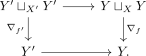
We say that a map \(f\colon X \to Y\) is \(n\)-cotruncated if it is \(n\)-truncated in \(T\catop\). Inductively, this equivalently means that the \((-2)\)-cotruncated maps are precisely the isomorphisms, and that a map \(f\) is \((n+1)\)-cotruncated if and only if its codiagonal \(\nabla_f\colon Y \sqcup_X Y \to Y\) is \(n\)-cotruncated.

Lemma 5.6.

Let \(L\) be the collection of \(n\)-cotruncated morphisms in \(T\). Then the pair \((L, L^{\perp})\) forms a modality on \(T\).

Proof
We start by showing that \((L,L^{\perp})\) is a factorization system. In light of Proposition A.11, it suffices to show that \(L\) is saturated and of small generation.Let \(\nabla\colon \Ar(T)\to\Ar(T)\) be the codiagonal functor, which sends \(f\colon X\to Y\) to \(\nabla_f\colon Y\sqcup_XY\to Y\). This is an accessible functor, since it is constructed from finite colimits. By Definition 5.5, a morphism \(f\) is \(n\)-cotruncated if and only if \(\nabla^{n+2}(f)\) is an isomorphism. Consequently, \(L\) is the inverse image under the accessible functor \(\nabla^{n+2}\) of the accessible subcategory of isomorphisms in \(\Ar(T)\). It follows that \(L\subseteq\Ar(T)\) is accessible and accessibly embedded.The class \(L\) is saturated. Indeed, this is immediate for \(n=-2\), and the inductive step follows because the codiagonal construction preserves colimits in \(\Ar(T)\). Since \(L\) is accessible, accessibly embedded, and closed under all colimits, it is generated under colimits by a small collection of its objects. In particular, it is the saturation of a small set of morphisms.To show that the \(n\)-cotruncated maps are stable under base change, consider a pullback square
Commutative diagram generated from the LaTeX source
and assume that \(f\) is \(n\)-cotruncated. We will show that also \(f'\) is \(n\)-cotruncated. By induction, it will suffice to show that the following square is a pullback square:
Commutative diagram generated from the LaTeX source
But this is clear from universality of colimits.

Definition 5.7.

A morphism \(f\colon X \to Y\) in \(T\) is called an epimorphism if it is \((-1)\)-cotruncated, i.e. if the square

Commutative diagram generated from the LaTeX source

is a pushout square. Let \(T^+\subseteq T\) be the full subcategory of objects \(Z\) for which \(Z\to *\) is right orthogonal to all epimorphisms. The factorization system of Lemma 5.6 gives a reflection \((-)^+\colon T\to T^+\) and hence a factorization

\[X \to X^+ \to *\]

into an epimorphism followed by a map which is right orthogonal to the epimorphisms.

As already mentioned in Warning 2.28, the terminology regarding `epimorphism' and `effective epimorphism' is a rather unfortunate historical accident: effective epimorphisms are not generally epimorphisms.

Example 5.8.

For \(T= \An\), the map \(S^0 \to *\) is an effective epimorphism (as it is a surjection on path components), but it is not an epimorphism: the pushout of \(S^0 \to *\) along itself is \(S^1\), which is not isomorphic to \(*\).

The situation is made even more confusing by the fact that the converse does hold.

Proposition 5.9.

Every epimorphism in \(T\) is 0-connected, hence in particular an effective epimorphism.

Proof
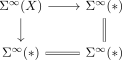
We may assume that \(Y = *\) by passing to the slice topos: the forgetful functor \(T_{/Y} \to T\) preserves all colimits, hence preserves and detects epimorphisms. So we need to show: if \(X \to *\) is an epimorphism, then \(\tau_0 X\) is terminal.Since the suspension functor \(\Sigma^{\infty}\colon T \to \Sp(T)\) preserves colimits, it follows that the commutative square
Commutative diagram generated from the LaTeX source
is a pushout square, hence a pullback square by stability. It follows that the map \(\Sigma^{\infty}(X) \to \Sigma^{\infty}(*)\) is an isomorphism. The suspension functor factors as
\[T \xrightarrow{F^{\CGrp}} \CGrp(T) \xhookrightarrow{\bbB^{\infty}} \Sp(T),\]
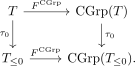
where the first functor is the free commutative group functor and the second functor is the classifying spectrum functor which identifies commutative groups with connective spectra. By conservativity of \(\bbB^{\infty}\) we conclude that \(F^{\CGrp}(X) \iso F^{\CGrp}(*)\). Now, since the truncation functor \(\tau_0\colon T \to T_{\leq 0}\) commutes with finite products, it induces a functor \(\tau_0\colon \CGrp(T) \to \CGrp(T_{\leq 0})\). Since also the inclusion \(T_{\leq 0} \hookrightarrow T\) preserves finite products, it follows that \(\tau_0\) also commutes with the free commutative group construction, giving a commutative diagram as follows:
Commutative diagram generated from the LaTeX source
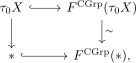
In particular, we conclude that \(F^{\CGrp}(\tau_0 X) \iso F^{\CGrp}(*)\). To deduce that \(\tau_0 X = *\), note that for any \(0\)-truncated object \(X'\) the unit map \(X' \to F^{\CGrp}(X')\) is a monomorphism. Indeed, this is clear for \(T = \An\) (where \(F^{\CGrp}(X') = \Z[X']\) is the free abelian group generated by the set \(X'\)), thus also for any presheaf topos, and then finally for any left exact localization \(f^*\colon \PSh(C) \to T\) of a presheaf topos as \(f^*\) preserves monomorphisms and commutes with the adjunction \(T \rightleftarrows \CGrp(T)\). From the commutative diagram
Commutative diagram generated from the LaTeX source
it follows that \(\tau_0 X \to *\) is a monomorphism in \(T_{\leq 0}\). Since \(\tau_0(-)\) preserves colimits, it is also an epimorphism. But then we are done, as in a classical topos, every monomorphism which is also an epimorphism is an isomorphism, see Lemma 5.10.

Lemma 5.10.

Let \(T\) be a topos, and let \(f\colon X \to Y\) be a morphism in \(T_{\leq 0}\) which is both an epimorphism and a monomorphism. Then \(f\) is an isomorphism.

Proof
Since \(f\) is a monomorphism, it is contained in \((T_{/Y})_{\leq -1}\). The fact that it is an epimorphism in \(T_{\leq 0}\) means that the map \(\tau_0(Y \sqcup_X Y) \to Y\) induced by the codiagonal is an isomorphism. This \(0\)-truncation is a priori computed in \(T\), but since \(Y\) is \(0\)-truncated it may as well be computed in \(T_{/Y}\), so that the map \(f \colon X \to Y\) is also an epimorphism in \((T_{/Y})_{\leq 0}\). This reduces the claim to \(Y = *\).In this case, the map \(f\colon X \to *\) to the terminal object is a monomorphism. By definition of the subobject classifier \(\Omega\) from Definition 2.50, this means that there is a pullback square in \(T\) of the following form:
Commutative diagram generated from the LaTeX source
Recall from Lemma 2.51 that \(\Omega\) is 0-truncated, hence this is a pullback square in \(T_{\leq 0}\). Since \(f\) is assumed to be an epimorphism in \(T_{\leq 0}\), it follows that the bottom map \(g\) must agree with the universal monomorphism \(* \hookrightarrow \Omega\). But then \(X\) is the pullback of the map \(* \hookrightarrow \Omega\) along itself, which implies that \(X \iso *\). This finishes the proof.

5.1.2. Acyclic maps and the plus construction

We now specialize to animae. Cohomology with all local coefficient systems detects precisely the epimorphisms, and the corresponding reflection is Quillen's plus construction. We first record the two detection arguments used in the proof.

Lemma 5.11. (Detection by local coefficients)

Let \(f\colon X\to Y\) be a map of animae. If

\[H^0(Y,A)\longrightarrow H^0(X,f^*A)\]

is an isomorphism for every local system \(A\) of abelian groups on \(Y\), then \(\pi_0(f)\) is an isomorphism and \(\pi_1(X,x)\to\pi_1(Y,f(x))\) is surjective for every \(x\in X\).

Proof
Taking \(A\) to be the constant local system \(\mathbb Z/2\) shows that pullback along \(\pi_0(f)\) induces a bijection on functions to \(\mathbb Z/2\). Hence \(\pi_0(f)\) is a bijection.We may therefore work on one connected component. Fix \(x\in X\), write \(G=\pi_1(Y,f(x))\), and let \(H\subseteq G\) be the image of \(\pi_1(X,x)\). If \(H\neq G\), consider the \(G\)-module
\[M:=(\mathbb Z/2)^{G/H}\]
with the permutation action. The characteristic function of the coset \(H\) is fixed by \(H\) but not by \(G\). Thus the inclusion \(M^G\to M^H\) is not surjective. This contradicts the assumed isomorphism on \(H^0\), since \(H^0(Y,M)=M^G\) and \(H^0(X,f^*M)=M^H\). Therefore \(H=G\).

Lemma 5.12. (Whitehead theorem with local coefficients)

Let \(f\colon X\to Y\) be a map of animae which induces isomorphisms on \(\pi_0\) and \(\pi_1\). If \(f\) induces an isomorphism on cohomology with every local system of abelian groups on \(Y\), then \(f\) is an isomorphism.

Proof
The claim may be checked componentwise, so suppose \(X\) and \(Y\) are connected and put \(G=\pi_1(Y)\iso\pi_1(X)\). Choose CW models and lift \(f\) to a \(G\)-equivariant map of universal covers. Let \(Q_*\) be the mapping cone of the induced map of cellular chain complexes over \(\mathbb Z[G]\). The hypothesis says that
\[H^*\!\operatorname{Hom}_{\mathbb Z[G]}(Q_*,M)=0\]
for every \(\mathbb Z[G]\)-module \(M\).We claim that \(Q_*\) is acyclic. Otherwise, let \(q\) be the least degree for which \(H_q(Q_*)\) is nonzero, and choose an injective \(\mathbb Z[G]\)-module \(I\) receiving a nonzero map from \(H_q(Q_*)\). The universal coefficient spectral sequence for the complex of projective \(\mathbb Z[G]\)-modules \(Q_*\) degenerates for the coefficient module \(I\) and gives
\[H^q\!\operatorname{Hom}_{\mathbb Z[G]}(Q_*,I) \iso \operatorname{Hom}_{\mathbb Z[G]}(H_q(Q_*),I)\neq 0,\]
contradicting the hypothesis. Thus the map of universal covers is a homology isomorphism. Since both universal covers are simply connected, the relative Hurewicz theorem implies that it is a homotopy equivalence. The original map \(f\) is therefore an isomorphism of animae.

We now identify the epimorphisms in the topos of animae.

Proposition 5.13.

Consider the topos \(T = \An\).

  1. A map of animae \(f\colon X \to Y\) is an epimorphism if and only if \(f\) is acyclic, meaning that for any local system \(A\) of abelian groups on \(Y\), the induced map

    \[H^*(Y,A) \xrightarrow{ \cong } H^*(X,f^*A)\]

    is an isomorphism.

  2. A map of animae \(f\colon X \to Y\) is in the right orthogonal class to the epimorphisms if and only if the group \(\pi_1(f) \in \Grp((T_{/Y})_{\leq 0})\) is hypoabelian.

  3. For any anima \(X\), the unique factorization \(X \to *\) as

    \[X \xrightarrow{ \mathrm{epi} } X^+ \xrightarrow{ \pi_1\textup{ hypoabelian} } *\]

    is Quillen's \(+\)-construction.

In (2), we say that a group \(G\) is perfect if it is left orthogonal to abelian groups, i.e. if every map \(G \to A\) into an abelian group is trivial, or equivalently if the abelianization \(G^{\mathrm{ab}}\) is trivial. A group \(A\) is hypoabelian if it is right orthogonal to perfect groups, i.e. if every map \(G \to A\) from a perfect group is trivial, or equivalently if \(A\) has no nontrivial perfect subgroup.

Proof
(1) Suppose first that \(f\) is an epimorphism. For any local system \(A\) on \(Y\), the Mayer–Vietoris sequence associated to the pushout square
Commutative diagram generated from the LaTeX source
identifies the restriction map \(H^*(Y,A)\to H^*(X,f^*A)\) with an isomorphism. Thus \(f\) is acyclic.Conversely, suppose that \(f\) is acyclic and set \(C:=Y\sqcup_XY\). Let \(i_1,i_2\colon Y\to C\) be the two coprojections. For a local system \(A\) on \(C\), the Mayer–Vietoris sequence contains
\[\cdots\longrightarrow H^q(C,A)\longrightarrow H^q(Y,i_1^*A)\oplus H^q(Y,i_2^*A) \longrightarrow H^q(X,f^*i_1^*A)\longrightarrow\cdots.\]
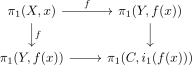
The two restrictions of \(A\) to \(X\) are canonically identified, and both restriction maps from the two copies of \(H^q(Y)\) to \(H^q(X)\) are isomorphisms by acyclicity of \(f\). Exactness therefore identifies \(H^q(C,A)\) with the diagonal copy of \(H^q(Y,i_1^*A)\). In particular, \(i_1\) is itself acyclic.By Lemma 5.11, the map \(f\) induces an isomorphism on \(\pi_0\) and a surjection on every fundamental group. We may consequently apply the Seifert–van Kampen theorem componentwise to the pushout defining \(C\). It gives a pushout square
Commutative diagram generated from the LaTeX source
in groups. Since the two maps out of \(\pi_1(X,x)\) agree and are surjective, the coprojection \(i_1\) induces an isomorphism on fundamental groups. The same van Kampen calculation on components shows that \(i_1\) induces an isomorphism on \(\pi_0\). Hence Lemma 5.12 applies and shows that \(i_1\) is an isomorphism. Since \(\nabla_f i_1=\id_Y\), the codiagonal \(\nabla_f\colon C\to Y\) is its inverse. Thus \(f\) is an epimorphism.(2) See [Hoyois 2019, Corollary 10].(3) By definition, Quillen's \(+\)-construction is the reflection of \(X\) into the subcategory of animae with hypoabelian fundamental group. By (2), this subcategory precisely consists of the objects \(Y\) for which \(Y \to *\) is right orthogonal to the epimorphisms, and the claim follows.

References

  1. Marc Hoyois. On Quillen’s plus construction. 2019.