3.5. Gerbes
3.5.1. Gerbes and Eilenberg–MacLane objects
Consider an object \(X \in T\). We have the Postnikov tower
The object \(\tau_n X \in T_{/\,\tau_{n-1} X}\) is \(n\)-truncated by Lemma 3.7 and \((n-1)\)-connected by Proposition 3.18. Maps with this property are known as gerbes:
Given \(n \geq 0\), we say an object \(X \in T\) is an \(n\)-gerbe if it is \(n\)-truncated and \((n-1)\)-connected. We define an Eilenberg–MacLane object of degree \(n\) to be a pointed \(n\)-gerbe. We denote by
the resulting full subcategories. More generally, we refer to a morphism \(X \to Y\) as an \(n\)-gerbe if it is an \(n\)-gerbe in the slice topos \(T_{/Y}\).
Let \(K\) be an \((n+1)\)-gerbe in \(T\), and consider two maps \(a,b\colon * \to K\). Define \(P\) as the following pullback:

Then \(P\) is an \(n\)-gerbe. Indeed, the map \(b\colon * \to K\) is an \(n\)-gerbe by the cancellation properties of truncated and connected maps from Lemma 3.7 and Corollary 3.33, hence the base change \(P \to *\) is also an \(n\)-gerbe.
The Eilenberg–MacLane objects can in fact be completely classified in terms of abelian group objects in \(T\), just as for the Eilenberg–MacLane animae in classical homotopy theory. To do this, we need an iterated version of the delooping principle from Proposition 2.35.
Given a category \(C\) with finite products, we inductively define for every \(n \geq 0\) the category \(E_n\Grp(C)\) of \(E_n\)-groups in \(C\) by setting
Proposition 3.44. (Iterated delooping principle)
For every \(n \geq 0\), there is an equivalence
Proof
For \(n \geq 0\) there are equivalences
Proof
3.5.2. Banded gerbes and cohomology
The \(n\)-gerbes play an important role in obstruction theory. Given objects \(Y, X \in T\) and a map \(Y \to \tau_0X\), we could ask whether we can lift this map to \(X\). Often, we can proceed inductively along the Postnikov tower of \(X\). Assuming we have already found a lift \(Y \to \tau_{n-1} X\), we may ask whether it lifts further to a map \(Y \to \tau_n X\):

In the remainder of this section we will explain how to reformulate this question in terms of the vanishing of a certain class in the cohomology of \(Y\).
Let \(n \geq 2\), and let \(X\) be an \(n\)-gerbe. Then there exists a unique \(A \in \Ab(T_{\leq 0})\) such that \(\pi_n X \cong X \times A\).
Proof
If \(n = 1\), then \(A \in \Grp(T_{\leq 0})\) is unique if it exists, but it might not exist.
Let \(n\geq1\), let \(X\) be an \(n\)-gerbe, and consider \(A \in \Ab(T_{\leq 0})\). We say that \(X\) is banded by \(A\) if it comes equipped with an isomorphism \(\pi_n X \cong X \times A\) in \(E_n\Grp((T_{/X})_{\leq 0})\). We denote by
the anima of pairs consisting of an \(n\)-gerbe \(X\) together with an isomorphism \(\pi_n X \cong X \times A\). Its morphisms are the band-preserving isomorphisms of \(n\)-gerbes.
Let \(n\geq1\). The trivial \(n\)-gerbe \(\bB^n A\) is banded by \(A\). Moreover, the anima of pointed \(n\)-gerbes banded by \(A\) and band-preserving pointed isomorphisms is contractible, with distinguished object \(\bB^nA\).
Proof
Let \(A \in \Ab(T_{\leq 0})\) and \(n \geq 1\). Then for any object \(X \in T\) there is an equivalence
Proof

Under the equivalence \(T_{/\bB G} \simeq \Mod_G(T)\), passing to fibers over \(T\) (with respect to the forgetful functor \(T_{/\bB G} \to T\) and the quotient functor \(\Mod_G(T) \to T\)) yields
Let us now return to the question of obstruction theory. Given an object \(X\) and \(n\geq2\), the map \(\tau_n X \to \tau_{n-1} X\) is an \(n\)-gerbe. By Lemma 3.46, it is banded by a static abelian group object
Applying Theorem 3.50 in the slice topos \(T_{/\tau_{n-1}X}\), we may write it as a pullback
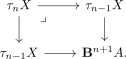
Here \(\bB^{n+1}A\) is formed in the slice over \(\tau_{n-1}X\), and the upper-right object is the terminal object of this slice. In particular, finding a lift \(Y \to \tau_n X\) of a map \(Y \to \tau_{n-1} X\) is equivalent to nullhomotoping the induced map \(Y \to \bB^{n+1}A\) in the slice. We wish to think of this as the question of whether a certain cohomology class vanishes:
Let \(A\) be an abelian group object in \(T_{\leq 0}\), and let \(Y \in T\). We define the \(n\)-th cohomology of \(Y\) with coefficients in \(A\) as