Chapters 1 and 2 use the rebuild2 formalization. Agda links for Chapter 3 remain temporarily unavailable.
3.5 Exponentiable functors
For a category \(T\), we may consider categories \(C\) equipped with a functor \(f\colon C \to T\), which we will refer to as categories over \(T\) (to be discussed in more detail in Chapter 4 (outside selection)). Given a functor \(p\colon S \to T\), we obtain a notion of base change along \(p\): \begin {align*} \{\text {categories }&\text {over $T$ }\} &&\to &\{\text {categories }&\text {over $S$ }\} \\ f\colon C &\to T &&\mapsto &p^*(f)\colon C \times _T &S \to S. \end {align*}
This assignment admits a left adjoint, given by postcomposition with \(p\): \begin {align*} \{\text {categories }&\text {over $S$ }\} &&\to &\{\text {categories }&\text {over $T$ }\} \\ g\colon D &\to S &&\mapsto &p \circ g\colon D &\to T. \end {align*}
However, in general this assignment will not admit a right adjoint. Let us illustrate this with the following simple counterexample:
Example 3.5.1. Consider the functor \(p = d_1\colon [1] \to [2]\) given by \(d_1(0) = 0\) and \(d_1(1) = 2\). We will argue that pullback along \(p\) does not preserve pushouts of categories, and hence cannot admit a right adjoint. To see this, consider the following commutative square:

We see as a consequence of the Segal axiom Axiom E that this is a pushout square of categories. If we pull back this square along the functor \(d_1\colon [1] \to [2]\), we obtain the commutative square

But this is no longer a pushout square of categories: if it were, then it would remain a pushout square after passing to geometric realization by Corollary 3.4.7. But since \(\geom {[1]} \iso *\) by part (2) of Proposition 3.4.4, this square takes the form

and this is only a pushout square if \(* \sqcup * \iso *\). Consequently, in every model in which \(*\sqcup *\) is not equivalent to \(*\), the functor \(d_1\) is not exponentiable. This supplies the intended semantic counterexample. The non-equivalence \(*\sqcup *\not \simeq *\) is not a consequence of the axioms imposed so far, so we do not claim internally that \(d_1\) fails to be exponentiable in every model.
As the previous example indicates, we cannot expect the existence of a right adjoint to \(p^*\) in full generality. There is, however, a large class of functors, the exponentiable functors, for which this right adjoint does exist. This class includes cartesian and cocartesian fibrations, to be introduced in Chapter 5 (outside selection).
In this section, we will give a precise definition of this class of functors. We start with some auxiliary definitions and constructions.
Definition 3.5.2. Let \(S\) be a category and let \(f\colon C \to S\) and \(g\colon D \to S\) be categories over \(S\). We define the category \(\Fun _S(C,D)\) of functors \(C \to D\) over \(S\) as the following pullback:
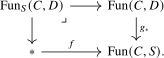
Note that objects of \(\Fun _S(C,D)\) are pairs \((h,\alpha )\) where \(h\colon C \to D\) is a functor and \(\alpha \) is an identification \(f = g \circ h\). In other words, objects are commutative triangles of the form

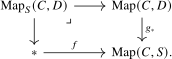
We write \(\Map _S(C,D)\) for the groupoid core of \(\Fun _S(C,D)\), which fits into a pullback square of the form
Construction 3.5.3. Let \(p\colon S \to T\) be a functor. For categories \(C\) and \(D\) over \(T\), we obtain an induced functor \[ p^*\colon \Fun _T(C,D) \to \Fun _{S}(C \times _T S, D \times _T S) \] by noting that the composite \(\Fun _T(C,D) \to \Fun (C,D) \xrightarrow {p^*} \Fun (C \times _T S, D \times _T S)\) lands in the correct fiber.
Definition 3.5.4 (Dependent product). Consider a functor \(p\colon S \to T\) and let \(f\colon C \to S\) be a category over \(S\). A dependent product of \(C\) along \(p\) is a category \(g\colon D \to T\) over \(T\) equipped with a functor \(\varepsilon \colon D \times _T S \to C\) over \(S\) which satisfies the property that for any other category \(E \to T\) over \(T\) the composite functor \[ \Map _{T}(E, D) \xrightarrow {p^*} \Map _{S}(E \times _T S, D \times _T S) \xrightarrow {\varepsilon \circ -} \Map _{S}(E \times _T S, C) \] is an equivalence.
If a dependent product of \(C\) along \(p\) exists, it is unique; see Exercise 3.8.6. We will denote it by \(p_*(f)\colon p_*(C) \to T\).
Terminology 3.5.5. Assume that \(C\) admits a dependent product \(p_*(C)\) along \(p\). Given a functor \(\varphi \colon D \to p_*(C)\) over \(T\), we obtain a functor \[ \varphi ^u := \varepsilon \circ p^*(\varphi )\colon D \times _T S \to C \] over \(S\) that we will refer to as the relative uncurrying of \(\varphi \). Conversely, there is for every functor \(\psi \colon D \times _T S \to C\) over \(S\) a relatively curried functor \(\psi _c\colon D \to p_*(C)\), satisfying \[ (\varphi ^u)_c = \varphi \qquadtext { and } (\psi _c)^u = \psi . \] In this way, we may think of the equivalence in Definition 3.5.4 as a relative version of currying/uncurrying.
Construction 3.5.6. Consider a pullback square

of categories, and let \(f\colon C \to S\) be a category over \(S\). Assume that:
- There exists a dependent product \(p_*(C) \to T\) of \(C\) along \(p\);
- There exists a dependent product \(p'_*(C \times _S S') \to T'\) of \(C \times _SS'\) along \(p'\).
We will construct a functor \[ \BC _*\colon p_*(C) \times _{T} T' \to p'_*(C \times _S S') \] over \(T'\) called the Beck-Chevalley map. By relative uncurrying, we may equivalently define \(\BC _*\) by specifying a map \((p_*(C) \times _{T} T') \times _{T'} S' \to C \times _S S'\), which we take to be the map \[ (p_*(C) \times _{T} T') \times _{T'} S' \simeq (p_*(C) \times _{T} S) \times _{S} S' \xrightarrow {\varepsilon \times _S S'} C \times _S S'. \]
We are now ready to introduce the class of exponentiable functors.
Definition 3.5.7. Let \(p\colon S \to T\) be a functor. We say that \(p\) is exponentiable if the following two conditions are satisfied:
- (1)
-
For every pullback square

and every category \(C'\) over \(S'\), there exists a dependent product \(p'_*(C') \to T'\) of \(C'\) along \(p'\).
- (2)
-
For every pullback diagram
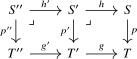
and every \(f'\colon C' \to S'\), the Beck-Chevalley map \(\BC _*\colon p'_*(C') \times _{T'} T'' \to p''_*(C' \times _{S'} S'')\) is an equivalence.
Remark 3.5.8. Note that exponentiable functors are by definition closed under base change: if \(p\colon S \to T\) is exponentiable, then so is any base change \(p'\colon S' \to T'\) of \(p\).
Construction 3.5.9. Let \(p\colon S \to T\) be an exponentiable functor, and write \(\varepsilon _C\colon p_*(C)\times _T S\to C\) and \(\varepsilon _D\colon p_*(D)\times _T S\to D\) for the evaluation functors. A functor \(\varphi \colon C\to D\) over \(S\) determines a composite \[ p_*(C)\times _T S\xrightarrow {\varepsilon _C}C\xrightarrow {\varphi }D \] over \(S\). Its relative currying is a functor \(p_*(\varphi )\colon p_*(C)\to p_*(D)\) over \(T\). The uniqueness part of relative currying supplies identifications \[ p_*(\id _C) = \id _{p_*(C)} \qquadtext {and}\qquad p_*(\psi \circ \varphi ) = p_*(\psi )\circ p_*(\varphi ). \] Thus dependent products are functorial in categories over \(S\).
Lemma 3.5.10. Let \(p\colon S \to T\) be an exponentiable functor. Then the assignment \(f \mapsto p_*(f)\) preserves pullbacks: given functors \(C_1 \to C_3 \leftarrow C_2\) over \(S\), there exists a preferred equivalence \[ p_*(C_1 \times _{C_3} C_2) \iso p_*(C_1) \times _{p_*(C_3)} p_*(C_2) \] over \(T\).
Proof
Proof. Functoriality of dependent products applied to the two projections constructs the displayed comparison functor. For every category \(E\) over \(T\), the universal properties of dependent products and pullbacks give equivalences \begin {align*} \Map _T\bigl (E,p_*(C_1\times _{C_3}C_2)\bigr ) &\simeq \Map _S\bigl (E\times _T S,C_1\times _{C_3}C_2\bigr )\\ &\simeq \Map _S(E\times _T S,C_1) \times _{\Map _S(E\times _T S,C_3)} \Map _S(E\times _T S,C_2)\\ &\simeq \Map _T(E,p_*(C_1)) \times _{\Map _T(E,p_*(C_3))} \Map _T(E,p_*(C_2))\\ &\simeq \Map _T\bigl (E,p_*(C_1)\times _{p_*(C_3)}p_*(C_2)\bigr ). \end {align*}
These equivalences are induced by the comparison functor and are natural in \(E\). Taking \(E\) to be either side of the comparison constructs an inverse over \(T\) and identifications between the two composites and the respective identity functors, exactly as in the proof of Proposition 1.4.11. Hence the comparison is an equivalence. □
Corollary 3.5.11. Let \(p\colon S \to T\) be an exponentiable functor. If \(f\colon C \to S\) is an embedding, then also \(p_*(f) \colon p_*(C) \to T\) is an embedding.
Proof
Proof. The identity functor of \(T\) exhibits \(T\to T\) as the dependent product of \(S\to S\) along \(p\), so there is a preferred equivalence \(p_*(S)\iso T\). Since \(f\) is an embedding, its diagonal square is a pullback. Applying Lemma 3.5.10 shows that the diagonal square of \(p_*(f)\colon p_*(C)\to p_*(S)\simeq T\) is a pullback. Hence \(p_*(f)\) is an embedding. □
The terminology ‘exponentiable’ comes from the fact that it allows us to construct certain ‘exponential objects’ relative to a base category \(S\):
Definition 3.5.12. Let \(p\colon C \to S\) and \(q\colon D \to S\) be two functors and assume that \(p\) is an exponentiable functor. We define the relative functor category \(\ulFun _S(C,D) \to S\) as
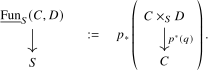
It comes equipped with an evaluation map \[ \ev \colon \ulFun _S(C,D) \times _S C \to D \] over \(S\) satisfying the property that for every other functor \(E \to S\) the composite functor \[ \Map _S(E,\ulFun _S(C,D)) \xrightarrow {- \times _S C} \Map _S(E \times _S C, \ulFun _S(C,D) \times _S C) \xrightarrow {\ev \circ -} \Map _S(E \times _S C, D). \] is an equivalence. In other words, \(\ulFun _S(C,D)\) is an ‘internal hom object’ or ‘exponential object’ for categories over \(S\).
Remark 3.5.13. Note that, for a category \(T\), the data of a functor \(T \to \ulFun _S(C,D)\) is equivalent to the data of a pair \((t,f)\), where \(t\colon T \to S\) is a functor and \(f\colon T \times _S C \to T \times _S D\) is a functor over \(T\).
Observation 3.5.14. For any functor \(t\colon T \to S\) and categories \(C\) and \(D\) over \(S\) such that \(C \to S\) is exponentiable, there is a pullback square
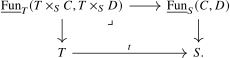
In particular, the fiber of \(\ulFun _S(C,D) \to S\) over an object \(s\) of \(S\) is the functor category \(\Fun (C_s,D_s)\), where \(C_s\) and \(D_s\) are the fibers of \(C\) and \(D\) over \(s\), respectively.
Proposition 3.5.15. For every category \(S\), the terminal functor \(p_S\colon S\to *\) is exponentiable. Moreover, if \(p\colon C\to S\) is exponentiable and \(q\colon D\to S\) is any functor, there is a canonical equivalence \[ \Fun _S(C,D)\iso (p_S)_*\,\ulFun _S(C,D). \]
Proof
Proof. Let \(T\) be a category. The base change of \(p_S\) along \(T\to *\) is the projection \(\pr _T\colon T\times S\to T\). Given a category \(r\colon E\to T\times S\), let \(\delta _T\colon T\to \Fun (S,T\times S)\) be the currying of \(\id _{T\times S}\). Define \(\Pi _S(E)\to T\) by the pullback square
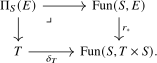
Uncurrying the upper horizontal functor gives an evaluation functor \(\Pi _S(E)\times S\to E\) over \(T\times S\). For every category \(K\to T\), the pullback property and currying identify \[ \Map _T(K,\Pi _S(E)) \iso \Map _{T\times S}(K\times S,E). \] Thus \(\Pi _S(E)\) is a dependent product of \(E\) along \(\pr _T\). If \(T'\to T\) is a functor, the pullback defining \(\Pi _S(E)\) base changes to the analogous pullback over \(T'\), since functor categories preserve pullbacks. The resulting Beck–Chevalley map is therefore an equivalence. This proves that \(p_S\) is exponentiable.
Now let \(p\colon C\to S\) and \(q\colon D\to S\) be as in the statement. For every category \(K\), the universal properties of the dependent product and the relative functor category give equivalences \begin {align*} \Map \bigl (K,(p_S)_*\ulFun _S(C,D)\bigr ) &\simeq \Map _S(K\times S,\ulFun _S(C,D))\\ &\simeq \Map _S(K\times C,D)\\ &\simeq \Map (K,\Fun _S(C,D)). \end {align*}
These equivalences are induced by evaluation and are natural in \(K\). Hence the canonical functor \(\Fun _S(C,D)\to (p_S)_*\ulFun _S(C,D)\) is an equivalence by Proposition 1.4.11. □
Corollary 3.5.16. Let \(p\colon C\to S\) be exponentiable and let \(q\colon D\to S\) be any functor. Then there is a canonical equivalence \[ \Map _S(C,D)\iso \bigl ((p_S)_*\,\ulFun _S(C,D)\bigr )^\simeq . \]
Proof
Proof. The definition of \(\Map _S(C,D)\) and preservation of pullbacks by groupoid cores give \(\Map _S(C,D)\iso \Fun _S(C,D)^\simeq \). Now apply the preceding proposition. □
Supplementary notes
- Triangles over a base AI-generated
- Base change of triangles AI-generated
- Relative currying and evaluation AI-generated