Chapters 1 and 2 use the rebuild2 formalization. Agda links for Chapter 3 remain temporarily unavailable.
3.1 Subcategories
In ordinary category theory, if one is given a collection \(M\) of morphisms in a category \(C\) which is closed under composition, then one may form the subcategory of \(C\) whose morphisms are precisely the morphisms in \(M\) (and the objects in the subcategory are precisely the objects whose identity morphism is in \(M\)). In this section, we discuss the analogous situation in the context of synthetic category theory.
We start by defining the notion of a subcategory. For this, we need the following auxiliary construction:
Construction 3.1.1. For categories \(C\), \(D\) and \(E\), we construct a map \[ \Map (C,D) \to \Map (\Map (E,C), \Map (E,D)) \] by currying the internal composition functor from Proposition 1.4.8: \[ \mu _{E,C,D}\colon \Map (C,D)\times \Map (E,C)\longrightarrow \Map (E,D). \] For an absolute functor \(f\colon C\to D\), the specialization of the resulting map at \(f\) is identified with the postcomposition functor \(f_*\colon \Map (E,C)\to \Map (E,D)\) constructed in Construction 1.4.3. This follows by uncurrying and comparing the two double-evaluation functors. Here we use the convention from Construction 1.4.1 of passing back and forth between functors and their representing points in the mapping anima.
Definition 3.1.2 (Subcategory). A functor \(f\colon A \to C\) is called a subcategory if the following two conditions are satisfied:
- (1)
-
The map \(f_*\colon \Map ([1],A) \to \Map ([1],C)\) is an embedding;
- (2)
-
For every category \(D\), the induced square

is a pullback square. Here the two vertical maps are given by Construction 3.1.1.
In other words, if \(f\colon A \to C\) is a subcategory, then a given functor \(D \to C\) factors through \(A\) if and only if the associated map on morphisms \(\Map ([1],D) \to \Map ([1],C)\) factors through \(\Map ([1],A)\).
Remark 3.1.3. The above notion of subcategory corresponds to what is known as a replete subcategory in the higher category theory literature. There is no sensible notion of non-replete subcategories in the synthetic setting.
Example 3.1.4. The identity functor \(\id _C\colon C \to C\) and the empty category \(\emptyset \to C\) are both seen to be subcategories.
Proof
Proof. By Proposition 1.6.20, it will suffice to show that the induced map \(\Map (D,A) \to \Map (D,C)\) is an embedding for every category \(D\). But this follows from its defining property, as it is the base change of the map \((f_*)_*\) induced by the map \(f_*\colon \Map ([1],A) \to \Map ([1],C)\) which was assumed to be an embedding. □
We would now like to construct subcategories of \(C\) out of the data of a collection of morphisms in \(C\) closed under composition. Let us start by defining this notion.
Definition 3.1.6 (Collection of morphisms). Let \(C\) be a category. A collection of morphisms in \(C\) is an anima \(M\) equipped with an embedding \[ m\colon M \hookrightarrow \Map ([1],C). \] We say that \(M\) is closed under composition if the following two conditions are satisfied:
-
If a morphism \(f\colon x \to y\) in \(C\) is in \(M\), then so are \(\id _x\) and \(\id _y\). More concretely, there are commutative diagrams of the following form:

-
For maps \(f\colon x \to y\) and \(g\colon y \to z\) in \(M\), also the composition of \(f\) and \(g\) is in \(M\). More concretely, there exists a dotted arrow in the following diagram:

Convention 3.1.7. Let \(m\colon M \hookrightarrow \Map ([1],C)\) be a collection of morphisms in \(C\). We say that a morphism \(f\colon x \to y\) in \(C\) is contained in \(M\), or simply is in \(M\), if the corresponding absolute object of \(\Map ([1],C)\) factors through \(m\). Since \(m\) is an embedding, such a factorization, if it exists, is unique, so being contained in \(M\) is a property. Thus, in phrases such as “a morphism in \(M\)”, the word “morphism” refers to a morphism in \(C\) contained in the subanima \(M \hookrightarrow \Map ([1],C)\), not to a morphism of the anima \(M\).
Example 3.1.8. Taking \(M = \Map ([1],C)\), it is clear that the identity map \(M \to \Map ([1],C)\) is a collection of morphisms in \(C\) closed under composition.
Example 3.1.9. Let \(A \to C\) be a subcategory. Then the map \(M_A := \Map ([1],A) \to \Map ([1],C)\) is a collection of morphisms in \(C\) closed under composition. This is immediate from the fact that the functor \(A \to C\) preserves compositions and identities.
Also the collection of isomorphisms in \(C\) determines a collection of morphisms closed under composition:
Lemma 3.1.10. For a category \(C\), the map \(\pi _{\Iso }^{\simeq }\colon \Iso (C)^{\simeq } \to \Map ([1],C)\) defines a collection of morphisms in \(C\) closed under composition.
Proof
Proof. We saw in Lemma 2.3.3 that the functor \(\pi _{\Iso }\) is an embedding, hence \(\pi _{\Iso }^{\simeq }\) is an embedding by Corollary 1.6.21. The identity-isomorphism construction shows that the source and target identities of every isomorphism again lie in \(\Iso (C)^{\simeq }\). Given composable isomorphisms \(f\) and \(g\), choose their functorially specified left and right inverses. Associativity and unitality exhibit \(f^{-1}\circ g^{-1}\) as a two-sided inverse of \(g\circ f\). This construction is functorial in \((f,g)\) and supplies the dotted composition map in Definition 3.1.6. Thus \(\Iso (C)^{\simeq }\) is closed under composition. □
We may now state the subcategory axiom:
Axiom H (Subcategory axiom). Let \(C\) be a category and let \(M \hookrightarrow \Map ([1],C)\) be a collection of morphisms in \(C\) closed under composition. Then there exists a category \(\lra {M}_C\) equipped with a functor \(i_M\colon \lra {M}_C \to C\) satisfying the following two conditions:
- (1)
-
The functor \(i_M\) sends morphisms in \(\lra {M}_C\) into \(M\): the first projection \(\pr _{1}\) in the following pullback square is an equivalence:
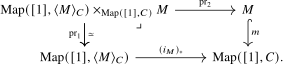
Equivalently: the map \((i_M)_*\colon \Map ([1],\lra {M}_C)\to \Map ([1],C)\) factors through the map \(m\colon M\to \Map ([1],C)\).
- (2)
-
The functor \(i_M\) is universal with this property: for any other category \(D\), the following commutative square is a pullback square:

Here the vertical maps use Construction 3.1.1 and the map from (1).
Corollary 3.1.11. In the situation of Axiom H, the functor \(\Map ([1],\lra {M}_C) \to M\) is an equivalence.
Proof
Proof. Applying the universal property of \(\lra {M}_C\) to \(D = [1]\), and using the equivalence \(\Map ([1],[1]) \simeq \{\id _0, \id _1,\can \}\) from Remark 2.1.29, we obtain a pullback square
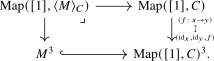
The claim now follows from the fact that the map \(M \hookrightarrow \Map ([1],C)\) is an embedding and that \(M\) is closed under composition, so that \(f\) lies in \(M\) if and only if each of \(\id _x, \id _y,f\) lie in \(M\). □
Corollary 3.1.12. In the situation of Axiom H, the functor \(i_{M}\colon \lra {M}_C \to C\) exhibits \(\lra {M}_C\) as a subcategory of \(C\). In particular, \(i_M\) is an embedding.
Proof
Lemma 3.1.13. Let \(f\colon A \to C\) be a subcategory and let \(M_A := \Map ([1],A) \hookrightarrow \Map ([1],C)\) denote the induced collection of morphisms in \(C\). Then the map \(i_{M_A}\colon \lra {M_A}_C \to C\) factors through an equivalence \(\lra {M_A}_C \iso A\).
Proof
Proof. Since the functor \(\lra {M_A}_C \to C\) induces the inclusion \(\Map ([1],A) \hookrightarrow \Map ([1],C)\), the fact that \(A\) is a subcategory of \(C\) implies that this functor factors through \(A\). It further follows that the induced map \(\Map (D,\lra {M_A}_C) \to \Map (D,A)\) is an equivalence for every category \(D\), since both sides sit in the same pullback square. The claim thus follows from Proposition 1.4.11. □
In particular, this shows:
Corollary 3.1.14. When \(M = \Map ([1],C)\) is the collection of all morphisms, the map \(i_M\colon \lra {M}_C \to C\) is an equivalence. □
We will now explain the functoriality of the construction of the subcategory \(\lra {M}_C\) in the pair \((C,M)\).
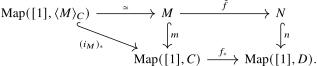
Definition 3.1.15. Let \(C\) and \(D\) be categories, and assume that they come equipped with collections of morphisms \(m\colon M \hookrightarrow \Map ([1],C)\) and \(n\colon N \hookrightarrow \Map ([1],D)\). A functor \(f\colon C \to D\) is said to send morphisms in \(M\) to morphisms in \(N\) if there exists a map \(\tilde {f}\colon M \to N\) making the following diagram commute:
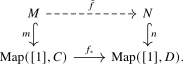
Since the map \(n\) is an embedding, the map \(\tilde {f}\colon M \to N\) is unique if it exists.
Construction 3.1.16. Let \(C\) and \(D\) be categories equipped with collections of morphisms \(M\) and \(N\) closed under composition, and let \(f\colon C \to D\) be a functor which sends morphisms in \(M\) to morphisms in \(N\). We construct a functor \(f\vert \colon \lra {M}_C \to \lra {N}_D\) making the following diagram commute:
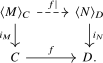
By the defining property of \(\lra {N}_D\), it suffices to show that the map \(f \circ i_M\colon \lra {M}_C \to D\) sends all morphisms to morphisms in \(N\). But this follows from the following commutative diagram:
Remark 3.1.17 (Exercise 3.8.3). The construction \(f \mapsto f\vert \) satisfies the following properties:
- (1)
-
The map \(f\vert \) is uniquely determined by \(f\).
- (2)
-
Given an identification \(f = f'\), we obtain an induced identification \(f\vert = f'\vert \).
- (3)
-
The construction is compatible with identities and composition through identifications \[ (\id _C)\vert = \id _{\lra {M}_C} \qquadtext {and}\qquad (g \circ f)\vert = g\vert \circ f \vert . \]
- (4)
-
If the maps \(f\) and \(\tilde {f}\) are equivalences, then also \(f\vert \colon \lra {M}_C \to \lra {N}_D\) is an equivalence.
Supplementary notes
- Lifting a family from three restrictions AI-generated