Chapters 1 and 2 use the rebuild2 formalization. Agda links for Chapter 3 remain temporarily unavailable.
3.7 Slice categories
The join operation can be used to describe functors into slice categories.
Construction 3.7.1 (Slice category). Let \(p_C\colon C\to \Gamma \) and \(p_Y\colon Y\to \Gamma \) be categories over \(\Gamma \), let \(\psi \colon Y\to C\) be a functor over \(\Gamma \), and assume that \(p_Y\) is exponentiable. Relative currying of \(\psi \) gives a section \(\bar \psi \colon \Gamma \to \ulFun _\Gamma (Y,C)\). Relative currying of the constant-family functor \((\pr _C,\pr _C)\colon C\times _\Gamma Y\to C\times _\Gamma C\) gives a functor \(p_Y^*\colon C\to \ulFun _\Gamma (Y,C)\) over \(\Gamma \). We define the slice \(C_{/\psi }\to \Gamma \) by the pullback square of categories over \(\Gamma \)
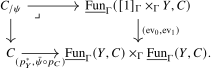
Here \([1]_\Gamma :=\Gamma \times [1]\to \Gamma \). The relative functor category in the upper right is constructed by taking the dependent product along \(p_Y\) of the arrow category of \(C\times _\Gamma Y\) over \(Y\); thus its existence uses only the assumed exponentiability of \(p_Y\).
For \(\Gamma =*\), the terminal functor \(Y\to *\) is exponentiable by Proposition 3.5.15. Thus the absolute slice exists without an additional exponentiability hypothesis.
Remark 3.7.2. We will mostly be interested in the case \(Y=\Gamma \) and \(p_Y=\id _\Gamma \). For a section \(x\colon \Gamma \to C\), we write \(C_{/x}\) for the resulting slice over \(\Gamma \).
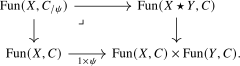
Lemma 3.7.3. For every category \(X\) and every functor \(\psi \colon Y \to C\), there is a pullback square of the form
Proof
Proof. Since the assignment \(C \mapsto \Fun (X,C)\) preserves pullbacks, applying it to the defining pullback square of \(C_{/\psi }\) gives

Because of the factorization of the bottom map, we may compute this pullback by first pulling back along the map \(\pr _X^* \times \pr _Y^*\), giving a pullback square
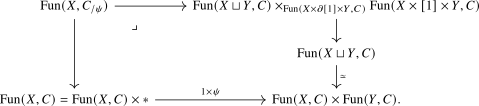
Since the upper right corner is equivalent to \(\Fun (X \star Y, C)\) by Remark 3.6.1, this finishes the proof. □
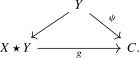
Remark 3.7.4. Informally speaking, the previous lemma says that a functor \(X \to C_{/\psi }\) into the slice consists of a map \(g \colon X \star Y \to C\) fitting in a commutative diagram as follows:
Completely analogously we obtain a dual slice construction.
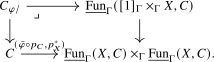
Construction 3.7.5. Let \(p_C\colon C\to \Gamma \) and \(p_X\colon X\to \Gamma \) be categories over \(\Gamma \), let \(\varphi \colon X\to C\) be a functor over \(\Gamma \), and assume that \(p_X\) is exponentiable. Let \(\bar \varphi \colon \Gamma \to \ulFun _\Gamma (X,C)\) be its relative currying. Define the coslice \(C_{\varphi /}\to \Gamma \) by the pullback square of categories over \(\Gamma \)
Supplementary notes
- Endpoint coordinates for slice categories AI-generated