Chapters 1 and 2 use the rebuild2 formalization. Agda links for Chapter 3 remain temporarily unavailable.
3.4 Geometric realizations
The localization of a category \(C\) at all its morphisms deserves special notation and terminology:
Definition 3.4.1 (Geometric realization). In the case where \(W := \Map ([1],C)\) consists of all morphisms in \(C\), we write \[ \geom {C} \quad :=\quad C[W^{-1}], \] and we denote the localization functor by \(\lambda _C \colon C \to \geom {C}\). We refer to \(\geom {C}\) as the geometric realization of \(C\).
In other words, the geometric realization is characterized by the property that for every category \(D\), the functor \[ \lambda _C^*\colon \Fun (\geom {C},D) \to \Fun ^{\Map ([1],C)}(C,D) \] is an equivalence.
By Construction 3.3.9, the assignment \(C \mapsto \geom {C}\) is functorial in \(C\): every functor \(f\colon C \to D\) induces a functor \[ \geom {f}\colon \geom {C} \to \geom {D}. \]
Lemma 3.4.2. Assume that \(X\) is a groupoid. Then the localization functor \(\lambda _X\colon X \to \geom {X}\) is an equivalence.
Proof
Proof. Using that \(\Iso (X) \simeq \Fun ([1],X)\), we obtain by Proposition 3.3.4 equivalences \[ \Fun ^{\Map ([1],X)}(X,D) \simeq \Fun ^{\Iso (X)^{\simeq }}(X,D) \simeq \Fun (X,D), \] which shows that the identity map \(X \to X\) exhibits \(X\) as a localization of \(X\) at all its morphisms. This gives the claim. □
Lemma 3.4.3. If \(C\) is a category and \(\Gamma \) is a groupoid, then precomposition with the localization functor \(\lambda _C\colon C \to \geom {C}\) defines an equivalence \[ \lambda _C^*\colon \Fun (\geom {C}, \Gamma ) \iso \Fun (C,\Gamma ) \]
Proof
Proof. We may simply compose the equivalence \(\Fun (\geom {C},\Gamma ) \iso \Fun ^{\Map ([1],C)}(C,\Gamma )\) with the equivalence \(\Fun ^{\Map ([1],C)}(C,\Gamma ) \iso \Fun (C,\Gamma )\) from Lemma 3.3.3. □
Since we have obtained \(\geom {C}\) from \(C\) by inverting all its morphisms, one may expect it to be a groupoid. While this is indeed the case, this question is somewhat more subtle than it may seem at first, since a priori the localization may create new morphisms that do not lift to \(C\) itself. This problem is closely related to a variety of other statements we may expect to hold. Let us first formulate these and prove that they are equivalent; we will see afterwards that they are in fact satisfied.
Proposition 3.4.4. The following conditions are equivalent:
- (1)
-
For every category \(C\), the category \(\geom {C}\) is a groupoid;
- (2)
-
The geometric realization \(\geom {[1]}\) of the walking morphism \([1]\) is contractible;
- (3)
-
For every category \(C\), the functor \(p_{[1]}^* \colon C \to \Fun ([1],C)\) is a full subcategory of \(\Fun ([1],C)\) (in the sense of Definition 3.2.2);
- (4)
-
For every category \(C\), the functor \(\pi _{\Iso }\colon \Iso (C) \to \Fun ([1],C)\) is a full subcategory;
- (5)
-
Every category \(C\) for which the map \(C^{\simeq } \simeq \Map (*,C) \xrightarrow {p_{[1]}^*} \Map ([1],C)\) is an equivalence is a groupoid;
- (6)
-
For every category \(C\), the subcategory \(\lra {\Iso (C)^{\simeq }}_C \subseteq C\) spanned by all the isomorphisms in \(C\) is a groupoid;
- (7)
-
For every category \(C\), the inclusion \(C^{\simeq } \hookrightarrow C\) induces an equivalence \(C^{\simeq } \iso \lra {\Iso (C)^{\simeq }}_C\) between the groupoid core of \(C\) and the subcategory of \(C\) spanned by all its isomorphisms.
Proof
Proof. We start by showing that (1) implies (2). By (1), the category \(\geom {[1]}\) is a groupoid, so it suffices by Proposition 1.4.11 to show that for every groupoid \(\Gamma \) the induced map \[ \Map (*,\Gamma ) \to \Map (\geom {[1]},\Gamma ) \] is an equivalence. By Lemma 3.4.3, this map corresponds under the canonical equivalences to the map \[ p_{[1]}^*\colon \Gamma \to \Map ([1],\Gamma ). \] But this map is an equivalence since \(\Gamma \) is a groupoid, finishing the proof.
For (2) \(\implies \) (3), the equivalence \(\geom {[1]}\iso *\) and the universal property of geometric realization show that precomposition with \(p_{[1]}\colon [1]\to *\) induces an equivalence \[ C \iso \Fun ^{\Map ([1],[1])}([1],C), \] where the right-hand side is a full subcategory of \(\Fun ([1],C)\) by construction. Thus \(p_{[1]}^*\) exhibits \(C\) as that full subcategory.
The Rezk equivalence \(C\iso \Iso (C)\) identifies \(p_{[1]}^*\) with the composite \(C\to \Iso (C)\xrightarrow {\pi _{\Iso }}\Fun ([1],C)\). Hence (3) and (4) are equivalent.
For (3) \(\implies \) (5), recall that \(C\) is a groupoid if and only if the map \(C \to \Fun ([1],C)\) is an equivalence. Since this functor is a full subcategory by (3), it follows from Lemma 3.2.12 that we may check this on objects, giving the criterion from (5).
We will now deduce (6) from (5). To show \(\lra {\Iso (C)^{\simeq }}_C\) is a groupoid, it suffices by (5) to show that the map \((\lra {\Iso (C)^{\simeq }}_C)^{\simeq } \to \Map ([1],\lra {\Iso (C)^{\simeq }}_C)\) is an equivalence. To this end, consider the following commutative diagram, where the two horizontal maps are induced by the inclusion \(i\colon \lra {\Iso (C)^{\simeq }}_C \hookrightarrow C\):
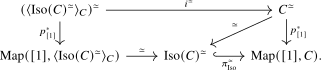
By the 2-out-of-3 property it remains to show that the top map is an equivalence. To construct an inverse, we consider the inclusion \(\imath _C\colon C^{\simeq } \to C\). It sends all morphisms to isomorphisms, so induces a functor \(C^{\simeq } \to \lra {\Iso (C)^{\simeq }}_C\). Since the source is a groupoid, it factors through a map \(\varphi \colon C^{\simeq } \to (\lra {\Iso (C)^{\simeq }}_C)^{\simeq }\). To check the relations \(\varphi \circ i^{\simeq } = \id \) and \(i^{\simeq } \circ \varphi = \id \), we may do so after composing with the embedding \(\imath _C\colon C^{\simeq } \hookrightarrow C\) from Corollary 2.5.3 and the embeddings \((\lra {\Iso (C)^{\simeq }}_C)^{\simeq } \hookrightarrow \lra {\Iso (C)^{\simeq }}_C\) and \(\lra {\Iso (C)^{\simeq }}_C \hookrightarrow C\) (Lemma 3.1.5) after which the claim becomes a tautology. This establishes (6).
Assume (6). The functor \(C^{\simeq } \to \lra {\Iso (C)^{\simeq }}_C\) constructed above is then a functor between groupoids. Its map on groupoid cores is inverse to the equivalence \(i^{\simeq }\) constructed in the preceding paragraph. Since the groupoid-core inclusions of its source and target are equivalences by Axiom G and Proposition 1.4.15, the functor itself is an equivalence by 2-out-of-3. This proves (7).
Finally, we show that (7) implies (1). The localization functor \(\lambda _C\colon C \to \geom {C}\) sends all morphisms of \(C\) to isomorphisms, hence it factors through the subcategory of \(\geom {C}\) spanned by its isomorphisms. By (7) this subcategory is equivalent to the groupoid core of \(\geom {C}\). The resulting functor \(C \to \geom {C}^{\simeq }\) still inverts all morphisms in \(C\), hence induces a functor \(\geom {C} \to \geom {C}^{\simeq }\). By uniqueness of the localization factorization, the composite \(\geom {C} \to \geom {C}^{\simeq } \hookrightarrow \geom {C}\) is identified with the identity. Thus the embedding \(\geom {C}^{\simeq } \hookrightarrow \geom {C}\) admits a section and is an equivalence by Lemma 1.6.24. It follows that \(\geom {C}\) is a groupoid. □
Proposition 3.4.5. All of the equivalent conditions from Proposition 3.4.4 are satisfied.
Proof
Proof. It will suffice to show that the map \(\geom {[1]} \to *\) is an equivalence. By Proposition 1.4.11, it will suffice to show that for any category \(D\), the induced functor \(D^{\simeq } \simeq \Map (*,D) \to \Map (\geom {[1]},D) \simeq \Map ^{\Map ([1],[1])}([1],D)\) is an equivalence. Recall from Remark 2.1.29 that the groupoid \(\Map ([1],[1])\) is a disjoint union of three points, corresponding to the identity on \(0\), the identity on \(1\), and the canonical map from \(0\) to \(1\) in \([1]\). Spelling out the definition of \(\Map ^{\Map ([1],[1])}([1],D)\), we obtain a pullback square
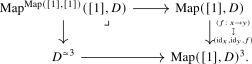
The bottom map is the third power of the embedding \(p_{[1]}^*\colon D^{\simeq }\to \Map ([1],D)\). Hence the pullback consists of those morphisms \(f\colon x\to y\) for which \(\id _x\), \(\id _y\), and \(f\) lie in the image of \(p_{[1]}^*\). The first two conditions are automatic, while the third says precisely that \(f\) is an isomorphism. The Rezk equivalence \(D^{\simeq }\iso \Iso (D)^{\simeq }\) therefore identifies the pullback with \(D^{\simeq }\), compatibly with the displayed map from \(D^{\simeq }\). This proves the claim. □
Proposition 3.4.6 (Objectwise criterion for natural isomorphisms). Let \(f,g\colon C\to D\) be functors and let \(\alpha \colon f\to g\) be a natural transformation. Then \(\alpha \) is a natural isomorphism if and only if \(\alpha _x\colon f(x)\to g(x)\) is an isomorphism for every object \(x\) of \(C\).
Proof
Proof. By Propositions 3.4.4 and 3.4.5, the functor \(\Iso (D)\to \Fun ([1],D)\) is a full subcategory. Unwinding, this means we have a pullback square
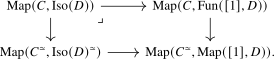
The transformation \(\alpha \) determines a term of the upper right corner, and the right-hand map restricts it to its components. If every component is invertible, applying this hypothesis to the universal object in the anima \(C^{\simeq }\) gives a lift to the lower left corner. The pullback property then supplies a lift \(C\to \Iso (D)\) of the functor encoding \(\alpha \). It follows from Lemma 1.7.11 that \(\Fun (C,\Iso (D)) \simeq \Iso (\Fun (C,D))\), so that this lift provides the inverse data for \(\alpha \) in \(\Fun (C,D)\), showing that \(\alpha \) is a natural isomorphism. Conversely, evaluation at each object sends an inverse of \(\alpha \) to an inverse of its component. □
Corollary 3.4.7. Consider a pushout square of categories

Then the induced square

is again a pushout square.
Proof
Proof. By Definition 1.8.1, it will suffice to show that the square becomes a pullback square after applying \(\Map (-,E)\) for every category \(E\). By Corollary 1.4.13 and Lemma 3.4.3, there are equivalences \[ \Map (\geom {C},E) \simeq \Map (\geom {C},E^{\simeq }) \simeq \Map (C,E^{\simeq }), \] and similarly for \(C\) replaced with \(C'\), \(D\) and \(D'\). The claim now follows from the assumption on the original square. □
Supplementary notes
- Lifting prescribed identifications through localization AI-generated
- Inverting the walking morphism AI-generated