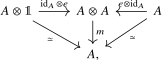
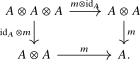
Remark 19.1.2. Because of the adjunction \(\Env \colon \Op _{\infty } \rightleftarrows \Cat _{\infty }^{\otimes }\noloc \Mm \), an associative algebra contains the same data as a symmetric monoidal functor \(\Env (\Assoc ) \to C\). The concrete description \(\Env (\Assoc )\simeq \Fin ^{\Alg }\) was given in Example 17.4.12. In particular, the maps \(\lra {0} \to \lra {1}\) and \(\lra {2} \to \lra {1}\) corresponding to the canonical ordering \(\{1 \leq 2\}\) provide structure maps \[ e\colon \unit \to A \qquadtext { and } m\colon A \otimes A \to A. \] Furthermore, the following two diagrams commute:
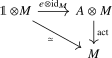
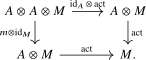
Similarly, a module over \(A\) is given by a symmetric monoidal functor \(\Env (\oLMod )\to C\) which on \(\Env (\Assoc )\) restricts to \(A\). The map \((\lra {1},\lra {1}) \to (\emptyset ,\lra {1})\) in \(\Env (\oLMod )\) coming from the fold map \(\lra {1} \sqcup \lra {1} \to \lra {1}\) gives rise to a map \[ \act \colon A \otimes M \to M, \] and the relations in \(\Env (\oLMod )\) ensure that the following two diagrams commute:
Generated from the authoritative LaTeX source.