This section establishes the basic theory of associative algebras and left modules in a monoidal \(\infty \)-category, including limits and free modules. Its organizing input is the ‘left module operad’ \(\oLMod \) from Example 12.2.9, Corollary 17.4.10, which comes equipped with the following morphisms of \(\infty \)-operads:
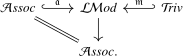
We may describe their total \(\infty \)-categories \(\Assoc ^{\otimes }\) and \(\oLMod ^{\otimes }\) as follows:
- The objects of \(\Assoc ^{\otimes }\) are finite sets \(I\). A morphism from \(I\) to \(J\) consists of a span \[ I \xleftarrow {f} K \xrightarrow {g} J \] of finite sets together with a collection of linear orders \((\preceq _j)_{j \in J}\) on the fibers \(g^{-1}(j)\). Composition is given by composition of spans and the canonical ordering.
- The objects of \(\oLMod ^{\otimes }\) are pairs \((I_A,I_M)\) of finite sets. A morphism from \((I_A,I_M)\) to \((J_A,J_M)\) is a span \[ I_A \sqcup I_M \xleftarrow {f} K \xrightarrow {g} J_A \sqcup J_M \] together with a collection of linear orders \((\preceq _j)_{j \in J_A\sqcup J_M}\) on the fibers \(g^{-1}(j)\), such that \(g\) induces a bijection between \(f^{-1}(I_M)\) and \(J_M\) and, for each \(j\in J_M\), the unique element of \(g^{-1}(j)\cap f^{-1}(I_M)\) is maximal in the order \(\preceq _j\).
The inclusion \(\fa \colon \Assoc ^{\otimes } \hookrightarrow \oLMod ^{\otimes }\) sends \(I\) to \((I,\emptyset )\), while the inclusion \(\fm \colon \Triv ^{\otimes } \hookrightarrow \oLMod ^{\otimes }\) sends \(I\) to \((\emptyset ,I)\). The map \(\oLMod ^{\otimes } \to \Assoc ^{\otimes }\) sends \((I_A,I_M)\) to \(I_A \sqcup I_M\).
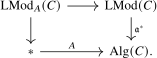
Definition 19.1.1. Let \(C\) be a monoidal \(\infty \)-category, regarded as \(\oLMod \)-monoidal by pullback along the collapse map \(\oLMod \to \Assoc \). We denote by \[ \LMod (C) := \Alg _{\oLMod }(C) \] the \(\infty \)-category of \(\oLMod \)-algebras in \(C\). Restriction along \(\fa \) defines a functor \(\fa ^*\colon \LMod (C) \to \Alg (C) := \Alg _{\Assoc }(C)\). For an associative algebra \(A \in \Alg (C)\) we define the \(\infty \)-category \(\LMod _A(C)\) of left modules over \(A\) as the fiber
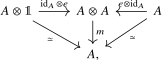
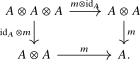
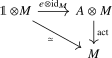
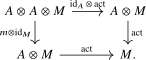
Remark 19.1.2. Because of the adjunction \(\Env \colon \Op _{\infty } \rightleftarrows \Cat _{\infty }^{\otimes }\noloc \Mm \), an associative algebra contains the same data as a symmetric monoidal functor \(\Env (\Assoc ) \to C\). The concrete description \(\Env (\Assoc )\simeq \Fin ^{\Alg }\) was given in Example 17.4.12. In particular, the maps \(\lra {0} \to \lra {1}\) and \(\lra {2} \to \lra {1}\) corresponding to the canonical ordering \(\{1 \leq 2\}\) provide structure maps \[ e\colon \unit \to A \qquadtext { and } m\colon A \otimes A \to A. \] Furthermore, the following two diagrams commute:
Similarly, a module over \(A\) is given by a symmetric monoidal functor \(\Env (\oLMod )\to C\) which on \(\Env (\Assoc )\) restricts to \(A\). The map \((\lra {1},\lra {1}) \to (\emptyset ,\lra {1})\) in \(\Env (\oLMod )\) coming from the fold map \(\lra {1} \sqcup \lra {1} \to \lra {1}\) gives rise to a map \[ \act \colon A \otimes M \to M, \] and the relations in \(\Env (\oLMod )\) ensure that the following two diagrams commute:
For future purposes, it will be convenient to introduce left modules in the more general setting of \(\infty \)-categories that are ‘left-tensored’ over \(C\).
Definition 19.1.3. Let \(C\) be a monoidal \(\infty \)-category. A left tensoring of an \(\infty \)-category \(D\) over \(C\) consists of an \(\oLMod \)-monoidal \(\infty \)-category, given by a cocartesian fibration of \(\infty \)-operads \(p_D\colon D^{\otimes } \to \oLMod ^{\otimes }\), together with the following identifications:
- The underlying monoidal \(\infty \)-category \(\fa ^*(p_D)\colon \fa ^*(D^{\otimes }) \to \Assoc ^{\otimes }\) is equivalent to \(C\);
- The underlying \(\Triv \)-monoidal \(\infty \)-category \(\fm ^*(p_D)\colon \fm ^*(D^{\otimes }) \to \Triv ^{\otimes }\) corresponds to \(D\) under the equivalence \(\Alg _{\Triv }(\Cat _{\infty }) \simeq \Cat _{\infty }\).
We say that \(D\) is left-tensored over \(C\) if it is equipped with such a left tensoring.
Definition 19.1.4. Let \(D\) be left-tensored over \(C\). Pullback along \(\fa \) defines a forgetful functor \(\fa ^*\colon \Alg _{\oLMod }(D) \to \Alg (C)\). Given an associative algebra \(A \in \Alg (C)\), we define the \(\infty \)-category \(\LMod _A(D)\) of \(A\)-modules in \(D\) as the fiber of this functor over \(A\).
Remark 19.1.5. By pulling back along the operad map \(\oLMod \to \Assoc \), every monoidal \(\infty \)-category \(C\) may be canonically regarded as left-tensored over itself. In this case, Definition 19.1.4 reduces to Definition 19.1.1.
Remark 19.1.6. All the definitions we just made also make sense for modules over commutative algebras, where we would replace the \(\infty \)-operad \(\oLMod \) by its commutative version \(\oMod \) from Example 12.2.8. It sits in a commutative diagram of \(\infty \)-operads as follows:
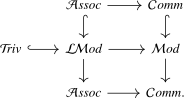
In particular, restriction along the inclusion \(\Comm \hookrightarrow \oMod \) defines a forgetful functor \(\Mod (C) := \Alg _{\oMod }(C) \to \CAlg (C)\), allowing us to define an \(\infty \)-category \(\Mod _A(C)\) for every commutative algebra \(A\) in \(C\). It turns out this \(\infty \)-category only depends on the underlying associative algebra of \(A\):
Proposition 19.1.7. Let \(C\) be a symmetric monoidal \(\infty \)-category. Then the following commutative square is a pullback square:
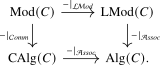
In particular, passing to vertical fibers over \(R \in \CAlg (C)\) induces an equivalence \[ \Mod _R(C) \iso \LMod _{R'}(C), \] where we denote the underlying associative algebra of \(R\) by \(R'\).
Proof. This follows by combining Glasman (2014), Proposition 7 with [Lurie (2017), Proposition 4.5.1.4]. More explicitly, the vertical functors are cartesian fibrations, the top comparison preserves cartesian morphisms because it does not change underlying objects, and the cited results identify it as an equivalence on every vertical fiber. Hence the square is a pullback. □
19.1.1 Unit algebras and their modules
We will now show that the monoidal unit \(\unit \in C\) is always a commutative algebra, and modules over it are simply objects of \(C\). In fact, we may do this more generally for unital \(\infty \)-operads:
Definition 19.1.8. An \(\infty \)-operad \(\Oo \) is called unital if its total \(\infty \)-category \(\Oo ^{\otimes }\) is pointed, i.e., if the terminal object (given by the empty tuple \(\emptyset _{\Oo } := \{\}\)) is also an initial object. Equivalently, \(\Oo \) is unital if we have \[ \Oo (\{\};x) \simeq * \] for every color \(x \in \Oo ^{\simeq }\).
Example 19.1.9. The \(\infty \)-operads \(\Comm \), \(\Assoc \) and \(\Ee _k\) are unital. The \(\infty \)-operads \(\Triv \), \(\oMod \) and \(\oLMod \) are not unital.
Definition 19.1.10. Let \(\Oo \) be a unital \(\infty \)-operad and let \(C\colon \Oo ^{\otimes } \to \Cat _{\infty }\) be an \(\Oo \)-monoidal \(\infty \)-category. For every color \(x \in \Oo ^{\simeq }\), the unique multimorphism \(e_x \in \Oo (\{\};x)\) defines a functor \[ \unit _x\colon * \simeq C(\{\}) \to C(\{x\}) = C_x. \] We refer to the corresponding object \(\unit _x \in C_x\) as the monoidal unit of \(C_x\).
Note that every \(\Oo \)-algebra \(A\) comes equipped with ‘unit maps’ \(e_x\colon \unit _x \to A_x\) in \(C_x\) for every color \(x \in \Oo ^{\simeq }\): this map is the unique lift of the map \(\{\} \to \{A_x\}\) along the cocartesian morphism \(\{\} \to \{\unit _x\}\). The following result by Lurie shows that, conversely, the monoidal units \(\unit _x \in C_x\) can always be assembled into an \(\Oo \)-algebra \(\unit _C\) for which the maps \(\unit _x \to (\unit _C)_x\) are isomorphisms:
Proposition 19.1.11 ([Lurie (2017), Proposition 3.2.1.8]). Let \(\Oo \) be a unital \(\infty \)-operad and let \(C\) be an \(\Oo \)-monoidal \(\infty \)-category. Then the \(\infty \)-category \(\Alg _{\Oo /\Oo }(C)\) of \(\Oo \)-algebras in \(C\) admits an initial object \(\unit _C \in \Alg _{\Oo /\Oo }(C)\). Furthermore, an \(\Oo \)-algebra is initial if and only if the unit maps \(e_x\colon \unit _x \to A_x\) are isomorphisms for all \(x \in \Oo ^{\simeq }\).
The proof uses the theory of operadic left Kan extensions, which we do not develop here. We nevertheless record the short construction of \(\unit _C\) as an \(\Oo \)-algebra of \(C\) from [Hebestreit and Wagner (2021), Lemma II.45a]. It suffices to define a cocartesian functor

of cocartesian fibrations over \(\Oo ^{\otimes }\). By straightening-unstraightening, we may equivalently define a natural transformation of functors \(\const _* \to \Str ^{\cc }(p_C)\) of functors \(\Oo ^{\otimes } \to \Cat _{\infty }\). Since \(\Oo ^{\otimes }\) admits an initial object \(\emptyset _{\Oo }\), there is a natural transformation \(\const _{\emptyset _{\Oo }} \to \id _{\Oo ^{\otimes }}\) of functors \(\Oo ^{\otimes } \to \Oo ^{\otimes }\). As the fiber of \(p_C\) over \(\emptyset _{\Oo }\) is the terminal \(\infty \)-category, composing this transformation with \(\Str ^{\cc }(p_C)\) gives the desired map \(\const _* \to \Str ^{\cc }(p_C)\). It is clear from the construction that the maps \(\unit _x \to (\unit _C)_x\) of the resulting \(\Oo \)-algebra are isomorphisms.
Corollary 19.1.12 ([Lurie (2017), Corollary 3.2.1.9]). Let \(C\) be a symmetric monoidal \(\infty \)-category. Then a commutative algebra \(R\) is initial in \(\CAlg (C)\) if and only if the unit map \(e\colon \unit \to R\) is an isomorphism in \(C\). In particular, the underlying object of the commutative algebra \(\unit _C \in \CAlg (C)\) from Proposition 19.1.11 is the monoidal unit of \(C\). □
19.1.2 Free modules
Let \(A\) be an associative ring and let \(M_0\) be an abelian group. The tensor product \(M := A \otimes M_0\) admits the structure of a left \(A\)-module, given by \[ A \otimes M = A \otimes (A \otimes M_0) \simeq (A \otimes A) \otimes M_0 \xrightarrow {m \otimes M_0} A \otimes M_0 = M. \] Moreover, \(M\) comes equipped with a morphism \(\phi \colon M_0 \simeq \unit \otimes M_0 \xrightarrow {e \otimes M_0} A \otimes M_0 = M\) that exhibits \(M\) as the free \(A\)-module on \(M_0\): for every other left \(A\)-module \(N\), composition with \(\phi \) induces a bijection \(\Hom _A(M,N) \iso \Hom _{\Ab }(M_0,N)\), where \(\Hom _A(M,N)\) is the set of \(A\)-module homomorphisms from \(M\) to \(N\).
This admits the following \(\infty \)-categorical refinement:
Proposition 19.1.13 ([Lurie (2017), Proposition 4.2.4.2, Corollary 4.2.4.4]). Let \(C\) be a monoidal \(\infty \)-category and let \(D\) be an \(\infty \)-category left tensored over \(C\).
- (1)
-
The forgetful functor \(\LMod (D) \xrightarrow {(\fa ^*,\fm ^*)} \Alg (C) \times D\) admits a left adjoint \[ F\colon \Alg (C) \times D \to \LMod (D), \qquad (A,M_0) \mapsto F_A(M_0) \] satisfying \(\fa ^*F_A(M_0) \simeq A\) and \(\fm ^*F_A(M_0) \simeq A \otimes M_0\).
- (2)
-
For an associative algebra \(A \in \Alg (C)\), the forgetful functor \(\fm ^*\colon \LMod _A(D) \to D\) admits a left adjoint \[ F_A\colon D \to \LMod _A(D), \] where the underlying object of \(F_A(M_0)\) is \(A \otimes M_0\).
As a consequence, we may deduce that modules over a trivial algebra are simply objects of \(D\):
Corollary 19.1.14 ([Lurie (2017), Proposition 4.2.4.9]). Let \(C\) be a monoidal \(\infty \)-category and let \(A \in \Alg (C)\) be an algebra object such that the unit map \(e\colon \unit \to A\) is an isomorphism in \(C\). Then for every left \(C\)-tensored \(\infty \)-category \(D\) the forgetful functor \(\LMod _A(D) \to D\) is an equivalence of \(\infty \)-categories.
Proof. By Proposition 19.1.13, the forgetful functor admits a left adjoint \(F_A\colon D \to \LMod _A(D)\). Since the forgetful functor is conservative, it suffices to show that the unit map \(M_0 \to A \otimes M_0\) is an isomorphism. Since this map is given by tensoring the map \(e \colon \unit \to A\) by \(M_0\), this follows from the assumption on \(A\). Indeed, the triangle identity then identifies the underlying counit with the inverse of the unit at the underlying object, and conservativity implies that the counit is also an isomorphism. □
Remark 19.1.15. There is also a conceptual proof of Corollary 19.1.14. If \(e\colon \unit \to A\) is an isomorphism, then the monad \(A \otimes -\) is isomorphic to the identity monad. Its category of modules is therefore equivalent to \(D\). We have kept the direct proof above because it is shorter and does not require the monadicity package.
19.1.3 Limits and colimits of modules
Restriction of scalars can be organized into a cartesian fibration:
Proposition 19.1.16 ([Lurie (2017), Corollary 4.2.3.2]). Let \(D\) be left-tensored over a monoidal \(\infty \)-category \(C\). The restriction functor \[ \fa ^*\colon \LMod (D)\longrightarrow \Alg (C) \] is a cartesian fibration. A morphism in \(\LMod (D)\) is \(\fa ^*\)-cartesian if and only if its underlying morphism in \(D\) is an isomorphism. Consequently, a morphism \(f\colon A\to B\) of associative algebras induces a restriction-of-scalars functor \[ f_*\colon \LMod _B(D)\longrightarrow \LMod _A(D) \] which does not change the underlying object of \(D\).
We can now deduce the limit statement for modules from the corresponding result for operadic algebras.
Corollary 19.1.17 ([Lurie (2017), Corollaries 4.2.3.3 and 4.2.3.5]). Let \(C\) be a monoidal \(\infty \)-category, let \(D\) be left-tensored over \(C\), and let \(A\in \Alg (C)\). Let \(\fm ^*\colon \LMod _A(D)\to D\) be the forgetful functor, and let \(I\) be a small \(\infty \)-category.
- (1)
-
If \(D\) admits \(I\)-indexed limits, then \(\fm ^*\) creates and preserves \(I\)-indexed limits.
- (2)
-
If \(D\) admits \(I\)-indexed colimits and the functor \(X\otimes -\colon D\to D\) preserves \(I\)-indexed colimits for every \(X\in C\), then \(\fm ^*\) creates and preserves \(I\)-indexed colimits.
Proof. We prove (1). Equip \(\Fun (I,D)\) with the pointwise left tensoring over \(C\). The identity functor of \(C\) and the constant-diagram functor \(\const \colon D\to \Fun (I,D)\) assemble to an \(\oLMod \)-monoidal functor between the corresponding left tensorings. Since \(\const \) has right adjoint \(\lim _I\), Proposition 14.4.7 equips the pair \[ (\id _C,\lim _I) \] with the right-adjoint lax \(\oLMod \)-monoidal structure. Passing to \(\oLMod \)-algebras and taking the fiber over \(A\) therefore gives an adjunction \[ \const \colon \LMod _A(D) \rightleftarrows \LMod _A(\Fun (I,D)) \simeq \Fun (I,\LMod _A(D)) \noloc \lim _I. \] The underlying object of the right adjoint is the limit in \(D\). Thus \(\fm ^*\) preserves these limits. Since it detects isomorphisms, comparison with the constructed limit also shows that it creates them.
Part (2) is [Lurie (2017), Corollary 4.2.3.5]. Its proof uses the simplicial model for modules to lift an operadic colimit of the underlying diagram; we briefly recall this model in Section 19.3. □
Generated from the authoritative LaTeX source.