If \(R\) is a classical commutative ring, then the category \(\Mod _R(\Ab )\) of \(R\)-modules comes equipped with a symmetric monoidal structure given by the relative tensor product \(M \otimes _R N\) of two \(R\)-modules \(M\) and \(N\). Moreover, if \(f\colon R \to S\) is a morphism of commutative rings, then the relative tensor product \(S \otimes _R M\) admits the structure of an \(S\)-module for every \(R\)-module \(M\), resulting in a symmetric monoidal functor \(f^*\colon \Mod _R(\Ab ) \to \Mod _S(\Ab )\) which is left adjoint to the forgetful functor \(\Mod _S(\Ab ) \to \Mod _R(\Ab )\).
The goal of this section is to introduce this structure in an arbitrary symmetric monoidal \(\infty \)-category that admits operadic geometric realizations. The organizing idea is that associative algebras are objects, bimodules are morphisms, and relative tensor products compose these morphisms. Associativity and unitality of the relative tensor product then express the coherence of this composition, while extension of scalars is composition with the regular bimodule associated to a morphism of algebras. We will make this perspective precise without constructing the ambient \((\infty ,2)\)-category explicitly.
19.2.1 Bimodules
Let \(A\) and \(B\) be ordinary associative algebras. Then we may speak of \((A,B)\)-bimodules: objects \(M\) that are simultaneously a left \(A\)-module and a right \(B\)-module in a compatible way. This notion extends to the \(\infty \)-categorical setting.
Definition 19.2.1. We define a colored operad \(\oBMod \). It has three colors: \(\fa _-\), \(\fa _+\) and \(\fm \). The multimorphism sets \(\oBMod (\{X_i\}_{i \in I}; Y)\) are then given as follows:
- If \(Y = \fa _-\), then this set is empty unless \(X_i = \fa _-\) for all \(i \in I\), in which case it is the set of linear orders on \(I\);
- If \(Y = \fa _+\), then this set is empty unless \(X_i = \fa _+\) for all \(i \in I\), in which case it is the set of linear orders on \(I\);
- If \(Y = \fm \), then this set is the set of linear orders \(\{i_1 < i_2 < \dots < i_n\}\) on \(I\) with the following property: there exists precisely one index \(i_k \in I\) such that \(X_{i_k} = \fm \), \(X_{i_j} = \fa _-\) for \(j < k\) and \(X_{i_j} = \fa _+\) for \(j > k\).
Composition in \(\oBMod \) is given by composition of linear orders.
By Proposition 17.4.9, this colored operad canonically determines the \(\infty \)-operad \(\oBMod \) used below.
Observation 19.2.2. We identify \(\oLMod \) with the full suboperad of \(\oBMod \) spanned by the colors \(\fa _-\) and \(\fm \), and let \(\oRMod \subseteq \oBMod \) denote the full suboperad spanned by \(\fm \) and \(\fa _+\). Thus \(\oBMod \) contains two copies of \(\Assoc \), on \(\fa _-\) and \(\fa _+\), a copy of \(\Triv \) on \(\fm \), and the full suboperads \(\oLMod \) and \(\oRMod \). There is also an operad map \[ \oBMod \longrightarrow \Assoc \] which sends all three colors to \(\fa \) and forgets the restrictions on the linear orders. Its restrictions to \(\oLMod \) and \(\oRMod \) are the usual collapse maps to \(\Assoc \).
Notation 19.2.3. For a monoidal \(\infty \)-category \(C\) we write \[ \RMod (C) := \Alg _{\oRMod }(C) \qquadtext { and } \BMod (C) := \Alg _{\oBMod }(C). \] Similarly, if \(A\) and \(B\) are associative algebras in \(C\), we write \[ \RMod _B(C) \qquad \qquadtext { and } \qquad {}_A\BMod _B(C) \] for the fibers over \(B\) and \((A,B)\) of the two forgetful functors \(\fa _+^*\colon \RMod (C) \to \Alg (C)\) and \((\fa _-^*, \fa _+^*)\colon \BMod (C) \to \Alg (C) \times \Alg (C)\), respectively.
Observation 19.2.4. There is an operad map \(\oBMod \to \oMod \) which sends \(\fm \) to \(\fm \) and sends both \(\fa _-\) and \(\fa _+\) to \(\fa \). Composing it with the inclusion \(\oLMod \hookrightarrow \oBMod \) gives the canonical map \(\oLMod \to \oMod \), and similarly for \(\oRMod \). It follows that for a commutative algebra \(A\) in a symmetric monoidal \(\infty \)-category \(C\), restriction along these operad maps defines forgetful functors
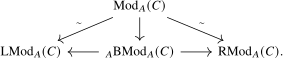
Here the left diagonal equivalence is the one from Proposition 19.1.7. The right one follows by applying Observation 19.2.5, since a commutative algebra is canonically isomorphic to its opposite algebra.
Observation 19.2.5. There are equivalences of \(\infty \)-operads \[ \rev \colon \Assoc \iso \Assoc , \qquad \rev \colon \oLMod \iso \oRMod \qquadtext { and } \rev \colon \oBMod \iso \oBMod \] given on objects by \(\fa \mapsto \fa \), \(\fa _- \mapsto \fa _+\), \(\fa _+ \mapsto \fa _-\) and \(\fm \mapsto \fm \), and on multimorphisms by reversing the order on the finite set. The map \(\Assoc \to \Comm \) coequalizes \(\rev \) and the identity, so the symmetric monoidal structure on \(C\) canonically identifies the two induced monoidal structures. Consequently, restriction along \(\rev \) defines an endofunctor \(\rev ^*\colon \Alg (C) \to \Alg (C)\). It sends an associative algebra \(A\) to its opposite algebra, denoted \(A^{\rev }\), which has the same underlying object but whose multiplication is given by \[ A \otimes A \iso A \otimes A \xrightarrow {m_A} A, \] where the first map is the swap map. For associative algebras \(A\) and \(B\) we thus get equivalences \[ \LMod _A(C) \iso \RMod _{A^{\rev }}(C) \qquadtext { and } {}_A\BMod _B(C) \iso {}_{B^{\rev }}\BMod _{A^{\rev }}(C). \]
Informally speaking, an \((A,B)\)-bimodule \(M\) comes equipped with structure maps \[ A^{\otimes n} \otimes M \otimes B^{\otimes m} \to M \] for all \(n,m \geq 0\) that are compatible with the multiplication maps of \(A\) and \(B\). By setting \(m = 0\) or \(n = 0\) we obtain a left \(A\)-module structure and a right \(B\)-module structure on \(M\), respectively. These structures are compatible with each other in a very strong sense: the \(A\)-module structure on \(M\) can be upgraded to an \(A\)-module structure internal to the \(\infty \)-category \(\RMod _B(C)\) and vice versa:
Theorem 19.2.6 ([Lurie (2017), Theorem 4.3.2.7]). Let \(A\) and \(B\) be associative algebras in a monoidal \(\infty \)-category \(C\).
- (1)
-
The \(\infty \)-category \(\RMod _B(C)\) is left tensored over \(C\), and there is an equivalence \[ {}_A\BMod _B(C) \simeq \LMod _A(\RMod _B(C)); \]
- (2)
-
The \(\infty \)-category \(\LMod _A(C)\) is right tensored over \(C\), and there is an equivalence \[ {}_A\BMod _B(C) \simeq \RMod _B(\LMod _A(C)). \]
Corollary 19.2.7. For associative algebras \(A\) and \(B\) in \(C\), there are equivalences \[ {}_A\BMod _{\unit }(C) \iso \LMod _A(C) \qquadtext { and } {}_{\unit }\BMod _B(C) \iso \RMod _B(C). \]
Proof. In light of the equivalences \(\RMod _{\unit }(C) \iso C\) and \(\LMod _{\unit }(C) \iso C\) from Corollary 19.1.14, this follows directly from the previous theorem. □
19.2.2 The relative tensor product
Let \(B\) be a discrete associative ring. A central construction in the theory of modules is the relative tensor product: Given a right \(B\)-module \(M\) and a left \(B\)-module \(N\), their relative tensor product \(M \otimes _B N\) is obtained as the quotient of \(M \otimes N\) by identifying \(mb \otimes n\) with \(m \otimes bn\) for all \(m \in M\), \(n \in N\) and \(b \in B\). In other words, \(M \otimes _B N\) is the coequalizer of the following diagram: \[ M \otimes B \otimes N \rightrightarrows M \otimes N. \] In the \(\infty \)-categorical setting, this coequalizer needs to be replaced by the geometric realization of a simplicial diagram, called the two-sided bar construction. The construction is somewhat subtle, and is handled by Lurie in [Lurie (2017), Construction 4.4.2.7]. We will first give the non-coherent description, and then indicate its coherent version in Remark 19.2.10 below.
Construction 19.2.8 (Bar construction). Let \(B\) be an associative algebra in a monoidal \(\infty \)-category \(C\), let \(M\) be a right \(B\)-module, and let \(N\) be a left \(B\)-module. The two-sided bar construction for \(M\) and \(N\) over \(B\), denoted \(\Bar _B(M,N)_{\bullet }\), is a simplicial object in \(C\) described as follows:
- In degree \([n] \in \simp \catop \), it is given by \(\Bar _B(M,N)_n := M \otimes B^{\otimes n} \otimes N\);
-
The face maps \(d_i \colon \Bar _B(M,N)_n \to \Bar _B(M,N)_{n-1}\) are given by:
- \(d_0 = \act _M \otimes \id _{B^{\otimes (n-1)}} \otimes \id _N \colon M \otimes B \otimes B^{\otimes (n-1)} \otimes N \to M \otimes B^{\otimes (n-1)} \otimes N\).
- For \(0 < i < n\), \(d_i\) is induced by the multiplication map \(m\colon B \otimes B \to B\) on the \(i\)-th and \((i+1)\)-th factors of \(B^{\otimes n}\).
- \(d_n = \id _M \otimes \id _{B^{\otimes (n-1)}} \otimes \act _N \colon M \otimes B^{\otimes (n-1)} \otimes B \otimes N \to M \otimes B^{\otimes (n-1)} \otimes N\).
- The degeneracy maps \(s_i \colon \Bar _B(M,N)_n \to \Bar _B(M,N)_{n+1}\) are induced by inserting the unit \(e\colon \unit \to B\) at the \((i+1)\)-th position.
Definition 19.2.9 (Relative tensor product). Let \(C\) be a monoidal \(\infty \)-category. Assume that \(C\) admits geometric realizations and that the tensor product \(- \otimes -\colon C \times C \to C\) preserves geometric realizations in both variables. For an associative algebra \(B\), a right \(B\)-module \(M\) and a left \(B\)-module \(N\), their relative tensor product is the object of \(C\) given by the geometric realization of the bar construction: \[ M \otimes _B N := \abs {\Bar _B(M,N)_{\bullet }} = \colim _{[n] \in \simp \catop } \Bar _B(M,N)_n. \] More generally, let \(A,B,D\in \Alg (C)\). If \(M\in {}_A\BMod _B(C)\) and \(N\in {}_B\BMod _D(C)\), then the bar construction lifts to a simplicial object of \({}_A\BMod _D(C)\). Geometric realizations of bimodules are created on underlying objects by [Lurie (2017), Proposition 4.3.3.9], so its realization defines an \((A,D)\)-bimodule \[ M\otimes _BN\in {}_A\BMod _D(C). \]
Remark 19.2.10. To formally construct \(\Bar _B(M,N)_{\bullet }\), Lurie defines in [Lurie (2017), Definition 4.4.1.1] an \(\infty \)-operad \(\oTens _2\) and shows in [Lurie (2017), Proposition 4.4.1.11] that it sits in a pushout square of \(\infty \)-operads as follows:
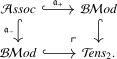
In particular, for a monoidal \(\infty \)-category \(C\), the operad \(\oTens _2\) encodes the data of algebras \(A,B,D\in \Alg (C)\), an \((A,B)\)-bimodule \(M\), and a \((B,D)\)-bimodule \(N\): there is a pullback square
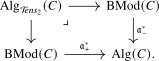
For this reason, we denote the five colors of \(\oTens _2\) by \(\fa \), \(\fm \), \(\fb \), \(\fn \) and \(\fc \).
Lurie’s construction supplies a functor \[ \BCut \colon \simp \catop \longrightarrow \oTens _2^{\otimes } \] which sends \([n]\) to the tuple \((\fm ,\fb ,\fb ,\dots ,\fb ,\fn )\) encoding \(M\otimes B^{\otimes n}\otimes N\). It can be described as the pullback, in \(\oTens _2^{\otimes }\), of the following cospan:
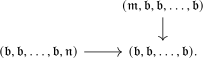
Both maps are inert, and their pullback is the indicated tuple. The compatibility of these pullbacks with the simplicial operators is part of [Lurie (2017), Construction 4.4.2.7]; it may also be expressed using the cut functors discussed later in Section 19.3.
Now, given an \((A,B)\)-bimodule \(M\) and a \((B,D)\)-bimodule \(N\), we may think of this data as defining a \(\oTens _2\)-algebra in \(C\), which in particular defines a functor \(\oTens _2^{\otimes } \to C^{\otimes }\). Precomposing this with \(\BCut \) gives a functor \(\simp \catop \to C^{\otimes }\). One can check that this actually factors through the active morphisms. Using cocartesian transport, we can then turn this into the desired functor \(\Bar _B(M,N)_{\bullet }\colon \simp \catop \to C\).
Proposition 19.2.11. Let \(C\) and \(D\) be monoidal \(\infty \)-categories which admit geometric realizations and whose tensor products preserve geometric realizations separately in both variables. If \(F\colon C\to D\) is a monoidal functor which preserves geometric realizations, then for every associative algebra \(B\in \Alg (C)\), right \(B\)-module \(M\), and left \(B\)-module \(N\), there is a natural isomorphism \[ F(M)\otimes _{F(B)}F(N)\iso F(M\otimes _BN). \]
Proof. The monoidal structure on \(F\), together with the functorial construction of the coherent bar diagram from Remark 19.2.10, gives an isomorphism of simplicial objects \[ \Bar _{F(B)}(F(M),F(N))_{\bullet }\iso F(\Bar _B(M,N)_{\bullet }). \] Taking geometric realizations and using that \(F\) preserves them gives the asserted isomorphism. □
The relative tensor product is therefore a composition law for bimodules. More precisely, it assembles into a functor \[ \BMod (C) \times _{\Alg (C)} \BMod (C) \longrightarrow \BMod (C), \] where the fiber product matches the right algebra of the first bimodule with the left algebra of the second. This composition is coherently associative and unital. In particular, for bimodules \({}_AM_B\), \({}_BN_C\) and \({}_CP_D\) there is a natural isomorphism \[ (M \otimes _B N) \otimes _C P \simeq M \otimes _B (N \otimes _C P) \qin {}_A\BMod _D(C). \] For a bimodule \({}_AM_B\), the regular bimodules \(A\) and \(B\) act as units: \[ A \otimes _A M \simeq M \qquadtext { and } M \otimes _B B \simeq M \qin {}_A\BMod _B(C). \] These statements, including their coherent compatibility, are proved in [Lurie (2017), Propositions 4.4.3.14 and 4.4.3.16]. They are the higher-categorical reason that the usual change-of-algebras formalism works exactly as in ordinary algebra.
Proposition 19.2.12 (Change of algebras). Let \(C\) be a monoidal \(\infty \)-category which admits geometric realizations and whose tensor product preserves geometric realizations separately in both variables. For every morphism \(f\colon A\to B\) in \(\Alg (C)\), the restriction functor from Proposition 19.1.16 \[ f_*\colon \LMod _B(C)\longrightarrow \LMod _A(C) \] admits a left adjoint given by extension of scalars: \[ f^*:=B\otimes _A-\colon \LMod _A(C)\longrightarrow \LMod _B(C). \] Analogously, restriction from right \(B\)-modules to right \(A\)-modules admits the left adjoint \(-\otimes _A B\).
Proof. The morphism \(f\) makes every left \(B\)-module into a left \(A\)-module and makes \(B\) into a \((B,A)\)-bimodule. For a left \(A\)-module \(M\) and a left \(B\)-module \(N\), an \(A\)-linear morphism \(g\colon M\to f_*N\) induces the \(B\)-linear composite \[ B\otimes _A M\xrightarrow {\id _B\otimes _A g}B\otimes _A f_*N\longrightarrow N, \] where the final map is induced by the \(B\)-action on \(N\). Conversely, precomposition with \[ M\iso A\otimes _A M\xrightarrow {f\otimes _A\id _M}B\otimes _A M \] turns every \(B\)-linear morphism \(B\otimes _A M\to N\) into an \(A\)-linear morphism \(M\to f_*N\). These assignments arise from the displayed natural transformations, so they define maps between the corresponding mapping animae. Unitality and associativity of relative tensor products show that these maps are inverse. The argument for right modules is analogous. □
If all the algebras involved are a fixed algebra \(A\), the relative tensor product takes the form of a functor \[ - \otimes _A - \colon {}_A\BMod _A(C) \times {}_A\BMod _A(C) \to {}_A\BMod _A(C) \] which satisfies associativity and unitality. Lurie shows that this assembles into a monoidal structure on \({}_A\BMod _A(C)\):
Proposition 19.2.13 ([Lurie (2017), Proposition 4.4.3.12]). Let \(C\) be a monoidal \(\infty \)-category. Assume that \(C\) admits geometric realizations and that the tensor product \(- \otimes -\colon C \times C \to C\) preserves geometric realizations in both variables. For an associative algebra \(A\), there exists a monoidal structure on \({}_A\BMod _A(C)\) given by the relative tensor product over \(A\).
19.2.3 Modules over commutative algebras
Let \(R\) be a discrete commutative ring. Given \(R\)-modules \(M\) and \(N\), the relative tensor product \(M \otimes _R N\) is again an \(R\)-module, with the scalar multiplication given by \(r(m \otimes n) = rm \otimes n = m \otimes rn\). In fact, the construction \((M,N) \mapsto M \otimes _R N\) equips the category \(\Mod _R(\Ab )\) of \(R\)-modules with a symmetric monoidal structure. The analogous statement also holds in the \(\infty \)-categorical setting:
Theorem 19.2.14 ([Lurie (2017), Theorem 4.5.2.1]). Let \(C\) be a symmetric monoidal \(\infty \)-category. Assume that \(C\) admits geometric realizations and that the tensor product of \(C\) preserves geometric realizations in both variables. Let \(R\) be a commutative algebra in \(C\). Then:
- (1)
-
The \(\infty \)-category \(\Mod _R(C)\) admits a symmetric monoidal structure.
- (2)
-
The functor \(\Mod _R(C) \to {}_R\BMod _R(C)\) from Observation 19.2.4 refines to a monoidal functor, where the target has the monoidal structure from Proposition 19.2.13.
In particular, the tensor product on \(\Mod _R(C)\) is given as the following composite: \[ \begin {aligned} \Mod _R(C) \times \Mod _R(C) &\longrightarrow {}_R\BMod _R(C) \times {}_R\BMod _R(C) \\ &\xrightarrow {- \otimes _R -} {}_R\BMod _R(C) \longrightarrow \LMod _R(C) \iso \Mod _R(C). \end {aligned} \]
Proposition 19.2.15 ([Lurie (2017), Theorem 5.1.4.10 and Corollary 3.4.1.7]). Let \(C\) be a symmetric monoidal \(\infty \)-category. Assume that \(C\) admits geometric realizations and that the tensor product of \(C\) preserves geometric realizations in both variables. Let \(R\) be a commutative algebra in \(C\). The forgetful functor \(\CAlg (\Mod _R(C))\to \CAlg (C)\) lifts to an equivalence of \(\infty \)-categories \[ \CAlg (\Mod _R(C))\iso \CAlg (C)_{R/}. \]
Warning 19.2.16. There is no analogous equivalence \(\Alg (\Mod _R(C))\simeq \Alg (C)_{R/}\). Already for ordinary rings, the structure map from \(R\) to an associative algebra in \(\Mod _R(C)\) is central, whereas an arbitrary morphism from \(R\) to an associative algebra need not have central image; see also [Lurie (2017), Warning 7.1.3.9].
Corollary 19.2.17 (Localization of a commutative base algebra). Let \(R\in \CAlg (C)\) be as in Theorem 19.2.14, and let \[ L\colon \Mod _R(C)\rightleftarrows D\colon i \] be a symmetric monoidal Bousfield localization as in Proposition 14.5.3. Then the local \(R\)-module \(L(R)\) canonically underlies a commutative algebra in \(C\) equipped with a morphism \(R\to L(R)\). It is initial among commutative algebras under \(R\) whose underlying \(R\)-modules are local.
Proof. The object \(R\) is the monoidal unit of \(\Mod _R(C)\) and hence the initial object of \(\CAlg (\Mod _R(C))\). By Corollary 14.5.4, its reflection \(L(R)\) is the initial object of \(\CAlg (D)\), and the essential image of \[ \CAlg (D)\hookrightarrow \CAlg (\Mod _R(C)) \] consists of the commutative \(R\)-algebras with local underlying module. The equivalence \(\CAlg (\Mod _R(C))\simeq \CAlg (C)_{R/}\) from Proposition 19.2.15 gives the result. □
When \(C\) is presentably symmetric monoidal, the symmetric monoidal \(\infty \)-category \(\Mod _R(C)\) is again presentably symmetric monoidal: its underlying category is presentable by Proposition 19.1.7, Proposition 22.5.5, and its relative tensor product preserves colimits separately by [Lurie (2017), Corollary 4.4.2.15]. It is therefore closed by Proposition 22.5.3; in particular, each functor \(-\otimes _RN\) admits an internal right adjoint \(\iHom _R(N,-)\).
19.2.4 Restriction and extension of scalars
Let \(f\colon A \to B\) be a morphism of classical commutative rings. Every \(B\)-module \(M\) may be regarded as an \(A\)-module via the scalar multiplication \(am := f(a)m\), resulting in a functor \[ f_*\colon \Mod _B(\Ab ) \to \Mod _A(\Ab ) \] called restriction of scalars1 . Furthermore, this functor admits a left adjoint \[ f^*\colon \Mod _A(\Ab ) \to \Mod _B(\Ab ) \] sending an \(A\)-module to the relative tensor product \(B \otimes _A M\) of \(B\) and \(M\) over \(A\), where we regard \(B\) as a \((B,A)\)-bimodule. Furthermore, this left adjoint is symmetric monoidal: there are natural isomorphisms of \(B\)-modules \[ B \otimes _A (M \otimes _A N) \iso (B \otimes _A M) \otimes _B (B \otimes _A N) \] for all \(A\)-modules \(M\) and \(N\).
It turns out that this structure exists for commutative algebras in an arbitrary symmetric monoidal \(\infty \)-category \(C\).
Theorem 19.2.18 ([Lurie (2017), Theorem 4.5.3.1]). Let \(C\) be a symmetric monoidal \(\infty \)-category. Assume that \(C\) admits geometric realizations and that the tensor product \(\otimes \colon C \times C \to C\) preserves geometric realizations in both variables separately. Then there exists a cocartesian fibration \[ p\colon \Mod (C)^{\otimes } \to \CAlg (C) \times \Span (\Fin ) \] such that for every commutative algebra \(R\) the pullback along \(\{R\} \times \Span (\Fin ) \hookrightarrow \CAlg (C) \times \Span (\Fin )\) is the cocartesian fibration \[ p_R\colon \Mod _R(C)^{\otimes } \to \Span (\Fin ) \] encoding the symmetric monoidal structure on \(\Mod _R(C)\) from Theorem 19.2.14.
By straightening-unstraightening, the cocartesian fibration \(p\) corresponds to a functor \[ \Str ^{\cc }\colon \CAlg (C) \times \Span (\Fin ) \to \Cat _{\infty } \] which preserves finite products in the second variable. By currying, this may equivalently be encoded as a functor \[ \CAlg (C) \to \Fun ^{\times }(\Span (\Fin ),\Cat _\infty ) = \Cat _{\infty }^{\otimes } \] from commutative algebras in \(C\) to symmetric monoidal \(\infty \)-categories. In particular, every morphism \(f\colon R \to S\) in \(\CAlg (C)\) induces a symmetric monoidal functor \[ f^*\colon \Mod _R(C) \to \Mod _S(C). \] When \(R = \unit \) is the monoidal unit, the resulting symmetric monoidal functor \[ C \simeq \Mod _{\unit }(C) \to \Mod _S(C) \] is the free module functor \(F_S\colon C \to \Mod _S(C)\) from Proposition 19.1.13.
Notes
Generated from the authoritative LaTeX source.