Remark 19.2.10. To formally construct \(\Bar _B(M,N)_{\bullet }\), Lurie defines in [Lurie (2017), Definition 4.4.1.1] an \(\infty \)-operad \(\oTens _2\) and shows in [Lurie (2017), Proposition 4.4.1.11] that it sits in a pushout square of \(\infty \)-operads as follows:
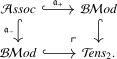
In particular, for a monoidal \(\infty \)-category \(C\), the operad \(\oTens _2\) encodes the data of algebras \(A,B,D\in \Alg (C)\), an \((A,B)\)-bimodule \(M\), and a \((B,D)\)-bimodule \(N\): there is a pullback square
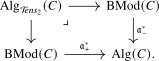
For this reason, we denote the five colors of \(\oTens _2\) by \(\fa \), \(\fm \), \(\fb \), \(\fn \) and \(\fc \).
Lurie’s construction supplies a functor \[ \BCut \colon \simp \catop \longrightarrow \oTens _2^{\otimes } \] which sends \([n]\) to the tuple \((\fm ,\fb ,\fb ,\dots ,\fb ,\fn )\) encoding \(M\otimes B^{\otimes n}\otimes N\). It can be described as the pullback, in \(\oTens _2^{\otimes }\), of the following cospan:
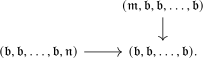
Both maps are inert, and their pullback is the indicated tuple. The compatibility of these pullbacks with the simplicial operators is part of [Lurie (2017), Construction 4.4.2.7]; it may also be expressed using the cut functors discussed later in Section 19.3.
Now, given an \((A,B)\)-bimodule \(M\) and a \((B,D)\)-bimodule \(N\), we may think of this data as defining a \(\oTens _2\)-algebra in \(C\), which in particular defines a functor \(\oTens _2^{\otimes } \to C^{\otimes }\). Precomposing this with \(\BCut \) gives a functor \(\simp \catop \to C^{\otimes }\). One can check that this actually factors through the active morphisms. Using cocartesian transport, we can then turn this into the desired functor \(\Bar _B(M,N)_{\bullet }\colon \simp \catop \to C\).
Generated from the authoritative LaTeX source.