Definition 23.1.1. Consider a functor \(p\colon E \to C\).
- (1)
-
A morphism \(\phi \colon e \to e'\) in \(E\) is called \(p\)-cocartesian if, for every other object \(e''\) in \(E\), the commutative square
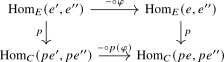
is a pullback square. Informally, this means that for every solid diagram of the form


in \(E\) for which its image in \(C\) has been completed to a triangle, there exists a unique map \(e' \to e''\) that forms a commutative triangle in \(E\) and projects to the given one in \(C\).
- (2)
-
We say that \(p\) is a cocartesian fibration if for every morphism \(f\colon x \to y\) in \(C\) and every object \(e \in E_x\) there exists a \(p\)-cocartesian morphism \(\phi \colon e \to e'\) satisfying \(p(\phi ) = f\). We refer to such a morphism \(\phi \) as a \(p\)-cocartesian lift of \(f\).
- (3)
-
Let \(p\colon E \to C\) and \(p'\colon E' \to C\) be two cocartesian fibrations. A functor \(F\colon E \to E'\) over \(C\), i.e., a commutative triangle

is called cocartesian over \(C\) if it sends \(p\)-cocartesian morphisms in \(E\) to \(p'\)-cocartesian morphisms in \(E'\).
- (4)
-
If \(C\) is a small \(\infty \)-category, we denote by \[ \Cocart (C) \subseteq (\Cat _{\infty })_{/C} \] the non-full subcategory spanned by the cocartesian fibrations \(p\colon E \to C\) and the cocartesian functors between them.
Generated from the authoritative LaTeX source.