Proposition 16.5.5 (Excisiveness criterion). Let \(C\) be a pointed \(\infty \)-category with finite colimits and let \(D\) be a pointed \(\infty \)-category with finite limits. A reduced functor \(F\colon C \to D\) is excisive if and only if the map \(\eta _X\colon F(X) \to \Omega _DF(\Sigma _CX)\) is an isomorphism for every object \(X \in C\).
Proof. If \(F\) is excisive, it sends the pushout square defining \(\Sigma _CX\) to a pullback square, which identifies \(F(X)\) with \(\Omega _DF(\Sigma _CX)\).
Conversely, suppose all maps \(\eta _X\) are isomorphisms. For a commutative square \(Q\) as below, write \[ P_F(Q):=F(X)\times _{F(W)}F(Y) \] and let \(\alpha _F(Q)\colon F(Z)\to P_F(Q)\) be the comparison map. Now let \(Q\) be a pushout square

The standard \(3\times 3\) diagram of cofibers contains a map \(W\to \Sigma _CZ\) whose composites with \(X\to W\) and \(Y\to W\) are zero. Applying \(F\) therefore gives a morphism of cospans
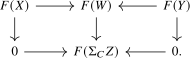
Taking pullbacks defines a map \[ \beta _F(Q)\colon P_F(Q)\longrightarrow \Omega _DF(\Sigma _CZ). \] Put \(T(F):=\Omega _DF\Sigma _C\). The remaining faces of the \(3\times 3\) diagram identify the two indicated length-two composites in

The first identity is the suspension square defining \(\eta _Z\). The second is obtained by taking pullbacks of the suspension squares defining \(\eta _X,\eta _W,\eta _Y\); here \(P_{\eta _F}(Q)\) denotes the resulting map on pullbacks. The first length-two composite is an isomorphism by assumption, and the second is an isomorphism because it is induced on pullbacks by three isomorphisms. Hence the 2-out-of-6 property shows that \(\alpha _F(Q)\) is an isomorphism. Thus \(F\) is excisive. □
Generated from the authoritative LaTeX source.