The construction of \(\Sp \) in Chapter 4 used prespectra. For the symmetric monoidal structure, a different model is more convenient. We will consider functors from finite pointed animae which send the zero object to a terminal object and pushout squares to pullback squares. We will show that these reduced excisive functors give a second model for spectra, and that their inclusion into the full functor category admits a left adjoint. This realizes \(\Sp \) as a Bousfield localization of a functor category on which Day convolution is available.
Definition 16.5.1. Let \(F\colon C \to D\) be a functor between \(\infty \)-categories.
- (1)
-
If \(C\) admits pushouts, we say that \(F\) is excisive if it sends pushout squares in \(C\) to pullback squares in \(D\).
- (2)
-
If \(C\) admits a terminal object, we say that \(F\) is reduced if it sends the terminal object of \(C\) to a terminal object of \(D\).
We write \(\Exc (C,D) \subseteq \Fun (C,D)\) for the full subcategory of excisive functors, \(\Fun _*(C,D) \subseteq \Fun (C,D)\) for the full subcategory of reduced functors, and \(\Exc _*(C,D)\) for their intersection.
Notation 16.5.2. We write \(\An _*^{\fin }\) for the small \(\infty \)-category of finite pointed animae. Its universal property is given in Lemma 4.3.12.
Definition 16.5.3. Let \(C\) be an \(\infty \)-category with finite limits. We denote by \(\Sp ^{\exc }(C)\) the full subcategory \[ \Sp ^{\exc }(C) := \Exc _*(\An _*^{\fin }, C) \subseteq \Fun (\An _*^{\fin }, C) \] spanned by the reduced, excisive functors from \(\An _*^{\fin }\) to \(C\). We denote by \(\Omega ^{\infty }\colon \Sp ^{\exc }(C) \to C\) the evaluation at \(S^0 \in \An _*^{\fin }\).
A reduced functor \(\An _*^{\fin }\to C\) has a canonical lift to \(C_*\), obtained from the maps \(F(*)\to F(X)\); cf. Lemma 4.1.13. We will therefore freely use the equivalence \[ \Fun _*(\An _*^{\fin },C)\simeq \Fun _*(\An _*^{\fin },C_*), \] and its restriction to reduced excisive functors.
The following criterion is the basic reason that reduced excisive functors behave like spectra.
Construction 16.5.4. Let \(C\) be a pointed \(\infty \)-category with finite colimits, let \(D\) be a pointed \(\infty \)-category with finite limits, and let \(F\colon C \to D\) be a reduced functor. Applying \(F\) to the pushout square defining \(\Sigma _CX\) gives a square
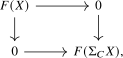
and hence a canonical map \[ \eta _X\colon F(X) \to \Omega _DF(\Sigma _CX). \]
Proposition 16.5.5 (Excisiveness criterion). Let \(C\) be a pointed \(\infty \)-category with finite colimits and let \(D\) be a pointed \(\infty \)-category with finite limits. A reduced functor \(F\colon C \to D\) is excisive if and only if the map \(\eta _X\colon F(X) \to \Omega _DF(\Sigma _CX)\) is an isomorphism for every object \(X \in C\).
Proof. If \(F\) is excisive, it sends the pushout square defining \(\Sigma _CX\) to a pullback square, which identifies \(F(X)\) with \(\Omega _DF(\Sigma _CX)\).
Conversely, suppose all maps \(\eta _X\) are isomorphisms. For a commutative square \(Q\) as below, write \[ P_F(Q):=F(X)\times _{F(W)}F(Y) \] and let \(\alpha _F(Q)\colon F(Z)\to P_F(Q)\) be the comparison map. Now let \(Q\) be a pushout square

The standard \(3\times 3\) diagram of cofibers contains a map \(W\to \Sigma _CZ\) whose composites with \(X\to W\) and \(Y\to W\) are zero. Applying \(F\) therefore gives a morphism of cospans
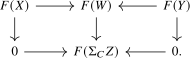
Taking pullbacks defines a map \[ \beta _F(Q)\colon P_F(Q)\longrightarrow \Omega _DF(\Sigma _CZ). \] Put \(T(F):=\Omega _DF\Sigma _C\). The remaining faces of the \(3\times 3\) diagram identify the two indicated length-two composites in

The first identity is the suspension square defining \(\eta _Z\). The second is obtained by taking pullbacks of the suspension squares defining \(\eta _X,\eta _W,\eta _Y\); here \(P_{\eta _F}(Q)\) denotes the resulting map on pullbacks. The first length-two composite is an isomorphism by assumption, and the second is an isomorphism because it is induced on pullbacks by three isomorphisms. Hence the 2-out-of-6 property shows that \(\alpha _F(Q)\) is an isomorphism. Thus \(F\) is excisive. □
Corollary 16.5.6. The following conditions are equivalent for a reduced functor \(F\colon C \to D\) between stable \(\infty \)-categories:
- (1)
-
\(F\) is an exact functor;
- (2)
-
\(F\) commutes with loop objects;
- (3)
-
\(F\) commutes with suspensions.
Proof. Since \(C\) and \(D\) are stable, the functor \(F\) is exact if and only if it is excisive. By Proposition 16.5.5, this holds if and only if the canonical map \(F(X)\to \Omega _DF(\Sigma _CX)\) is an isomorphism for every \(X\in C\). By adjunction, this is equivalent to the canonical comparison \(\Sigma _DF(X)\to F(\Sigma _CX)\) being an isomorphism. Thus exactness is equivalent to preservation of suspensions, and preservation of loops is equivalent because suspension and loops are inverse equivalences in both categories. □
Proposition 16.5.7. Let \(C\) be a pointed \(\infty \)-category with finite colimits and let \(D\) be an \(\infty \)-category with finite limits. Then \(\Exc _*(C,D)\) is stable.
Proof. By replacing \(D\) with \(D_*\), we may assume \(D\) is pointed. The \(\infty \)-category \(\Exc _*(C,D)\) has finite limits computed pointwise, and reduced excisive functors are closed under such limits. It is also pointed. By Theorem 4.2.2, it remains to show that its loop functor is an equivalence.
The loop functor is computed pointwise: \(\Omega (F)=\Omega _D\circ F\). Define a shift functor by \(\Shift (F):=F\circ \Sigma _C\). Since \(\Sigma _C\) preserves zero objects and pushout squares, \(\Shift (F)\) is again reduced excisive. Applying an excisive functor \(F\) to the pushout square defining suspension gives natural isomorphisms \[ F \simeq \Omega _DF\Sigma _C = \Omega (\Shift F) = \Shift (\Omega F), \] so \(\Omega \) and \(\Shift \) are inverse equivalences. □
Lemma 16.5.8. If \(C\) is stable, the evaluation functor \(\Omega ^\infty \colon \Sp ^{\exc }(C) \to C\) is an equivalence.
Proof. When \(C\) is stable, a reduced functor \(\An _*^{\fin }\to C\) is excisive if and only if it preserves finite colimits. Hence \[ \Sp ^{\exc }(C) = \Exc _*(\An _*^{\fin },C) \simeq \Fun _*^{\mathrm {rex}}(\An _*^{\fin },C). \] Evaluation at \(S^0\) is an equivalence by the universal property of \(\An _*^{\fin }\) from Notation 16.5.2. □
Corollary 16.5.9. The \(\infty \)-category \(\Sp ^{\exc }(C)\) is stable for every \(\infty \)-category \(C\) with finite limits.
Proof. Take the source category in Proposition 16.5.7 to be \(\An _*^{\fin }\). □
Proposition 16.5.10. For every \(\infty \)-category \(C\) with finite limits, the evaluation functor \(\ev _{S^0}\colon \Sp ^{\exc }(C) \to C\) exhibits \(\Sp ^{\exc }(C)\) as a stabilization of \(C\).
Proof. The functor \(\ev _{S^0}\) is left exact, since limits in the functor category are computed pointwise and reduced excisive functors are closed under limits. Let \(D\) be stable. Since pushout squares and pullback squares agree in \(D\), a functor \(D \to C\) is left exact if and only if it is reduced and excisive. Thus it is enough to show that \[ \Exc _*(D,\Sp ^{\exc }(C)) \to \Exc _*(D,C) \] is an equivalence. Since reducedness and excisiveness are pointwise conditions, currying restricts to the relevant full subcategories and identifies the source with \[ \Exc _*(D,\Exc _*(\An _*^{\fin },C)) \simeq \Sp ^{\exc }(\Exc _*(D,C)). \] The target \(\Exc _*(D,C)\) is stable by Proposition 16.5.7, so evaluation at \(S^0\) is an equivalence by Lemma 16.5.8. □
Corollary 16.5.11. There is a unique equivalence \[ \Sp \simeq \Sp ^{\exc }(\An )=\Exc _*(\An _*^{\fin },\An ) \] under which the two functors to \(\An \) given by \(\Omega ^\infty \) and evaluation at \(S^0\) agree.
Proof. By Proposition 4.3.16, Proposition 16.5.10, both sides, equipped with the displayed functors to \(\An \), are stabilizations of \(\An \). The result follows from the uniqueness of stabilization. □
Proposition 16.5.12 (Excisive approximation). Let \(C\) be an \(\infty \)-category that admits finite limits, finite colimits, and sequential colimits, and assume that the loop functor \(\Omega \colon C_*\to C_*\) preserves sequential colimits. Then the two inclusions \[ \Sp ^{\exc }(C)=\Exc _*(\An _*^{\fin },C) \hookrightarrow \Fun _*(\An _*^{\fin },C) \qquadtext { and } \Fun _*(\An _*^{\fin },C) \hookrightarrow \Fun (\An _*^{\fin },C) \] admit left adjoints \[ P_1\colon \Fun _*(\An _*^{\fin },C) \to \Exc _*(\An _*^{\fin },C) \qquadtext { and } (-)^{\mathrm {red}}\colon \Fun (\An _*^{\fin },C) \to \Fun _*(\An _*^{\fin },C). \]
Proof. For the reduction functor, let \(F\colon \An _*^{\fin }\to C\) be arbitrary. Since \(*\) is initial in \(\An _*^{\fin }\), the unique natural transformation \(\const _*\to \id \) induces \(\const _{F(*)}\to F\). Define \[ F^{\mathrm {red}}(X):=*\sqcup _{F(*)}F(X). \] This is reduced. If \(G\) is reduced, every natural transformation \(F\to G\) vanishes on \(F(*)\), and hence factors uniquely through \(F\to F^{\mathrm {red}}\). Thus \((-)^{\mathrm {red}}\) is left adjoint to the inclusion of reduced functors.
For \(P_1\), we may replace \(C\) by \(C_*\), which inherits finite and sequential colimits from \(C\), so assume \(C\) is pointed. Write \[ T(F):=\Omega F\Sigma \] for the endofunctor of \(\Fun _*(\An _*^{\fin },C)\), equipped with the natural transformation \(\eta \colon \id \to T\) from Construction 16.5.4. We first record the coherence needed below. For a finite set \(S\) and \(X\in \An _*^{\fin }\), let \(K_S(X)\) be the colimit of the star-shaped diagram with central object \(X\) and one map \(X\to 0\) for every element of \(S\). Thus \[ K_{\emptyset }(X)=X,\qquad K_{\{s\}}(X)=0,\qquad K_{\{0,1\}}(X)=\Sigma X. \] Injections of finite sets induce maps between these pointed cones. Since finite colimits commute with each other, interchanging the two colimit coordinates gives natural isomorphisms \(K_SK_{S'}\simeq K_{S'}K_S\), coherently in \(S\) and \(S'\). This simultaneous interchange is the coherence needed below; it does not require choosing an order in which to identify the two suspension coordinates. Moreover, \[ T(F)(X)\simeq \lim _{\emptyset \neq S\subseteq \{0,1\}}F(K_S(X)) \simeq F(0)\times _{F(\Sigma X)}F(0) \simeq \Omega F(\Sigma X). \] Under this description, the maps \(K_{\emptyset }(X)\to K_S(X)\) induce \(\eta _F\). The isomorphisms which interchange \(K_S\) and \(K_{S'}\) therefore identify the two natural transformations \[ T(\eta _F),\eta _{T(F)}\colon T(F)\longrightarrow T^2(F). \]
Now let \(F\colon \An _*^{\fin }\to C\) be reduced. Iterate \(\eta \) to form \[ F \xrightarrow {\eta _F} T(F) \xrightarrow {\eta _{T(F)}} T^2(F) \longrightarrow \cdots \] and define \[ P_1(F):=\colim _{n\geq 0}T^n(F). \] Thus \(T^n(F)\simeq \Omega ^nF\Sigma ^n\), with the transition maps specified coherently by the pointed-cone construction.
The functor \(T\) preserves sequential colimits by assumption. Consequently, \[ T(P_1(F))\simeq \colim _{n\geq 0}T^{n+1}(F), \] and under this isomorphism \(\eta _{P_1(F)}\) is the map from the defining telescope to its tail. The shift \(n\mapsto n+1\) is cofinal, so this map is an isomorphism. The excisiveness criterion now shows that \(P_1(F)\) is excisive.
It remains to verify the universal property. The coherence \(T(\eta _G)\simeq \eta _{T(G)}\) identifies the sequential diagram defining \(P_1(T(G))\) with the tail of the diagram defining \(P_1(G)\), compatibly with \[ P_1(\eta _G)\colon P_1(G)\longrightarrow P_1(T(G)). \] Thus \(P_1(\eta _G)\) corresponds to the cofinal tail map and is an isomorphism. Moreover, \(P_1\) preserves sequential colimits, since \(T\) does.
Let \(u_F\colon F\to P_1(F)\) be the map into the telescope. Since \(P_1\) preserves sequential colimits, the map \[ P_1(u_F)\colon P_1(F)\longrightarrow P_1(P_1(F)) \] is the sequential colimit of the maps \(P_1(F)\to P_1(T^n(F))\). Each of these is a composite of the isomorphisms \(P_1(\eta _{T^k(F)})\), so \(P_1(u_F)\) is an isomorphism. If \(G\) is already excisive, the excisiveness criterion shows that every map in the defining telescope for \(P_1(G)\) is an isomorphism, so \(u_G\colon G\to P_1(G)\) is an isomorphism. In particular, \(u_{P_1(F)}\) is an isomorphism. By Proposition 21.8.9, the functor \(P_1\) is left adjoint to the inclusion of reduced excisive functors. □
Corollary 16.5.13. The conclusion of Proposition 16.5.12 applies when \(C=\An \) or \(C=\An _*\).
Proof. Both categories admit the required limits and colimits. Moreover, filtered colimits of animae commute with finite limits, so their loop functors preserve sequential colimits. □
Lemma 16.5.14. The evaluation functor \[ \ev _{S^0}\colon \Exc _*(\An _*^{\fin },\An _*) \to \An _* \] admits a left adjoint. It sends a pointed anima \(X\) to the excisive approximation of the smash product functor \[ P_1(X \wedge -) \colon \An _*^{\fin } \to \An _*. \]
Proof. First consider evaluation at \(S^0\) on the full functor category. Its left adjoint is the left Kan extension along \(S^0\colon *\to \An _*^{\fin }\), which sends a pointed anima \(X\) to the functor \[ K\longmapsto X\wedge \fgt (K)_+. \] Its value at the zero object is \(X\). Applying the reduction functor gives \(K\mapsto X\wedge K\), since the cofiber of the canonical map \(S^0\to \fgt (K)_+\) is \(K\). Thus \(X\wedge -\) is left adjoint to evaluation on reduced functors. Composing with the excisive approximation \(P_1\), which exists by Corollary 16.5.13, gives the asserted left adjoint on reduced excisive functors. □
Generated from the authoritative LaTeX source.