This section works out Day convolution for graded and filtered objects and for arrow categories, where it recovers pushout products and smash products.
16.3.1 Graded and filtered objects
Example 16.3.1 (Graded objects). Regard \(\Z \) as a discrete symmetric monoidal category under addition, and let \(C\) be a cocomplete symmetric monoidal \(\infty \)-category whose tensor product preserves colimits separately in each variable. Day convolution equips the \(\infty \)-category \(\Fun (\Z ,C)\) of \(\Z \)-graded objects with a symmetric monoidal structure. Explicitly, \[ (F \otimes _{\Day } G)_n \simeq \coprod _{i+j=n} F_i \otimes G_j. \] For \(C=\Ab \) this is the usual tensor product of graded abelian groups, and for \(C=\Sp \) it is the corresponding tensor product of graded spectra.
Example 16.3.2 (Filtered objects). Under the same hypotheses on \(C\), regard \((\Z ,\leq )\) as a poset with its usual ordering and as a symmetric monoidal category under addition. The Day convolution on \(\Fun ((\Z ,\leq ),C)\) is the standard tensor product of increasing filtered objects: \[ (F \otimes _{\Day } G)_n \simeq \colim _{i+j\leq n} F_i \otimes G_j. \] The transition maps are induced by the order on \(\Z \). Replacing \((\Z ,\leq )\) by \((\N ,\leq )\) gives the analogous tensor product of nonnegatively filtered objects.
16.3.2 Pushout products and smash products
Lemma 16.3.3 (Pushout product). Let \(C\) be a symmetric monoidal \(\infty \)-category that admits finite colimits and such that \(X \otimes -\colon C\to C\) preserves finite colimits for every \(X\in C\). Then \(\Ar (C)\) admits a symmetric monoidal structure via Day convolution. Its unit is \(\emptyset \to \unit \), and its tensor product is the pushout product \[ (f\colon X\to Y)\mathbin {\square }(f'\colon X'\to Y') \; := \; (X\otimes Y')\sqcup _{X\otimes X'}(Y\otimes X')\longrightarrow Y\otimes Y'. \]
Proof. Equip \([1]=\{0\leq 1\}\) with the symmetric monoidal structure given by the minimum. Since the relative tensor-product slices of \(([1],\min )\) are finite, Proposition 16.2.7 applies to \(\Fun ([1],C)=\Ar (C)\). By Remark 16.2.9, the unit is the left Kan extension of \(\unit \colon *\to C\) along \(\{1\}\hookrightarrow [1]\), hence is \(\emptyset \to \unit \). The binary Day convolution is the left Kan extension along \(\min \colon [1]\times [1]\to [1]\); the pointwise formula identifies its value at \(0\) with the displayed pushout and its value at \(1\) with \(Y\otimes Y'\). □
Lemma 16.3.4 (Smash product). Let \(C\) be a symmetric monoidal \(\infty \)-category that admits finite colimits and a terminal object, and assume that \(X \otimes -\colon C\to C\) preserves finite colimits for every \(X\in C\). Equip \(\Ar (C)\) with the pushout-product monoidal structure of Lemma 16.3.3. Then \(C_*\subseteq \Ar (C)\) is symmetric monoidal, and the localization functor \[ \cofib \colon \Ar (C)\to C_*, \qquad (f\colon X\to Y)\longmapsto (*\to \cofib (f)) \] is symmetric monoidal. The tensor product of pointed objects is therefore \[ (x\colon *\to X)\otimes (y\colon *\to Y) = \cofib (X\otimes *\sqcup _{*\otimes *}*\otimes Y\to X\otimes Y). \]
Proof. The inclusion \(C_* \hookrightarrow \Ar (C)\) admits a left adjoint given by taking cofibers. By Proposition 14.5.3, it thus remains to show that tensoring in \(\Ar (C)\) with an object preserves those morphisms (= commutative squares in \(C\)) which induce isomorphisms on cofibers. To see this, consider such a morphism

Let us write \(Z := \cofib (f\colon X \to Y)\) and \(Z' := \cofib (f'\colon X' \to Y')\), so that the condition on the square is that the induced map \(Z \to Z'\) is an isomorphism. Our task is to show that for every other morphism \((g\colon A \to B)\) in \(C\) the induced commutative square

again induces an isomorphism on (vertical) cofibers. Since \(Z \iso Z'\), it will suffice to express the two vertical cofibers purely in terms of \(g\), \(Z\) and \(Z'\). We will do so by showing that the bottom front square in the following commutative diagram is a pushout square:
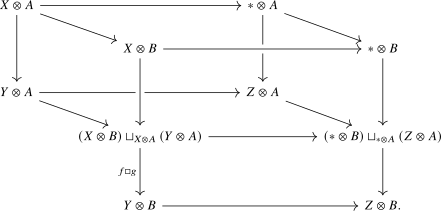
But this follows from the pasting law for pushout squares: the left and right faces of the diagram are pushouts by definition, while the back square and front rectangle are pushout squares since \(- \otimes A\) and \(- \otimes B\) preserve the pushout square defining \(Z\) as a cofiber of \(X \to Y\). □
Definition 16.3.5. Let \(C\) be an \(\infty \)-category with finite products and finite colimits such that the functor \(X \times -\colon C \to C\) preserves finite colimits for all \(X \in C\). We may then apply Lemma 16.3.4 to the cartesian monoidal structure on \(C\). We refer to the resulting symmetric monoidal structure \((C_*,\wedge ,S^0)\) on the pointed objects in \(C\) as the smash product. The monoidal unit is \(S^0 := * \sqcup *\), while the smash product \(X \wedge Y\) is given by \[ X \wedge Y \quad := \quad \cofib (X \vee Y \to X \times Y), \] where \(X \vee Y := X \sqcup _* Y\).
Example 16.3.6. Since the cartesian product in \(\An \) preserves colimits separately in both variables, this equips \(\An _*\) with the smash product monoidal structure. Its underlying tensor product is the smash product introduced in Definition 2.4.10.
Generated from the authoritative LaTeX source.