Proposition 16.2.7 (Lurie (2017), Proposition 2.2.6.16, Winges (2026), Proposition 4.1). Let \((C, \otimes _C, \unit _C)\) and \((D, \otimes _D, \unit _D)\) be symmetric monoidal \(\infty \)-categories. Let \(\Kk \) be the collection of all relative slice categories \((\bigotimes _C^n)_{/c}\) defined by the pullback squares
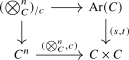
for every natural number \(n \geq 0\) and every object \(c \in C\). Assume that the following two conditions are satisfied:
- (1)
-
The \(\infty \)-category \(D\) admits all \(\Kk \)-indexed colimits.
- (2)
-
The tensor product functor \(\otimes _D\colon D \times D \to D\) preserves \(\Kk \)-indexed colimits in each variable separately.
Then the Day convolution operad \(\oDay (\Mm _C,\Mm _D)\) defines a symmetric monoidal structure \(\otimes _{\Day }\) on \(\Fun (C,D)\).
Proof of Proposition 16.2.7. We wish to show that the Day convolution operad \(\Oo := \oDay (\Mm _C, \Mm _D)\) defines a symmetric monoidal \(\infty \)-category, i.e., that the functor \(p_{\Oo }\colon \Oo ^{\otimes } \to \Span (\Fin )\) is a cocartesian fibration. Recall from Lemma 14.2.8 that it is enough to show that the following two conditions are satisfied:
- (a)
-
For every finite collection of functors \(\{F_i\}_{i \in I}\), there exists a functor \(G = \bigotimes _{i \in I}^{\Day } F_i\) and a multimorphism \(\{F_i\}_{i \in I} \to G\) in \(\Oo \) inducing for every other functor \(H\colon C \to D\) an equivalence \[ \Hom _{\Oo _{\lra {1}}}(G,H) \iso \Oo (\{F_i\};H). \]
- (b)
-
For a map \(f\colon I \to J\) of finite sets, if we let \(G_j := \bigotimes _{i \in f^{-1}(j)}^{\Day } F_i\) for all \(j \in J\), then the canonical map \[ \bigotimes _{i \in I}^{\Day } F_i \to \bigotimes _{j \in J}^{\Day } G_j \] is a natural isomorphism of functors \(C \to D\).
For part (a), we define \(G\) as the left Kan extension of the composite functor \[ \prod _{i \in I} C \xrightarrow {\prod _{i \in I} F_i} \prod _{i \in I} D \xrightarrow {\otimes _D} D \] along the tensor product functor \(\otimes _C\colon C^I \to C\). Explicitly, for an object \(c \in C\), its value is given by the colimit: \[ G(c) := \colim _{\{c'_i\}_{i \in I} \in (\bigotimes _C^I)_{/c}} \left ( \bigotimes _{i \in I} F_i(c'_i) \right ). \] The existence of this left Kan extension is guaranteed by condition (1) of our hypothesis, as the indexing category \((\bigotimes _C^I)_{/c}\) is in our collection \(\Kk \). The universal property of this left Kan extension provides a natural transformation \[ \eta \colon \bigotimes _D^I \circ \prod _{i \in I} F_i \Longrightarrow G \circ \bigotimes _C^I, \] which by Proposition 16.2.6 corresponds to a multimorphism \(\eta \colon \{F_i\}_{i \in I} \to G\) in \(\Oo \). The universal property of left Kan extension precisely says that for any other functor \(H\colon C \to D\), composition with \(\eta \) induces an equivalence \[ \Hom _{\Oo _{\lra {1}}}(G,H) \simeq \Nat (G, H) \iso \Nat \left ( \bigotimes _D^I \circ \prod _{i \in I} F_i, H \circ \bigotimes _C^I \right ) \simeq \Oo (\{F_i\}_{i \in I};H), \] as desired.
We now show that also (b) holds. Let \(f\colon I \to J\) be a map in \(\Fin \), and write \(G_j := \bigotimes _{i \in f^{-1}(j)}^{\Day } F_i\) for all \(j \in J\). We need to show that the canonical transformation \[ \bigotimes _{i \in I}^{\Day } F_i \to \bigotimes _{j \in J}^{\Day } G_j \] is a natural isomorphism of functors \(C \to D\). To help visualize this, consider the following diagram:
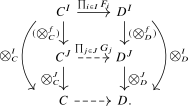
Since left Kan extensions compose, it will suffice to show that the composite \(\bigotimes _D^J \circ \prod _{j \in J} G_j\colon C^J \to D\) is the left Kan extension of the composite \(\bigotimes _D^I \circ \prod _{i \in I} F_i \colon C^I \to D\) along \((\bigotimes _C^f)\colon C^I \to C^J\). By the pointwise formula for Kan extensions, this amounts to showing that for every tuple \((c_j)_{j \in J} \in C^J\), the map \[ \colim _{(c'_i) \in (\bigotimes _C^f)_{/c}} \bigotimes _{i \in I}^D F_i(c'_i) \to \bigotimes _{j \in J} G_j(c_j) \] is a natural isomorphism. Since the functor \(\bigotimes _C^f\colon C^I \to C^J\) is a product of the individual functors \(\bigotimes _C^{I_j}\colon C^{I_j} \to C\), the indexing category \((\bigotimes _C^f)_{/c}\) on the left is a product over \(j \in J\) of the relative slice categories \((\bigotimes _C^{I_j})_{/c_j}\). But we also have \[ G_j(c_j) = \colim _{(c''_i) \in (\bigotimes _C^{I_j})_{/c_j}} \bigotimes _{i \in I_j}^D F_i(c''_i), \] and since the functor \(\bigotimes _{j \in J}^D\colon D^J \to D\) preserves the relevant colimits in each variable separately it follows that the map is a natural isomorphism. This finishes the proof. □
Generated from the authoritative LaTeX source.