Proposition 16.2.6. Let \(C\) and \(D\) be symmetric monoidal \(\infty \)-categories, let \(I\) be a finite set, and let \(\{F_i\colon C \to D\}_{i \in I}\) and \(G\colon C \to D\) be functors. Then there is an equivalence \[ \oDay (\Mm _C,\Mm _D)(\{F_i\}_{i \in I}; G) \simeq \Nat \left ( \bigotimes _D^I \circ \prod _{i \in I} F_i, G \circ \bigotimes _C^I \right ) \] between the anima of multimorphisms \(\{F_i\}_{i \in I} \to G\) in the Day convolution operad and the anima of natural transformations \(\alpha \) fitting in the following diagram:
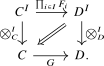
Proof. Let us write \(\Oo := \oDay (\Mm _C, \Mm _D)\) for simplicity. By definition, the anima of multimorphisms \(\Oo (\{F_i\}_{i \in I}; G)\) is the fiber of the projection map \[ p_{\Oo }\colon \Hom _{\Oo ^{\otimes }}(\{F_i\}_{i \in I}, G) \to \Hom _{\Span (\Fin )}(I, \lra {1}) \] over the active span \(I \xleftarrow {\;\id \;} I \to \lra {1}\). By Theorem 16.2.4, the operad \(\Oo \) sits in the following pullback square of \(\infty \)-operads:
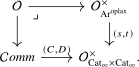
Since hom animae in a pullback of \(\infty \)-categories form a pullback of animae, \(\Hom _{\Oo ^{\otimes }}(\{F_i\}_{i \in I}, G)\) is itself
the fiber in a pullback square of hom animae. Taking the fibers of these hom animae over the
active span \(I \to \lra {1}\), we find that \(\Oo (\{F_i\}_{i \in I}; G)\) is the fiber in the following pullback square of animae: \begin {equation*} 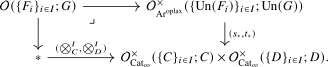

By applying Theorem 16.2.2 to the trivial \(\infty \)-operad, we get that the functor \((s,t)\colon \Ar ^{\oplax } \to \Cat _{\infty } \times \Cat _{\infty }\) is a cartesian fibration over \(\Cat _{\infty } \times \{D\}\) and a cocartesian fibration over \(\{C\} \times \Cat _{\infty }\). The fibers of \((s,t)\) are given by the functor categories \(\Fun (C,D)\), with functoriality in \(C\) given by precomposition and functoriality in \(D\) given by postcomposition. The fiber of the upper-right hom anima over a pair \((f,g)\) is therefore the anima of natural transformations \(g\circ \prod _iF_i\to G\circ f\). In particular, Equation 16.1 identifies the required fiber as \[ \Oo (\{F_i\}_{i \in I}; G) \simeq \Hom _{\Fun (C^I,D)}(\bigotimes _D^I \circ \prod _{i \in I} F_i, G \circ \bigotimes _C^I), \] as claimed. □
Generated from the authoritative LaTeX source.