Proposition 17.2.8. Let \((\Ll ,\Rr )\) be a factorization system on \(S\). If \(p\colon E\to S\) is \(\Ll \)-cocartesian, then \(E_{\Rr }(p)\to S\) is a cocartesian fibration, with cocartesian morphisms given by those diagrams
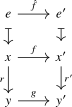
such that \(f\) lies in \(\Ll \) and \(\hat {f}\) is a \(p\)-cocartesian morphism in \(E\). Similarly, if \(g\colon E \to E'\) is an \(\Ll \)-cocartesian functor over \(S\), the induced map \(E_{\Rr }(g)\) is a cocartesian functor over \(S\).
Proof. We start by showing that \(E_{\Rr }(p)\) is a cocartesian fibration: given an object \((e, r\colon x \to y)\) in \(E_{\Rr }(p)\) and a morphism \(g\colon y \to y'\) in \(S\), we will construct a cocartesian lift over \(g\). To this end, consider the unique factorization of \(gr\colon x \to y'\) as \(r'f\), where \(f\colon x \to x'\) is in \(\Ll \) and \(r'\colon x' \to y'\) is in \(\Rr \). Also consider a \(p\)-cocartesian lift \(\hat {f}_e\colon e \to e'\) of \(f\) starting in \(e\); this exists by assumption on \(E\). We claim that the resulting morphism \((\hat {f},f,g)\colon (e,r) \to (e',r')\) in \(E_{\Rr }(p)\) is a cocartesian morphism with respect to the map \(t\pr _2\colon E_{\Rr }(p) \to S\). In other words, we must show that for every third object \((e'', r''\colon x''\to y'')\), the outer square in the commutative diagram
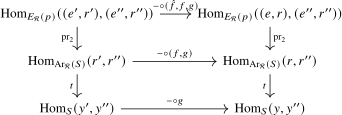
is a pullback square. But this follows from the pasting law of pullback squares: the top square is a pullback square since \(\hat {f}_e\) is \(p\)-cocartesian, and the bottom square is a pullback square since the morphism \((f,g)\colon r \to r'\) is \(t\)-cocartesian by Lemma 17.1.9.
This shows that \(E_{\Rr }(p)\) is a cocartesian fibration. By uniqueness of cocartesian lifts, it also confirms the description of the cocartesian morphisms. The fact that \(E_{\Rr }(g)\) preserves cocartesian morphisms over \(S\) is clear from this description. □
Generated from the authoritative LaTeX source.