Example 23.2.6. An illustrative example is (un)straightening over the walking morphism \(C = [1]\).
Consider first a cocartesian fibration \(p\colon E \to [1]\), with \(E\) small, and let \(E_0\) and \(E_1\) denote its fibers over \(0\) and \(1\), respectively. Cocartesian transport along the canonical morphism in \([1]\) results in a functor \(F\colon E_0 \to E_1\), which corresponds to a morphism in \(\Cat _{\infty }\), i.e. a functor \([1] \to \Cat _{\infty }\). This is \(\Str ^{\cc }(p)\).
Conversely, consider a functor \(F\colon E_0 \to E_1\) between small \(\infty \)-categories. Regarding this as a morphism in \(\Cat _{\infty }\), its unstraightening takes the form of a cocartesian fibration \(E \to [1]\). Since the fibers over \(0\) and \(1\) are \(E_0\) and \(E_1\), there are inclusions \(i_0\colon E_0 \hookrightarrow E\) and \(i_1\colon E_1 \hookrightarrow E\). Moreover, by choosing coherent choices of cocartesian lifts, there is a natural transformation \(\alpha \colon i_0 \Rightarrow i_1 \circ F\) of functors \(E_0 \to E\). All in all, we have constructed a commutative square in \(\Cat _{\infty }\) as follows:
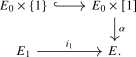
It can be shown that this square is a pushout square in \(\Cat _{\infty }\), see for example [Lurie (2009), Section 3.2.2].
Generated from the authoritative LaTeX source.