Proposition 14.3.11. Let \(R\colon D \to C\) be a lax symmetric monoidal functor between symmetric monoidal \(\infty \)-categories. Assume that \(R\) (as a plain functor from \(D\) to \(C\)) admits a left adjoint \(L\colon C \to D\) such that for all \(n \geq 0\) and objects \(x_1, \dots , x_n \in C\) the composite \[ L(\bigotimes _{i=1}^n x_i) \xrightarrow {L(\bigotimes _{i=1}^n \eta _{x_i})} L(\bigotimes _{i=1}^n RLx_i) \xrightarrow {L(\lax _R)} LR(\bigotimes _{i=1}^n Lx_i) \xrightarrow {\epsilon } \bigotimes _{i=1}^n L(x_i) \] is an isomorphism in \(D\). Then the following statements hold:
- (1)
-
The functor \(R^{\otimes }\colon D^{\otimes } \to C^{\otimes }\) admits a left adjoint \(L^{\otimes }\colon C^{\otimes } \to D^{\otimes }\).
- (2)
-
The functor \(L^{\otimes }\) has a canonical structure as a functor over \(\Span (\Fin )\) for which \(L^{\otimes }\dashv R^{\otimes }\) is a relative adjunction over \(\Span (\Fin )\).
- (3)
-
With this structure, \(L^{\otimes }\) defines a morphism of \(\infty \)-operads from \(\Mm _C\) to \(\Mm _D\).
- (4)
-
This morphism of \(\infty \)-operads comes from a symmetric monoidal functor from \(C\) to \(D\) refining \(L\).
In particular, \(R\) admits a strong symmetric monoidal left adjoint \(L\colon (C,\otimes _C) \to (D,\otimes _D)\).
Proof. (1) As in the proof of Proposition 14.3.6, we use the pointwise criterion for left adjoints from Lemma 21.1.4. We define \(L^{\otimes }\) objectwise as \(L^{\otimes }(\{x_i\}_{i \in I}) := \{L(x_i)\}_{i \in I}\); the unit maps \(\eta _{x_i} \colon x_i \to RLx_i\) induce a candidate unit map \(\eta _X \colon X \to R^{\otimes }L^{\otimes }X\). We must show that for every object \(Y \in D^{\otimes }_J\) the composite \[ \Hom _{D^{\otimes }}(L^{\otimes }X, Y) \xrightarrow {R^{\otimes }} \Hom _{C^{\otimes }}(R^{\otimes }L^{\otimes }X, R^{\otimes }Y) \xrightarrow {- \circ \eta _X} \Hom _{C^{\otimes }}(X, R^{\otimes }Y) \] is an equivalence. This may be tested fiberwise over any span \(\alpha \colon I \xleftarrow {f} K \xrightarrow {g} J\). Let \[ X \to \alpha _!X, \qquad L^{\otimes }X \to \alpha _!L^{\otimes }X, \qquadtext { and } R^{\otimes }L^{\otimes }X \to \alpha _!R^{\otimes }L^{\otimes }X \] denote cocartesian lifts of \(\alpha \) in \(C^{\otimes }\) and \(D^{\otimes }\), and let \(\lax _R\colon \alpha _!R^{\otimes }L^{\otimes }X \to R^{\otimes }\alpha _!L^{\otimes }X\) denote the lax structure map of \(R\) associated to \(\alpha \). We then get a commutative diagram as follows:
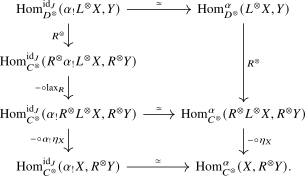
It will thus suffice to show that the left vertical composite is an equivalence. Under the identifications \(C^{\otimes }_J \simeq \prod _{j \in J} C\) and \(D^{\otimes }_J \simeq \prod _{j \in J} D\), this composite is the product over \(j \in J\) of the analogous composites associated to the restricted spans \[ \alpha _j \colon I \xleftarrow {f|_{g^{-1}(j)}} g^{-1}(j) \longrightarrow \lra {1}. \] Indeed, \(R^{\otimes }\) is a morphism of \(\infty \)-operads and therefore respects these product decompositions; in particular, the \(j\)-th component of \(\lax _R\) is the lax structure map associated to \(\alpha _j\). The map \(\alpha _!\eta _X\) decomposes in the same way. It therefore suffices to treat the case \(J = \lra {1}\). Composing the vertical composite with the adjunction equivalence \(\Hom _C(\alpha _!X, RY) \simeq \Hom _D(L\alpha _!X, Y)\), we obtain a map \[ \Hom _D(\alpha _!L^{\otimes }X, Y) \to \Hom _D(L\alpha _!X,Y) \] which we must show is an equivalence. But unwinding definitions shows that this map is given by precomposition with the composite \[ L\alpha _!X \xrightarrow {L\alpha _!\eta _X} L\alpha _!R^{\otimes }L^{\otimes } X\xrightarrow {L(\lax _R)} LR\alpha _!L^{\otimes }X \xrightarrow {\epsilon _{\alpha _!L^{\otimes }X}} \alpha _!L^{\otimes } X. \] This is precisely the comparison map from the hypothesis for the family \(\{x_{f(k)}\}_{k\in K}\), and is therefore an isomorphism. This proves the existence of the left adjoint \(L^{\otimes }\).
(2) The unit maps \(\eta _X\colon X \to R^{\otimes }L^{\otimes }X\) used in the construction lie in the same fibers of \(C^{\otimes } \to \Span (\Fin )\) as their sources. Their images in \(\Span (\Fin )\) therefore give a natural identification \(p_D L^{\otimes } \simeq p_C\) which equips \(L^{\otimes }\) with the structure of a functor over \(\Span (\Fin )\) and lifts the unit to a morphism in \(\Fun _{/\Span (\Fin )}(C^{\otimes },C^{\otimes })\). By Lemma 14.3.4, this makes \(L^{\otimes }\dashv R^{\otimes }\) a relative adjunction over \(\Span (\Fin )\).
(3) The objectwise formula on tuples shows that \(L^{\otimes }\) preserves finite products. Thus it is a morphism of \(\infty \)-operads. Finally, the comparison isomorphism above identifies \(L^{\otimes }\alpha _!X\) with \(\alpha _!L^{\otimes }X\) for every span \(\alpha \). Hence \(L^{\otimes }\) preserves cocartesian morphisms and is strong symmetric monoidal.
(4) By its objectwise definition, the restriction of \(L^{\otimes }\) to the fiber over \(\lra {1}\) is \(L\). □
Generated from the authoritative LaTeX source.