4.5. Colimits of topoi along étale morphisms

Recall from Definition 4.35 the wide subcategory \(\Topos^{\et} \subseteq \Topos\) spanned by the étale morphisms of topoi. The goal in this section is the following somewhat surprising theorem:

Theorem 4.41. ([Uemura 2025, Theorem 5.15])

The category \(\Topos^{\et}\) admits colimits, and these colimits are preserved by the inclusion \(\Topos^{\et} \hookrightarrow \Topos\).

There are two distinct issues in this theorem. For a fixed base topos \(T\), the classification \(\Topos^{\et}_{/T}\simeq T\) and descent in \(T\) make colimits of étale morphisms over \(T\) comparatively easy to control. The difficult point is global: if a diagram in \(\Topos\) has étale transition morphisms, one must prove that its structure morphisms into the colimit are again étale.

We follow the proof of Uemura (2025, Theorem 5.15). After passing to logoi, the problem becomes one about the projections from a limit of a diagram with étale transition morphisms. Uemura recognizes étale morphisms by two properties: preservation of dependent products and the existence of enough univalent families. The first property is stable under limits. For the second, univalent completion allows an initially unrelated tuple of families to be enlarged, by a fixed-point construction, to a compatible tuple in the limit logos. A general criterion for colimits in wide subcategories then completes the proof.

The theorem may also be viewed as a descent statement for the assignment \(T\mapsto\Topos^{\et}_{/T}\simeq T\). This perspective connects with the small and large topoi associated to geometric objects, which will reappear in Section 7.2 and Section 7.3; it is not needed for the proof here. We thank David Wärn for bringing Uemura's article to our attention.

4.5.1. Univalent families

A univalent family is one for which being obtained by pullback is a property rather than additional structure. The main result of this subsection is that every family admits a universal map to a univalent family. Besides avoiding the use of a larger universe of object classifiers, this has an important coherence consequence: maps between univalent families form propositions. Consequently, once compatible maps have been constructed in both directions, all higher compatibility data are automatic. The material in this subsection follows [Uemura 2025, Section 4].

Definition 4.42.

Let \(T\) be a topos. We write

\[\Fam(T) := \Ar^{\pb}(T)\]

for the wide subcategory of \(\Ar(T)\) whose morphisms are pullback squares. We call an object \(u\colon E \to B\) of \(\Fam(T)\) a family in \(T\), and we call its codomain \(B\) the base of the family.

A family \(u \in \Fam(T)\) is univalent if it is a \((-1)\)-truncated object of the category \(\Fam(T)\). We write

\[\Fam^{\univ}(T) \subseteq \Fam(T)\]

for the full subcategory spanned by the univalent families.

Informally, a morphism \(u\colon E \to B\) is univalent if it is a property for an arbitrary morphism \(v\) in \(T\) to be a pullback of \(u\), i.e. if the anima \(\Hom_{\Fam(T)}(v,u)\) is \((-1)\)-truncated. Once we know that \(\Fam(T)\) admits binary products, this is equivalently the condition that the diagonal

\[u \longrightarrow u \times u\]

is an isomorphism in \(\Fam(T)\).

Lemma 4.43. ([Uemura 2025, Lemma 4.2])

Let \(u\colon E \to B\) be a family in a topos \(T\). The functor

\[\Fam(T)_{/u} \longrightarrow T_{/B}\]

sending a pullback square \(v \to u\) to the induced morphism from the base of \(v\) to \(B\) is an equivalence.

Proof
The inverse sends a morphism \(f\colon X \to B\) to the pullback family \(f^*u\). Since morphisms in \(\Fam(T)\) are by definition pullback squares, these two constructions are inverse to each other.

Lemma 4.44. ([Uemura 2025, Lemma 4.3])

The wide subcategory \(\Fam(T) \subseteq \Ar(T)\) is closed under small colimits and pullbacks.

Proof
The assertion about colimits is precisely the topos direction of Proposition 2.16, after identifying \(\Fam(T)\) with \(\Ar^{\pb}(T)\).For pullbacks, note that \(\Fam(T)\) admits pullbacks if and only if for each \(u \in \Fam(T)\) the slice category \(\Fam(T)_{/u}\) admits binary products, which is immediate from Lemma 4.43.

Proposition 4.45. ([Uemura 2025, Lemma 4.4])

The category \(\Fam(T)\) has binary products, and these products preserve small colimits in each variable.

Proof
Let \(u_1\colon E_1 \to B_1\) and \(u_2\colon E_2 \to B_2\) be families. For an object \(X \to B_1 \times B_2\), write \(f_i\colon X \to B_i\) for the two projections. Consider the presheaf on \(T_{/B_1 \times B_2}\) which sends \(X\) to
\[\operatorname{Iso}_{T_{/X}}\!\left(f_1^*u_1,f_2^*u_2\right),\]
the anima of isomorphisms in \(T_{/X}\) between the pullbacks of \(u_1\) and \(u_2\) to \(X\). This presheaf preserves limits: if \(X \simeq \colim_i X_i\) in \(T_{/B_1 \times B_2}\), then descent identifies \(T_{/X}\) with \(\lim_i T_{/X_i}\), and under this identification the two pulled-back families are the compatible systems of their pullbacks to the \(X_i\). Thus isomorphisms between them are computed as the limit of the isomorphism animae over the \(X_i\). By the adjoint functor theorem, the presheaf is therefore representable by some object \(P \to B_1 \times B_2\). Pulling back either \(u_1\) or \(u_2\) along the universal isomorphism gives a family over \(P\), and this family is the product \(u_1 \times u_2\) in \(\Fam(T)\).It remains to prove preservation of colimits in each variable. Fix a family \(u_1\colon E_1 \to B_1\). To show that \(u_1 \times -\colon \Fam(T) \to \Fam(T)\) preserves colimits, we may equivalently show that for any family \(v\colon E' \to B'\) the functor
\[\Fam(T)_{/v} \longrightarrow \Fam(T)_{/u_1\times v}\]
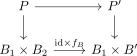
induced by \(u_1 \times -\) preserves colimits, since slices detect colimits. Let \(P'\) denote the base of the product \(u_1\times v\). We claim that under the equivalences \(\Fam(T)_{/v} \simeq T_{/B'}\) and \(\Fam(T)_{/u_1\times v} \simeq T_{/P'}\) from Lemma 4.43, the functor identifies with pullback along the projection map \(P' \to B'\). Since this functor preserves colimits by descent in \(T\), this will finish the proof. To show the claim, we must show that for every \(f\colon u_2 \to v\) in \(\Fam(T)\) with base \(f_B\colon B_2 \to B'\), the square of bases
Commutative diagram generated from the LaTeX source
is a pullback square in \(T\). We compare the presheaves represented by the two objects over \(B_1\times B_2\). Let \(X\to B_1\times B_2\) be an object, and write \(g_1\colon X\to B_1\) and \(g_2\colon X\to B_2\) for the two projections. The object \(P\) represents the presheaf
\[X \longmapsto \operatorname{Iso}_{T_{/X}}\!\left(g_1^*u_1,g_2^*u_2\right).\]
On the other hand, the pullback \((B_1\times B_2)\times_{B_1\times B'}P'\) represents the presheaf
\[X \longmapsto \operatorname{Iso}_{T_{/X}}\!\left(g_1^*u_1,(f_Bg_2)^*v\right),\]
because \(P'\) represents the analogous equivalence presheaf for \(u_1\) and \(v\) over \(B_1\times B'\). Since \(f\colon u_2\to v\) is a morphism in \(\Fam(T)\), the family \(u_2\) is the pullback \(f_B^*v\), and hence \(g_2^*u_2\simeq (f_Bg_2)^*v\). These two presheaves are therefore naturally equivalent, proving that the square is a pullback.

Corollary 4.46. ([Uemura 2025, Corollary 4.6])

Let \(u_{\bullet}\colon [\omega] \to \Fam(T)\) be a sequence of univalent families. Then \(\colim_n u_n\) is univalent.

Proof
By Proposition 4.45, we have
\[\left(\colim_n u_n\right)\times\left(\colim_m u_m\right) \simeq \colim_{(n,m)\in [\omega]\times[\omega]}(u_n\times u_m).\]
(1)
The diagonal functor \([\omega] \to [\omega]\times[\omega]\) is final, so this is further equivalent to \(\colim_n (u_n\times u_n)\). The diagonal of \(\colim_n u_n\) is therefore the colimit of the diagonals \(u_n \to u_n\times u_n\), which are isomorphisms by univalence.

Proposition 4.47. ([Uemura 2025, Proposition 4.7])

The inclusion

\[\Fam^{\univ}(T) \hookrightarrow \Fam(T)\]

admits a left adjoint. We call it the univalent completion functor.

Proof
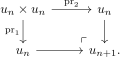
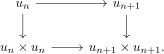
Let \(u\) be a family. We construct a sequence \(u_0 \to u_1 \to u_2 \to \cdots\) in \(\Fam(T)\) by setting \(u_0=u\) and defining \(u_{n+1}\) by the pushout square
Commutative diagram generated from the LaTeX source
Let \(u_{\infty}:=\colim_n u_n\). We claim that \(u_{\infty}\) is univalent. Indeed, the pushout square gives a canonical map \(q_n\colon u_n\times u_n \to u_{n+1}\) for which both composites \(u_n\rightrightarrows u_n\times u_n \to u_{n+1}\) agree with the structure map \(u_n\to u_{n+1}\). In other words, \(q_n\) is a diagonal filler for
Commutative diagram generated from the LaTeX source
Moreover, the composites
\[u_n \longrightarrow u_n\times u_n \xrightarrow{q_n} u_{n+1} \qquadtext{ and } \qquad u_n\times u_n \xrightarrow{q_n} u_{n+1} \longrightarrow u_{n+1}\times u_{n+1}\]
are the structure maps of the shifted sequence \((u_{n+1})_n\) and of the sequence \((u_n\times u_n)_n\), respectively. Since the shift \([\omega]_{\geq 1}\hookrightarrow [\omega]\) is final, and since ((1)) holds without assuming the \(u_n\) are univalent, passing to colimits identifies the resulting map with the diagonal
\[u_{\infty}\longrightarrow u_{\infty}\times u_{\infty}\]
and the maps \(q_n\) induce an inverse. Hence this diagonal is an isomorphism.Now let \(v\) be a univalent family. We show that restriction along \(u \to u_{\infty}\) induces an equivalence
\[\Hom_{\Fam(T)}(u_{\infty},v) \longrightarrow \Hom_{\Fam(T)}(u,v).\]
Given a map \(u_n \to v\), the two induced maps \(u_n\times u_n \rightrightarrows v\) agree because \(v\) is \((-1)\)-truncated in \(\Fam(T)\). Hence the map \(u_n \to v\) extends uniquely across the pushout defining \(u_{n+1}\). Iterating and passing to the limit gives the desired isomorphism. This proves the adjunction.

Remark 4.48.

This construction is the join construction for propositional truncation, transplanted from homotopy type theory to the category \(\Fam(T)\); compare [Uemura 2025, Proposition 4.7].

From this point on, we formulate the proof in the logos direction. Thus an étale morphism of logoi is, after choosing an object \(X\), the canonical functor \(T \to T_{/X}\) sending \(U\) to \(U\times X\), dual to the corresponding geometric morphism of topoi.

4.5.2. Dependent products

If \(T\) is a logos and \(p\colon X \to Y\) is a morphism in \(T\), then the pullback functor

\[p^*\colon T_{/Y} \longrightarrow T_{/X}\]

preserves colimits by descent, hence admits a right adjoint \(\Pi_p\), called dependent product along \(p\).

Definition 4.49.

Let \(\phi^*\colon T \to S\) be a morphism of logoi. We say that \(\phi^*\) preserves dependent products if, for every morphism \(p\colon X \to Y\) in \(T\), the canonical comparison

\[\phi^*(\Pi_p Z) \longrightarrow \Pi_{\phi^*(p)}\phi^*(Z)\]

is an isomorphism for every \(Z \in T_{/X}\).

Proposition 4.50. ([Uemura 2025, Proposition 3.13])

The wide subcategory of \(\Logos\) spanned by the morphisms which preserve dependent products is closed under small limits.

Proof
Let \(T_{\bullet}\colon I\to\Logos\) be a diagram whose transition morphisms preserve dependent products, and let \(T:=\lim_iT_i\). By Proposition 4.30, the underlying category of \(T\) is the limit of the categories \(T_i\). Slices, pullback functors, and their right adjoints are therefore computed pointwise. Hence every projection \(T\to T_i\) preserves dependent products. The same pointwise description shows that the universal cone remains a limit cone in the wide subcategory, which proves the claim.

Definition 4.51.

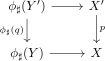
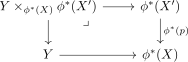
Let \(\phi^*\colon T \to S\) be a morphism of logoi and suppose that \(\phi^*\) admits a left adjoint \(\phi_{\sharp}\colon S \to T\). We say that \(\phi_{\sharp}\) is \(T\)-indexed if, for every morphism \(p\colon X' \to X\) in \(T\) and every pullback square in \(S\) of the form
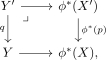
Commutative diagram generated from the LaTeX source

the transposed square

Commutative diagram generated from the LaTeX source

is a pullback in \(T\).

Lemma 4.52. ([Uemura 2025, Proposition 3.16])

Let \(\phi^*\colon T \to S\) be a morphism of logoi. Then \(\phi^*\) preserves dependent products if and only if it admits a \(T\)-indexed left adjoint.

Proof
First suppose that \(\phi^*\) admits a left adjoint \(\phi_{\sharp}\colon S\to T\). For every object \(X\in T\), the induced functor
\[\phi_X^*\colon T_{/X}\longrightarrow S_{/\phi^*(X)}\]
has a left adjoint
\[\phi_{\sharp,X}\colon S_{/\phi^*(X)}\longrightarrow T_{/X},\]
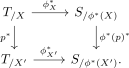
which sends a map \(Y\to \phi^*(X)\) to its transpose \(\phi_{\sharp}(Y)\to X\).Now let \(p\colon X'\to X\) be a morphism in \(T\). Since \(\phi^*\) is left exact, we have a commutative square of pullback functors
Commutative diagram generated from the LaTeX source
The assertion that \(\phi^*\) preserves dependent products along \(p\) is precisely that the corresponding right Beck–Chevalley comparison
\[\phi_X^*\Pi_p \longrightarrow \Pi_{\phi^*(p)}\phi_{X'}^*\]
is an isomorphism. Taking mates under the adjunctions \(\phi_{\sharp,X}\dashv \phi_X^*\), \(\phi_{\sharp,X'}\dashv \phi_{X'}^*\), \(p^*\dashv \Pi_p\), and \(\phi^*(p)^*\dashv \Pi_{\phi^*(p)}\), this is equivalent to the left Beck–Chevalley comparison
\[\phi_{\sharp,X'}\phi^*(p)^* \longrightarrow p^*\phi_{\sharp,X}\]
being an isomorphism. Evaluating this comparison on a map \(Y\to \phi^*(X)\) gives the canonical map from the transpose of the pullback square
Commutative diagram generated from the LaTeX source
to the pullback of \(\phi_{\sharp}(Y)\to X\) along \(p\). Thus the left Beck–Chevalley comparison is an isomorphism exactly when every such transposed square is a pullback. This is precisely the condition that \(\phi_{\sharp}\) is \(T\)-indexed.It remains to note that preservation of dependent products implies that \(\phi^*\) has a left adjoint. Let \(\{X_i\}_{i\in I}\) be a small family of objects in \(T\). The product \(\prod_i X_i\) can be constructed as the dependent product of the object
\[\coprod_{i\in I} X_i \longrightarrow \coprod_{i\in I} *\]
along the fold map \(\coprod_{i\in I} *\to *\). Since \(\phi^*\) preserves colimits, the coproducts in this construction are carried to the corresponding coproducts in \(S\), and by assumption \(\phi^*\) preserves the dependent product. Hence \(\phi^*\) preserves small products. Together with left exactness, this implies that \(\phi^*\) preserves all small limits. Since \(\phi^*\) is an accessible functor between presentable categories, the adjoint functor theorem gives a left adjoint to \(\phi^*\). The first part of the proof then shows that this left adjoint is \(T\)-indexed.

Lemma 4.53. ([Uemura 2025, Proposition 4.10])

Let \(\phi^*\colon T \to S\) be a morphism of logoi which preserves dependent products. Then \(\phi^*\) sends univalent families in \(T\) to univalent families in \(S\).

Proof
Let \(\phi_{\sharp}\) be the \(T\)-indexed left adjoint of \(\phi^*\) from Lemma 4.52. The adjunction gives a natural isomorphism on arrow categories
\[\Hom_{\Ar(S)}(v,\phi^*(u)) \simeq \Hom_{\Ar(T)}(\phi_{\sharp}(v),u).\]
Under this isomorphism, the \(T\)-indexed condition says that any morphism \(v\to \phi^*(u)\) whose square in \(S\) is a pullback is sent to a morphism \(\phi_{\sharp}(v)\to u\) whose square in \(T\) is a pullback. Thus we get a map
\[\Hom_{\Fam(S)}(v,\phi^*(u)) \longrightarrow \Hom_{\Fam(T)}(\phi_{\sharp}(v),u).\]
This map is a monomorphism of animae: both sides are subanimae of the corresponding arrow-category mapping animae, and the ambient map is an isomorphism. If \(u\) is univalent, then \(\Hom_{\Fam(T)}(\phi_{\sharp}(v),u)\) is \((-1)\)-truncated; hence its subanima \(\Hom_{\Fam(S)}(v,\phi^*(u))\) is also \((-1)\)-truncated. Thus \(\phi^*(u)\) is univalent.

4.5.3. Characterization of étale morphisms

We now combine dependent products with univalent families to recognize étale morphisms. Preservation of dependent products supplies an indexed left adjoint and hence a fully faithful factorization through a slice. The remaining question is whether that fully faithful factor is essentially surjective. The existence of enough families detects this, while univalence rigidifies the families sufficiently for the condition to survive the limit construction in the next subsection.

Definition 4.54.

Let \(\phi^*\colon T \to S\) be a morphism of logoi.

  1. We say that \(\phi^*\) provides enough families if, for every family \(v\) in \(S\), there exists a family \(u\) in \(T\) and a morphism \(v \to \phi^*(u)\) in \(\Fam(S)\).

  2. If \(\phi^*\) preserves dependent products, we say that \(\phi^*\) provides enough univalent families if the same condition holds after restricting to univalent families.

  3. We say that \(\phi^*\) is object-generating if the closure of the image of \(\phi^*\) under colimits and finite limits is all of \(S\).

Lemma 4.55.

Let \(\phi^*\colon T \to S\) be a morphism of logoi with a \(T\)-indexed left adjoint \(\phi_{\sharp}\). Then \(\phi^*\) factors as

\[T \xrightarrow{(-)\times \phi_{\sharp}(*)} T_{/\phi_{\sharp}(*)} \xrightarrow{\psi^*} S,\]

where \(\psi^*\) is fully faithful.

Proof
Let \(\eta\colon \id_S \to \phi^* \phi_{\sharp}\) be the unit of the adjunction \(\phi_{\sharp} \dashv \phi^*\). Define
\[\psi^*\colon T_{/\phi_{\sharp}(*)} \longrightarrow S\]
as the composite
\[T_{/\phi_{\sharp}(*)} \xrightarrow{\phi^*} S_{/\phi^* \phi_{\sharp}(*)} \xrightarrow{\eta_*^*} S,\]
where \(\eta_*\colon * \to \phi^* \phi_{\sharp}(*)\) is the unit at the terminal object of \(S\) and the second functor is pullback along \(\eta_*\). For \(X\in T\), the object \(\psi^*(X\times \phi_{\sharp}(*))\) is the pullback of \(\phi^*(X)\times \phi^* \phi_{\sharp}(*) \to \phi^* \phi_{\sharp}(*)\) along \(\eta_*\), hence is equivalent to \(\phi^*(X)\).The left adjoint of \(\psi^*\) is \(\phi_{\sharp}\) followed by the evident map to \(\phi_{\sharp}(*)\). The counit is identified, by the \(T\)-indexed condition, with the transpose of a pullback square, and is therefore an isomorphism. Hence \(\psi^*\) is fully faithful.

Proposition 4.56. ({Uemura, [Uemura 2025, Proposition 5.10]})

Let \(\phi^*\colon T \to S\) be a morphism of logoi which preserves dependent products. Then the following conditions are equivalent:

  1. \(\phi^*\) is an étale morphism.

  2. The unit \(\id_S \to \phi^*\phi_{\sharp}\) of the indexed adjunction is cartesian.

  3. \(\phi^*\) provides enough families.

  4. \(\phi^*\) provides enough univalent families.

  5. \(\phi^*\) is object-generating.

If these conditions hold, then \(\phi^*\) is equivalent, under \(T\), to the canonical étale morphism \(T \to T_{/\phi_{\sharp}(*)}\), \(Y\mapsto Y\times \phi_{\sharp}(*)\).

Proof
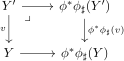
Assume first that \(\phi^*\) is an étale morphism. Choose \(X\in T\) and identify \(S\) with \(T_{/X}\) so that \(\phi^*\) is the functor \(Y\mapsto Y\times X\). Then the left adjoint is the forgetful functor \(T_{/X}\to T\), and the unit is cartesian because a morphism in a slice is recovered by pulling back its total space along the corresponding map to \(X\). This gives (1) \(\Rightarrow\) (2).If the unit is cartesian and \(v\colon Y'\to Y\) is a family in \(S\), then the naturality square
Commutative diagram generated from the LaTeX source
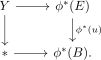
exhibits \(v\) as a pullback of the family \(\phi_{\sharp}(v)\) after applying \(\phi^*\). Thus (2) implies (3).Condition (3) implies (5): applying (3) to the family \(Y\to *\) gives a family \(u\colon E\to B\) in \(T\) and a pullback square
Commutative diagram generated from the LaTeX source
Since \(* \simeq \phi^*(*)\), the object \(Y\) is a finite limit of objects in the image of \(\phi^*\). Hence \(\phi^*\) is object-generating.Now assume (5). By Lemma 4.55, the morphism \(\phi^*\) factors as an étale morphism followed by a fully faithful morphism \(\psi^*\). Since \(\phi^*\) is object-generating, so is \(\psi^*\). A fully faithful morphism of logoi which is object-generating is an equivalence, because its essential image is already closed under colimits and finite limits. Hence \(\phi^*\) is an étale morphism. This proves (5) \(\Rightarrow\) (1).It remains to compare (3) and (4). The implication (4) \(\Rightarrow\) (3) follows by applying univalent completion from Proposition 4.47 to the target family. Conversely, if (3) holds and \(v\) is univalent in \(S\), choose a family \(u\) in \(T\) and a map \(v\to \phi^*(u)\). Let \(u^{\univ}\) be the univalent completion of \(u\). By Lemma 4.53, \(\phi^*(u^{\univ})\) is univalent, and the composite
\[v \longrightarrow \phi^*(u) \longrightarrow \phi^*(u^{\univ})\]
shows that (4) holds.

Proposition 4.57. ([Uemura 2025, Corollary 5.11 and Lemma 5.12])

For every logos \(C\), the functor

\[C\catop \longrightarrow \Logos^{\et}_{C/}, \qquad X \longmapsto (C \to C_{/X})\]

is an equivalence. Under this equivalence, the inclusion \(\Logos^{\et}_{C/}\hookrightarrow \Logos_{C/}\) preserves limits.

Proof
Essential surjectivity and full faithfulness are the slice classification of étale morphisms from Proposition 4.38, translated to logoi. Explicitly, an étale morphism \(\phi^*\colon C\to S\) is equivalent to \(C\to C_{/\phi_{\sharp}(*)}\) by Proposition 4.56.For preservation of limits, let \(X_{\bullet}\colon I\to C\) be a diagram with colimit \(X\). Descent gives
\[C_{/X} \simeq \lim_i C_{/X_i}\]
in \(\Logos_{C/}\). Passing to \(C\catop\), this says exactly that \(X\mapsto C_{/X}\) preserves the relevant limits.

4.5.4. Proof of the main theorem

We are now in a position to prove Theorem 4.41, i.e. the fact that \(\Topos^{\et} \subseteq \Topos\) is closed under colimits, or equivalently that \(\Logos^{\et} \subseteq \Logos\) is closed under limits.

Lemma 4.58. ([Uemura 2025, Lemma 5.13])

Let \(\{C_i\}_{i\in I}\) be a small family of logoi. Then every projection

\[\prod_{j\in I} C_j \longrightarrow C_i\]

is an étale morphism.

Proof
Let \(D=\prod_{j\in I}C_j\). Define an object \(x\in D\) by taking \(x_i=*\) and \(x_j=\emptyset\) for \(j\neq i\). Then
\[D_{/x} \simeq \prod_{j\in I}(C_j)_{/x_j} \simeq C_i,\]
since the slice over the initial object is terminal. Under this equivalence, the canonical étale functor \(D\to D_{/x}\) is the projection to \(C_i\).

Lemma 4.59. ([Uemura 2025, Lemma 5.14])

Let \(C_{\bullet}\colon I\to \Logos^{\et}\) be a small diagram, and let

\[C_{-\infty}:=\lim_{i\in I} C_i\]

be its limit in \(\Logos\). Then every projection \(\pi_i\colon C_{-\infty}\to C_i\) is an étale morphism.

Proof
Let \(D:=\prod_{i\in I} C_i\). By Lemma 4.58, it suffices to prove that the forgetful morphism
\[\pi\colon C_{-\infty}\longrightarrow D\]
is an étale morphism. By Proposition 4.56, it is enough to show that \(\pi\) preserves dependent products and provides enough univalent families.Every étale morphism preserves dependent products by Proposition 4.37 and Lemma 4.52. Hence Proposition 4.50 shows that \(\pi\) preserves dependent products.Let \(u=(u_i)_{i\in I}\) be a univalent family in \(D\), i.e. a tuple of univalent families \(u_i\in \Fam^{\univ}(C_i)\) without imposing the transition equivalences. Since limits of logoi are computed in \(\Cat\), we have \(\Fam(C_{-\infty})\simeq \lim_i\Fam(C_i)\). Hence \(\Fam^{\univ}(C_{-\infty})\) is the full subposet of \(\Fam^{\univ}(D)\) spanned by the tuples equipped with equivalences \(s^*(u_i)\simeq u_j\) for all arrows \(s\colon i\to j\) in \(I\); the higher coherences are automatic because univalent families form a poset. We will enlarge \(u\) to such a compatible tuple.For a morphism \(s\colon i\to j\) in \(I\), write \(s^*\colon C_i\to C_j\) for the corresponding étale morphism of logoi, and write \(s_{\sharp}\colon C_j\to C_i\) for its left adjoint. Both functors induce functors on families. For \(s^*\) this follows from left exactness. For \(s_{\sharp}\) it follows from the indexed condition in Lemma 4.52; after identifying \(s^*\) with a pullback functor into a slice, \(s_{\sharp}\) is the total-object functor and therefore preserves pullback squares. Both induced functors preserve colimits of families: \(s^*\) preserves colimits as a morphism of logoi, while \(s_{\sharp}\) preserves them as a left adjoint, and colimits in \(\Fam(C_i)\) and \(\Fam(C_j)\) are computed in the corresponding arrow categories by Lemma 4.44.Define an endofunctor \(\Phi\) of \(\Fam(D)\) by
\[\Phi(u)_i := \coprod_{(s\colon j\to i)} s^*(u_j) \sqcup \coprod_{(s\colon i\to j)} s_{\sharp}(u_j).\]
Let \(G\) be the endofunctor of \(\Fam^{\univ}(D)\) obtained by applying univalent completion componentwise to \(\Phi\). The summands indexed by the identity morphisms give a natural map \(u\to G(u)\). Moreover, for every \(s\colon i\to j\) there are natural maps
\[s^*(u_i) \longrightarrow G(u)_j \qquadtext{ and } \qquad u_j \longrightarrow s^*G(u)_i,\]
the second obtained by adjunction from \(s_{\sharp}(u_j)\to G(u)_i\).Now form the chain
\[u \longrightarrow G(u) \longrightarrow G^2(u) \longrightarrow \cdots\]
and set \(u^{\infty}:=\colim_n G^n(u)\). This colimit is computed in \(\Fam(D)\) and remains univalent by Corollary 4.46. The functor \(G\) preserves sequential colimits: the functor \(\Phi\) does so by the preceding paragraph, and univalent completion does so because it is a left adjoint. Consequently,
\[G(u^{\infty})\simeq\colim_nG^{n+1}(u).\]
Here it is essential that univalent families form a poset. In particular, the two morphisms \(G(u)\to G^2(u)\) obtained by applying \(G\) to \(u\to G(u)\) and by evaluating the natural transformation \(\id\to G\) at \(G(u)\) agree, and all higher compatibilities are unique. Thus applying \(G\) to the displayed chain gives its tail. Under the resulting identification, the natural map
\[u^{\infty}\longrightarrow G(u^{\infty})\]
agrees with the map induced by the structure maps \(G^n(u)\to G^{n+1}(u)\). It is an isomorphism because the inclusion of the tail of \([\omega]\) is final. This is the usual Adámek fixed-point argument [Adamek 1974].For every arrow \(s\colon i\to j\), the displayed maps for \(G\) pass to the colimit and give morphisms
\[s^*(u^{\infty}_i) \longrightarrow u^{\infty}_j \qquadtext{ and } \qquad u^{\infty}_j \longrightarrow s^*(u^{\infty}_i)\]
between univalent families. Here the fixed-point equivalence identifies the shifted colimits appearing in the construction with \(u^{\infty}\). Since univalent families form a poset inside \(\Fam(C_j)\), these two maps exhibit \(s^*(u^{\infty}_i)\) and \(u^{\infty}_j\) as equivalent. The higher compatibility data are unique for the same reason. Thus \(u^{\infty}\) is a univalent family in the limit logos \(C_{-\infty}\), and the map \(u\to u^{\infty}\) shows that \(\pi\) provides enough univalent families.

Proposition 4.60. ([Uemura 2025, Proposition 2.6])

Let \(C\) be a category with small colimits, and let \(D\subseteq C\) be a wide subcategory. Suppose that:

  1. For every object \(X\in C\), the wide subcategory \(D_{/X}\subseteq C_{/X}\) is closed under small colimits.

  2. For every small diagram \(X_{\bullet}\colon I\to D\), if \(X=\colim_i X_i\) is computed in \(C\), then all structure maps \(X_i\to X\) lie in \(D\).

Then \(D\) is closed under small colimits in \(C\).

Proof
Let \(X_{\bullet}\colon I\to D\) be a diagram and let \(X=\colim_i X_i\) in \(C\). We need to show that \(X\) has the universal property of a colimit in \(D\). For any object \(Y\), a morphism \(f\colon X\to Y\) belongs to \(D\) if and only if all composites \(X_i\to X\to Y\) belong to \(D\): the forward direction follows from (2), and the reverse direction follows from (1), since \(f\) is the colimit in \(C_{/Y}\) of the diagram of the composites \(X_i\to Y\). This identifies the mapping anima from \(X\) to \(Y\) in \(D\) with the limit of the mapping animae from the \(X_i\) to \(Y\) in \(D\), as desired.

We finally get to the main result.

Proof
We apply Proposition 4.60 to the wide subcategory \(\Topos^{\et}\subseteq \Topos\).First fix a topos \(S\). We claim that \((\Topos^{\et})_{/S}\subseteq \Topos_{/S}\) is closed under colimits. Under the equivalence
\[S \simeq \Topos^{\et}_{/S}, \qquad X\longmapsto S_{/X}\]
from Proposition 4.38, a diagram of étale morphisms over \(S\) corresponds to a diagram \(X_{\bullet}\) in \(S\). If \(X=\colim_i X_i\), descent in \(S\) gives
\[S_{/X} \simeq \lim_i S_{/X_i},\]
which says that the corresponding colimit in \(\Topos_{/S}\) is again étale over \(S\).It remains to verify the structure-map condition. Let \(T_{\bullet}\colon I\to \Topos^{\et}\) be a diagram, and let \(T=\colim_i T_i\) be its colimit in \(\Topos\). Passing to logoi, this is the limit of the opposite diagram in \(\Logos^{\et}\). By Lemma 4.59, each projection \(T\to T_i\) on the logos side is an étale morphism. Equivalently, each structure morphism \(T_i\to T\) on the topos side is étale.The criterion therefore shows that \(\Topos^{\et}\) is closed under colimits in \(\Topos\), and that the colimit computed in \(\Topos\) has the universal property in \(\Topos^{\et}\). Hence the inclusion preserves these colimits.

References

  1. Taichi Uemura. Colimits in the ∞-category of ∞-topoi and étale morphisms. 2025.
  2. Jiri Adamek. Free algebras and automata realizations in the language of categories. Commentat. Math. Univ. Carol., 15, 589–602. 1974.