7.1. Schemes
We begin with the topos-theoretic formulation of schemes. The point is to isolate the features that will later be abstracted by Lurie's notions of geometry and fractured topos.
A ringed topos is a pair \((T,\Oo)\) where \(T\) is a topos and \(\Oo\) is a commutative ring object of \(T\) whose underlying object is \(0\)-truncated. In other words, \(\Oo\) is a sheaf of static commutative rings on \(T\).
A Zariski scheme is a ringed topos \((T,\Oo)\) which is locally isomorphic to \(\Spec(R)_{\Zar}\), i.e. there exists a covering family \(\{U_i \to *\}_{i \in I}\) in \(T\) such that for every \(i \in I\) the induced ringed topos \((T_{/U_i}, \Oo|_{U_i})\) is isomorphic to \(\Spec(R_i)_{\Zar}\) for some ring \(R_i\). A morphism of Zariski schemes \((T,\Oo_T) \to (S,\Oo_S)\) is a pair \((f,f^{\sharp})\) consisting of a morphism of topoi \(f\colon T \to S\) together with a morphism of sheaves of static rings \(f^{\sharp}\colon \Oo_S \to f_*\Oo_T\). We require the adjoint morphism
to be local, meaning that the following square of objects of \(T\) is a pullback:
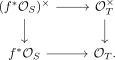
Equivalently, this condition may be tested on sections over every object of \(T\): a section of \(f^*\Oo_S\) is invertible if and only if its image in \(\Oo_T\) is invertible. This gives a category \(\Sch_{\Zar}\).
An étale scheme is a ringed topos \((T, \Oo)\) that is locally isomorphic to \(\Spec(R)_{\et}\). We similarly obtain a category \(\Sch_{\et}\).
A classical scheme is exactly a \(0\)-localic Zariski scheme.
A classical Deligne–Mumford stack is exactly a \(1\)-localic étale scheme.
If \((T,\Oo)\) is a Zariski scheme, and \(X \in T\), then \((T_{/X}, \Oo\vert_{T_{/X}})\) is again a Zariski scheme.
Étale schemes are also called Deligne–Mumford \(\infty\)-stacks.
The following are standard facts from scheme theory, translated into the language of structured topoi; see [Lurie 2011, Sections 2 and 3] for this formalism.
The global section functor
\[\mathrm{LocRingTopos} \to \CRing\catop, \qquad (T,\Oo) \mapsto \Oo(T)\]admits a fully faithful right adjoint
\[\CRing\catop \to \mathrm{LocRingTopos}, \qquad R \mapsto \Spec(R)_{\Zar}.\]The functor
\[\Sch_{\Zar} \to \Shv_{\Zar}(\CRing\catop), \qquad (T,\Oo) \mapsto \Hom(\Spec(-)_{\Zar}, (T,\Oo))\]is fully faithful. Moreover, a Zariski sheaf \(X\) is in the image if and only if there exists an effective epimorphism \(\bigsqcup_i U_i \xrightarrow{f_i} X\) where \(U_i\) is representable and \(f_i\) is representable by an étale map (of ringed topoi).
The category \(\Shv_{\Zar}(\CRing^{\mathrm{fp},\op})\) is the classifying topos for local rings.
We have made a number of different definitions here. These constructions fit into a common pattern, which we will now discuss. We first list some more facts about scheme theory which are a bit less standard.
A morphism \((f,f^{\sharp})\colon (T,\Oo_T) \to (S,\Oo_S)\) of Zariski schemes is called étale if the underlying morphism of topoi \(f\) is étale and the adjoint structural morphism
is an isomorphism. This use of the word étale is unrelated to the notion of an étale scheme from Definition 7.3. For example, every morphism which is locally on source and target an open immersion of schemes is étale in this sense.
We denote the resulting wide subcategory of \(\Sch_{\Zar}\) by
The category \(\Sch_{\Zar}^{\et}\) is (up to size issues) a topos. In fact, there is an equivalence
where \(\CRing^{\ad}\) is the wide subcategory of \(\CRing\) spanned by the localization maps of the form \(R \to R[s^{-1}]\).
The equivalence identifies a Zariski scheme with its functor of points restricted to open affine morphisms. The structural isomorphism in Definition 7.6 is essential here: requiring only that the underlying morphism of topoi be étale would give a larger category.
For every topos \(T\), the category \(\Shv_{\CRing}(T)\) admits a factorization system: every map \(A \to B\) factors uniquely as
where the second map is a local map. This factorization is functorial in \(T\).
Based on these results and observations, we see that the topos \(E = \Shv_{\Zar}(\CRing^{\mathrm{fp},\op})\) has the following additional structure:
Sheafified left Kan extension along the inclusion \(\CRing^{\mathrm{fp},\ad,\op} \hookrightarrow \CRing^{\mathrm{fp},\op}\) induces a faithful functor
\[E^{\corp} := \Shv_{\Zar}(\CRing^{\mathrm{fp},\ad,\op}) \hookrightarrow \Shv_{\Zar}(\CRing^{\mathrm{fp},\op}) = E\]whose image is also a topos. We refer to this subcategory \(E^{\corp}\) as the subcategory of corporeal objects.
There exists a wide subcategory \(E^{\ad}\) of \(E\) consisting of the “representable étale maps”.
The functor \(\Geom(-,E)\colon \Topos\catop \to \Cat\) factors as
\[\Topos\catop \to \Cat^{\mathrm{fact}} \to \Cat,\]where \(\Cat^{\mathrm{fact}}\) is the category of categories equipped with a factorization system.
The category \(\Topos_{//E}\) of ringed topoi admits a wide subcategory
\[(\Topos_{//E})^{\loc} \subseteq \Topos_{//E}\]consisting of the local morphisms of ringed topoi.
The guiding point is that these four structures are different manifestations of the same geometry. The theory below makes precise the relation between corporeal objects and admissible morphisms, and then explains how local morphisms recover the corresponding notion of scheme.
In the next two sections we will consider abstract versions of this story: Lurie's notion of a geometry which encapsulates the idea of having affine test objects with morphisms playing the role of open inclusions and the covers they generate, and the resulting notion of a fractured topos.
References
- Jacob Lurie. Derived algebraic geometry V: Structured spaces. 2011.