5.7. The Goodwillie tower of a topos

The acyclic product allows us to form powers of a congruence, just as one forms powers of an ideal in a commutative ring. The corresponding tower of quotients is a completion tower. Its successive layers already exhibit a stable phenomenon, and the special case associated with the \(\infty\)-connected maps recovers Goodwillie's tower of excisive approximations. The results of this section are due to Anel, Biedermann, Finster, and Joyal, principally [Anel et al. 2018, 2025].

5.7.1. Adic filtrations and their layers

Construction 5.85.

Let \(K \in \Cong(T)\) be a congruence. By Theorem 5.84, congruences form a subalgebra of \(\Acyc(T)\). We can therefore form powers \(K^n\), giving congruences for all \(n \geq 0\) sitting in a chain

\[\dots \subseteq K^3 \subseteq K^2 \subseteq K \subseteq \All.\]

We call this the \(K\)-adic filtration. If \(K\) is of small generation, so are its powers, and the filtration gives a tower of quotient logoi

\[T \to \dots \to T/K^3 \to T/K^2 \to T/K \to T/\All \iso *.\]

Let \((K^{n+1})^\perp\) denote the right class of the modality determined by \(K^{n+1}\). We define the \((n+1)\)-st layer of the filtration by

\[K^n/K^{n+1}:=K^n\cap(K^{n+1})^\perp.\]

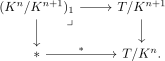
For \(X\in T\), let \((K^n/K^{n+1})_X\subseteq T_{/X}\) be the full subcategory spanned by the maps \(Y\to X\) in this class. At the terminal object, it can equivalently be described as the fiber
Commutative diagram generated from the LaTeX source

Thus an object of \((K^n/K^{n+1})_1\) is \(K^{n+1}\)-local and becomes terminal after localization at \(K^n\). The same description in the slice \(T_{/X}\) gives the layer at an arbitrary object \(X\).

Definition 5.86.

A category is pre-stable if it admits pullbacks and pushouts and a commutative square is cartesian if and only if it is cocartesian.

Proposition 5.87. ([Anel et al. 2025, Theorem 4.2.11])

Let \(n \geq 1\) and \(X \in T\). The layer \((K^n/K^{n+1})_X\) is pre-stable and has a terminal object. Its category of pointed objects is stable.

Proof
Replacing \(T\) by \(T_{/X}\) reduces us to \(X=*\). Put \(T':=T/K^{n+1}\), and let \(J\) be the congruence in \(T'\) generated by the image of \(K^n\). Then \(T/K^n\iso T'/J\). Since the quotient functor preserves acyclic products and \(2n\geq n+1\), we have
\[J^2=\Iso\]
in \(T'\). The layer \((K^n/K^{n+1})_*\) therefore identifies with \((J/J^2)_*\), the full subcategory of \(T'\) spanned by objects \(E\) for which \(E\to *\) belongs to \(J\).This subcategory is closed under pullbacks and pushouts in \(T'\). For pullbacks, use base-change stability of \(J\) and then compose with the terminal map of one of the factors; for pushouts, use closure of \(J\) under colimits in the arrow category. Consider a commutative square in the subcategory. Every morphism in the square belongs to \(J\) by the three-for-two property. If the square is cocartesian, the generalized Blakers–Massey theorem for the modality \((J,J^\perp)\) shows that its cartesian gap map belongs to \(J^2=\Iso\), so the square is cartesian. The dual Blakers–Massey theorem proves the converse. Thus the layer is pre-stable. The terminal object of \(T'\) belongs to it, and adjoining a point makes it pointed; a pointed pre-stable category is stable.

We can apply the \(K\)-adic filtration to the specific case where \(K\) is the congruence of \(\infty\)-connected maps.

Definition 5.88.

Let \(T\) be a topos. We define the \(n\)-th Goodwillie approximation of \(T\) as

\[T^{(n)} := T/(\Conn_{\infty})^{n+1}.\]

This gives rise to a tower of logoi

\[T \to \dots \to T^{(2)} \to T^{(1)} \to T^{(0)} \to T^{(-1)} = *.\]

By passing to right adjoints (geometric morphisms), this may alternatively be regarded as a filtration of \(T\) by subtopoi:

\[* = T^{(-1)} \hookrightarrow T^{(0)} \hookrightarrow T^{(1)} \hookrightarrow \dots \hookrightarrow T.\]

The terminology is justified by the comparison with excisive functors developed next.

5.7.2. Excisive functors and the Goodwillie comparison

We show that the topos-theoretic filtration recovers classical Goodwillie calculus when applied to functor categories.

Construction 5.89.

Let \(C\) be a small category with finite colimits, and let \(T\) be a topos. The category \(C\) is filtered, so the colimit functor

\[\colim\colon \Fun(C,T) \to T\]

preserves colimits and finite limits, since filtered colimits commute with finite limits in a topos. It is therefore a morphism of logoi. Its right adjoint is the constant-diagram functor \(X\mapsto\const_X\). This functor is fully faithful because \(C\) is weakly contractible, as follows already from the initial object of \(C\). Thus \(\colim\) is a quotient map.

Choose a small set \(\mathcal G\) of generators of \(T\), closed under finite products. For \(G\in\mathcal G\), write

\[y_G\colon C\catop\longrightarrow\Fun(C,T),\qquad X\longmapsto y(X)\otimes G.\]

A functor \(F\colon C\to T\) is constant if and only if it is local with respect to every map \(y_G(f)\colon y_G(Y)\to y_G(X)\), where \(f\colon X\to Y\) ranges through the morphisms of \(C\) and \(G\) ranges through \(\mathcal G\). Indeed, the corresponding locality map is obtained by applying \(\Hom_T(G,-)\) to \(F(X)\to F(Y)\), and the generators detect isomorphisms. Consequently, if

\[\Sigma_T:=\{\,y_G(f)\mid f\in\Ar(C), G\in\mathcal G\,\},\]

then the kernel \(K\) of \(\colim\) is the strong saturation \(\Sigma_T^s\).

We denote the monogenic-epigenic factorization of \(\colim\) as follows:

\[\Fun(C,T) \to \Shv(C\catop; T) \to T.\]

The middle term is the localization at the monogenic part \(K^{\mono}\). We use the notation \(\Shv(C\catop;T)\) because, for \(T=\An\), it is the logos of sheaves for the Grothendieck topology in which every morphism of \(C\catop\) generates a covering sieve. The notation in general denotes the corresponding \(T\)-valued sheaf logos.

We claim that the tower associated to the logos \(\Shv(C\catop; T)\) is precisely the tower of excisive functors. Recall the definition:

Definition 5.90.

A functor \(F\colon C \to T\) is called excisive if it sends pushout squares in \(C\) to pullback squares in \(T\).

For \(n \geq 0\), we say \(F\) is \(n\)-excisive if it sends strongly cocartesian \((n+1)\)-cubes in \(C\) to cartesian \((n+1)\)-cubes in \(T\). Recall that an \((n+1)\)-cube \(X\colon [1]^{n+1} \to C\) is called strongly cocartesian if it is left Kan extended from its restriction to the \(n+1\) edges \(\{0\}^{k} \times [1] \times \{0\}^{n-k}\), and it is cartesian if it is a limit cone.

We denote by \(\Exc^n(C,T) \subseteq \Fun(C,T)\) the full subcategory of \(n\)-excisive functors.

Remark 5.91.

For \(n = 0\), we see that a \(0\)-excisive functor \(F\) is one that sends any map \(X \to Y\) in \(C\) to a diagram \(F(X) \to F(Y)\) exhibiting \(F(X)\) as the limit of \(\{F(Y)\}\). This is precisely saying that \(F\) is a constant functor.

Theorem 5.92.

Let \(K\) be the kernel of the colimit functor \(\colim \colon \Fun(C,T) \to T\). Then there is an equivalence

\[\Fun(C,T)/K^{n+1} \simeq \Exc^n(C,T).\]

In particular, if \(T\) is hypercomplete, we have an equivalence \(\Shv(C\catop; T)^{(n)} \simeq \Exc^n(C,T)\).

Proof
We use the set \(\Sigma_T\) from Construction 5.89. Since \(K=\Sigma_T^s\) is the kernel of a morphism of logoi, it is a congruence. It follows from the two universal properties that
\[K=\Sigma_T^c:\]
the inclusion \(\Sigma_T^c\subseteq K\) holds because \(K\) is a congruence containing \(\Sigma_T\), while \(K\subseteq\Sigma_T^c\) holds because \(\Sigma_T^c\) is strongly saturated. Moreover, \(\Sigma_T\) is closed under diagonals up to isomorphisms. Indeed, the diagonal of \(y_G(f)\) is obtained by applying \(y_G\) to the codiagonal of \(f\), since \(C\) has pushouts; the same description applies to every iterated diagonal. The ABFJ formula now gives
\[K=\Sigma_T^c=\Sigma_T^m.\]
By Lemma 5.74, the power \(K^{n+1}\) is generated as an acyclic class by the \((n+1)\)-fold pushout products of maps in \(\Sigma_T\).For maps \(f_i\colon A_i\to B_i\) in \(C\), let
\[f_0\boxplus\dots\boxplus f_n\colon[1]^{n+1}\longrightarrow C\]
be their external coproduct cube. It is strongly cocartesian. The iterated pushout product of the corresponding opposite Yoneda maps is the cocartesian gap map of the Yoneda image of this cube. Every strongly cocartesian cube in \(C\) is a cobase change of such a free cocartesian cube, and base changes of its Yoneda gap map correspond to such cobase changes. Consequently, locality with respect to the \((n+1)\)-fold pushout products is equivalent to carrying every strongly cocartesian \((n+1)\)-cube to a cartesian cube. This is the content of [Anel et al. 2025, Lemmas 4.4.2--4.4.4]; tensoring with the generators \(G\in\mathcal G\) makes the same argument detect cartesian cubes in \(T\). Thus the \(K^{n+1}\)-local objects are precisely the \(n\)-excisive functors, proving the first equivalence.Now suppose that \(T\) is hypercomplete, and put \(E:=\Shv(C\catop;T)=\Fun(C,T)/K^{\mono}\). Since \(\Fun(C,T)/K\iso T\) is hypercomplete, Lemma 5.67 gives
\[K=(K^{\mono})^{\hyp}.\]
It follows that the image of \(K\) in \(E\) is precisely the congruence \(\Conn_\infty(E)\). Quotient functors preserve acyclic products, see [Anel et al. 2025, Proposition 3.6.1], so the image of \(K^{n+1}\) is \(\Conn_\infty(E)^{n+1}\). The first part now identifies
\[E^{(n)}=E/\Conn_\infty(E)^{n+1}\iso\Exc^n(C,T).\]

Lemma 5.93.

Let \(C = \An^{\fin}\) be the category of finite animae. Then the inclusion \(i\colon \An^{\fin} \hookrightarrow \An\) defines an \(\infty\)-connected object in the topos \(\Shv(\An^{\fin,\op})\). Moreover, it exhibits \(\Shv(\An^{\fin,\op})\) as the classifying topos for \(\infty\)-connected objects: for every topos \(T\), evaluation at \(i\) induces an equivalence of categories

\[\Geom(T,\Shv(\An^{\fin,\op})) \iso T^{\geq \infty}, \qquad \varphi \mapsto \varphi^*(i).\]
Proof
Every object \(X \in T\) determines a morphism of logoi \(\PSh(\An^{\fin,\op}) \to T\) given on generators by \(A \mapsto X^A\). The object \(X\) is \(\infty\)-connected if and only if, for every morphism \(f\colon A\to B\) of finite animae, the induced map
\[X^B\longrightarrow X^A\]
is an effective epimorphism. One direction follows by building finite animae from finitely many cells and using stability of effective epimorphisms under base change and composition. Conversely, the maps between finite spheres include the tests asserting that every iterated diagonal of \(X\to *\) is an effective epimorphism. This criterion is also recorded in [Anel et al. 2025, Example 2.1.16(g)].Let \(K\) be the kernel of \(\colim\colon\Fun(\An^{\fin},\An)\to\An\). By Lemma 5.56, its monogenic part is generated by the monomorphisms \(\im(y(f))\) for maps \(f\) of finite animae. A morphism of logoi preserves epi–mono factorizations, so the morphism classified by \(X\) sends \(\im(y(f))\) to an isomorphism if and only if it sends \(y(f)\) to an effective epimorphism, which is precisely the condition above. Thus the free morphism classified by \(X\) factors through \(\Fun(\An^{\fin},\An)/K^{\mono}\) exactly when \(X\) is \(\infty\)-connected. The universal property of the free logos therefore restricts from
\[\Fun_{\bbLog}(\PSh(\An^{\fin,\op}), T) \iso T, \qquad \varphi \mapsto \varphi(i)\]
to the desired equivalence
\[\Fun_{\bbLog}(\Shv(\An^{\fin,\op}), T) \iso T^{\geq \infty}.\]

Remark 5.94.

In the same way, one can show that \(\Shv(\An^{\fin,\op}_*)\) classifies pointed \(\infty\)-connected objects.

This classification allows us to identify the layers of the Goodwillie tower with known categories of spectra.

Proposition 5.95.

The category \(\Exc^1(\An_*^{\fin},T)\) is equivalent to the total category of \(T\)-parametrized spectra:

\[\int_{X\in T}\Sp(T_{/X}).\]
Proof idea
A \(1\)-excisive functor on finite pointed animae determines its base object \(X\) by evaluation at the zero object. Its reduced part is an excisive reduced functor in the slice \(T_{/X}\), hence a spectrum object of that slice. Conversely, a spectrum object in \(T_{/X}\) determines such a reduced excisive functor, and adjoining the base \(X\) recovers the original functor. These constructions are inverse and natural in \(X\). This is the internal version of Goodwillie's classification of \(1\)-excisive functors; see [Goodwillie 2003, Section 5] and [Anel et al. 2025, Section 4.3].

Proposition 5.96.

The category \(\Exc^1(\An^{\fin},T)\) is equivalent to the total category of \(T\)-parametrized spectral torsors:

\[\{(X,E,s) \mid X \in T, E \in \Sp(T_{/X}), s \in \Gamma(X,E)\}.\]

Here the right-hand side denotes the category whose morphisms consist of a map of base objects together with a compatible map of the pulled-back spectra carrying one section to the other.

Proof idea
Adjoining a disjoint basepoint gives a functor \(\An^{\fin}\to\An_*^{\fin}\). Under the preceding proposition, the additional datum required to descend a pointed excisive functor along this construction is a section of the underlying parametrized spectrum. This identifies unpointed \(1\)-excisive functors with parametrized spectral torsors.

5.7.3. Goodwillie equivalences and homogeneous layers

We conclude by translating the multiplicative properties of the adic filtration into familiar results about the Goodwillie tower. Let

\[P_n\colon \Fun(C,T) \longrightarrow \Exc^n(C,T)\]

be the left adjoint to the inclusion. By Theorem 5.92, this is localization at \(K^{n+1}\), where \(K:=\ker(\colim\colon\Fun(C,T)\to T)\). Thus a morphism is a \(P_n\)-equivalence precisely when it belongs to \(K^{n+1}\). Notice that this is a statement about the class inverted by \(P_n\), not about the right class of \(P_n\)-local morphisms.

Corollary 5.97.

We have

\[(P_n\textup{-equiv})(P_m\textup{-equiv}) = (P_{n+m+1}\textup{-equiv}).\]
Proof
Under the identification above, this is the equality
\[K^{n+1}K^{m+1}=K^{n+m+2}.\]
See also [Anel et al. 2018, Theorem 3.3.4(4)].

The generalized Blakers–Massey theorem now gives the corresponding excision estimate.

Corollary 5.98.

Consider a pushout square in \(\Fun(C,T)\) of the form

Commutative diagram generated from the LaTeX source

where \(f\) is a \(P_n\)-equivalence and \(g\) is a \(P_m\)-equivalence. Then the gap map \(F \to G \times_K H\) is a \(P_{n+m+1}\)-equivalence.

Proof
The two maps belong to \(K^{n+1}\) and \(K^{m+1}\), respectively. The generalized Blakers–Massey theorem places the gap map in their acyclic product, which is \(K^{n+m+2}\). This is the class of \(P_{n+m+1}\)-equivalences. Compare [Anel et al. 2018, Theorem 3.4.1].

Definition 5.99.

Let \(n\geq 1\). A functor \(F\colon C\to T\) is called \(n\)-reduced if the map \(F\to *\) is a \(P_{n-1}\)-equivalence, or equivalently if \(P_{n-1}F\iso *\). More generally, a map \(F\to B\) is called \(n\)-reduced relative to \(B\) if it is a \(P_{n-1}\)-equivalence.

An \(n\)-excisive and \(n\)-reduced functor is called \(n\)-homogeneous.

The shift in this definition is essential: \(n\)-reduced means that all polynomial information of degree at most \(n-1\) vanishes.

Corollary 5.100. (Goodwillie's structure theorem)

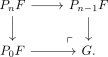
Consider a functor \(F\colon C \to T\), and define \(G\) via the following pushout square:
Commutative diagram generated from the LaTeX source

Then the canonical map \(G\to P_0F\) is \(n\)-reduced relative to \(P_0F\), and the square is \(P_n\)-cartesian. Equivalently, applying \(P_n\) turns it into a pullback square.

Proof
The map \(P_nF\to P_{n-1}F\) is a \(P_{n-1}\)-equivalence. Its cobase change \(P_0F\to G\) is therefore a \(P_{n-1}\)-equivalence, and so is the induced map \(G\to P_0F\), by three-for-two. This proves the first assertion.The maps \(P_nF\to P_{n-1}F\) and \(P_nF\to P_0F\) are a \(P_{n-1}\)-equivalence and a \(P_0\)-equivalence, respectively. By Corollary 5.98, the gap map
\[P_nF\longrightarrow P_{n-1}F\times_G P_0F\]
is a \(P_n\)-equivalence. After applying \(P_n\), it becomes an isomorphism, which is precisely the second assertion. This argument is the cartesian part of [Anel et al. 2018, Theorem 3.5.2].

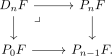
Suppose now that \(C\) is pointed. The zero object then gives natural maps \(P_0F\to F\to P_nF\). Define the \(n\)-th homogeneous layer \(D_nF\) by the pullback square
Commutative diagram generated from the LaTeX source

Corollary 5.101.

There is a canonical isomorphism

\[D_nF\iso\Omega_{P_0F}P_nG\]

in the pointed slice category \(\Fun(C,T)_{/P_0F,*}\). Thus \(P_nG\) is a delooping of the \(n\)-th homogeneous layer of \(F\).

Proof
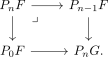
By Corollary 5.100, applying \(P_n\) to the defining pushout square for \(G\) gives a pullback square
Commutative diagram generated from the LaTeX source
The lower horizontal map points \(P_nG\) in the slice over \(P_0F\). Pulling this square back along the canonical point \(P_0F\to P_{n-1}F\) identifies the defining pullback for \(D_nF\) with the relative loop object of \(P_nG\). See also [Anel et al. 2018, Corollary 3.5.3].

Corollary 5.102.

If \(C\) is pointed, the category of \(n\)-homogeneous functors \(C\to T\) is stable.

Proof
An \(n\)-homogeneous functor is a \(K^{n+1}\)-local object whose map to the terminal object belongs to \(K^n\). Hence these functors form the layer \((K^n/K^{n+1})_*\). Since \(C\) is pointed, an \(n\)-reduced functor has a canonical point: the map \(P_0F\to F\) identifies with \(*\to F\). Thus the category of \(n\)-homogeneous functors identifies with the category of pointed objects in this layer. It is stable by Proposition 5.87; compare [Anel et al. 2025, Corollary 4.3.5].

References

  1. Mathieu Anel, Georg Biedermann, Eric Finster, André Joyal. Goodwillie's calculus of functors and higher topos theory. J. Topol., 11 (4), 1100–1132. 2018.
  2. Mathieu Anel, Georg Biedermann, Eric Finster, André Joyal. Left-exact localizations of $\infty$-topoi III: The acyclic product. 2025.
  3. Thomas\bibnamedelima G. Goodwillie. Calculus. III: Taylor series. Geom. Topol., 7, 645–711. 2003.