6.4. Localic topoi, Postnikov-completeness, and boundedness

Given an anima \(X\), we may form the truncations \(\tau_n X \in \An_{\leq n}\) for every \(n \geq 0\). These truncations fit into the Postnikov tower

\[X \to \dots \to \tau_{n+1}X \to \tau_nX \to \dots \to \tau_0 X.\]

Moreover, every anima is canonically the limit of its Postnikov tower; in fact, the functor \(\An \to \lim_{n} \An_{\leq n}\) sending \(X\) to the system \((\tau_n X)_n\) is an equivalence of categories.

The goal of this section is to study a closely related phenomenon in the world of topoi. Recall that every anima \(X\) gives rise to the slice topos \(\An_{/X}\). We saw in Proposition 4.38 that the assignment \(X \mapsto \An_{/X}\) defines a fully faithful functor

\[\An \hookrightarrow \Topos.\]

As we will see in this section, there are subcategories \(\Topos_n \subseteq \Topos\) of `\(n\)-localic topoi' for all \(n\), and left adjoints \(L_n\colon \Topos \to \Topos_n\). In the toposic situation, the comparison functor \(\Topos \to \lim_n \Topos_n\) will no longer be an equivalence. Instead, it admits fully faithful left and right adjoints:

We now properly define these notions. A great reference for this material is [Barwick et al. 2018, Section 3.2].

6.4.1. Localic topoi

The \(n\)-localic reflection of a topos retains precisely its \((n-1)\)-truncated objects. Thus localic reflection plays, for topoi, the role played by truncation for animae. We first characterize the topoi which are already determined by this truncated information.

Definition 6.52.

Let \(n \geq -1\). A topos \(T\) is called \(n\)-localic if for every topos \(S\) the induced functor

\[\Geom(S,T) \longrightarrow \Geom(S_{\leq n-1}, T_{\leq n-1}) := \Fun^{\lex, \colim}(T_{\leq n-1}, S_{\leq n-1})\]

is an equivalence.

Notation 6.53.

Let \(\Topos_n \subseteq \Topos\) denote the full subcategory spanned by the \(n\)-localic topoi.

Proposition 6.54.

  1. For any topos \(T\), there exists an \((n,1)\)-category \(C\) with finite limits and a Grothendieck topology on \(C\) such that \(T_{\leq n-1} \simeq \Shv_{\tau}(C)_{\leq n-1}\).

  2. The inclusion \(\Topos_n \hookrightarrow \Topos\) admits a left adjoint \(L_n\colon \Topos \to \Topos_n\) such that \(L_nT = \Shv_{\tau}(C)\) for all \((C,\tau)\) as in (1).

Proof
The category \(T_{\leq n-1}\) is an \(n\)-topos. The presentation theorem for \(n\)-topoi provides a small \((n,1)\)-category \(C\) with finite limits and a Grothendieck topology \(\tau\) for which
\[T_{\leq n-1}\iso\Shv_{\tau}(C)_{\leq n-1}.\]
One may obtain such a site by choosing a sufficiently large regular cardinal \(\kappa\), taking a small finite-limit-closed subcategory of \(\kappa\)-compact objects which generates \(T_{\leq n-1}\) as an \(n\)-topos, and equipping it with the effective epimorphism topology. This proves (1); see [Lurie 2009, Theorem 6.4.1.5 and Proposition 6.4.5.9] for the presentation theorem and its localic refinement.Set \(L_nT:=\Shv_{\tau}(C)\). By [Lurie 2009, Proposition 6.4.5.9], this topos is \(n\)-localic. Its \((n-1)\)-truncated objects are identified with those of \(T\), independently of the chosen presentation. If \(S\) is any \(n\)-localic topos, then the defining property of \(n\)-localic topoi gives natural equivalences \begin{align*} \Geom(L_nT,S) &\iso \Fun^{\lex,\colim}(S_{\leq n-1},(L_nT)_{\leq n-1}) \\ &\iso \Fun^{\lex,\colim}(S_{\leq n-1},T_{\leq n-1}) \\ &\iso \Geom(T,S). \end{align*} Thus \(L_n\) is left adjoint to the inclusion \(\Topos_n\hookrightarrow\Topos\), proving (2).

Example 6.55.

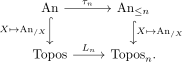
For \(T = \An_{/X}\) we have \(L_n(\An_{/X}) = \An_{/\tau_nX}\), providing a commutative diagram as follows:
Commutative diagram generated from the LaTeX source

So this is the sense in which \(L_n\) “generalizes” the truncation functor \(\tau_n\colon \An \to \An_{\leq n}\).

Warning 6.56.

The finite-limit hypothesis in the site presentation is essential. If \((C,\tau)\) is an \((n,1)\)-site whose underlying category does not have finite limits, then \(\Shv_{\tau}(C)\) need not be \(N\)-localic for any \(N\). For example, [Lurie 2018, Counterexample 20.4.0.1] constructs a basis \(C\) for the topology of the Hilbert cube

\[Q:=\prod_{k\in\N}[0,1]\]

such that the topos of sheaves on \(C\) for the induced topology is not \(N\)-localic for any \(N\). Its hypercompletion nevertheless agrees with the hypercompletion of the \(0\)-localic topos \(\Shv(Q)\).

Despite the previous warning, the presheaf category of an \((n,1)\)-category is still \(n\)-localic after hypercompletion. The proof requires the following auxiliary result:

Lemma 6.57.

Let \(T\) be a topos and let \(u\colon C \to T\) be a functor from a small category. Consider the following four statements:

  1. The restriction functor

    \[u^*\colon T \to \PSh(C), \qquad X \mapsto \Hom_T(u(-),X)\]

    is fully faithful.

  2. \(T\) is generated under colimits by the image of \(u\).

  3. Every \(X \in T\) is covered by the image of \(u\), i.e. there exist objects \(c_i \in C\) and an effective epimorphism \(\bigsqcup_i u(c_i) \twoheadrightarrow X\).

  4. The counit \(u_!u^*(X) \to X\) is \(\infty\)-connected for every \(X \in T\).

Then we have implications (1) \(\Rightarrow\) (2) \(\Rightarrow\) (3) \(\Rightarrow\) (4). Moreover, if \(T\) is hypercomplete then all four statements are equivalent.

Proof
To see that (1) implies (2), let \(u_!\colon \PSh(C) \to T\) be the left Kan extension of \(u\). Since \(u^*\) is fully faithful, the counit \(u_!u^* \to \id_T\) is an equivalence. As every presheaf is a colimit of representables and \(u_!(y(c)) = u(c)\), we conclude that every object of \(T\) is a colimit of objects in the image of \(u\).For (2) \(\Rightarrow\) (3), observe that the collection of objects receiving such an effective epimorphism is closed under colimits.For (3) \(\Rightarrow\) (4), the pointwise formula for left Kan extensions gives
\[u_!u^*(X) \simeq \colim_{(c,\alpha) \in C_{/X}} u(c),\]
where \(C_{/X}\) is the category of pairs \((c,\alpha)\) with \(c\in C\) and \(\alpha\colon u(c)\to X\). Write the counit as
\[X' := \colim_{(c,\alpha)\in C_{/X}} u(c) \to X\]
induced by the maps \(\alpha\). The chosen cover of \(X\) by objects in the image of \(u\) factors through this counit, so the counit is an effective epimorphism.We now prove inductively that it is \(n\)-connected for every \(n\geq 0\). Assume that the counit is \((n-1)\)-connected for every object of \(T\). Universality of colimits identifies
\[X'\times_X X'\iso \colim_{(c,\alpha),(d,\beta)\in C_{/X}}u(c)\times_Xu(d).\]
Under this identification, descent for the colimit defining \(X'\) identifies the diagonal \(X'\to X'\times_XX'\) with the colimit of the counits
\[\colim_{(e,\gamma)\in C_{/\,u(c)\times_X u(d)}}u(e) \longrightarrow u(c)\times_Xu(d)\]
as \((c,\alpha)\) and \((d,\beta)\) vary. Each of these maps is \((n-1)\)-connected by the induction hypothesis. Since \((n-1)\)-connected morphisms are closed under colimits, the diagonal is \((n-1)\)-connected. Together with effective epimorphy, Theorem 3.22 shows that the counit is \(n\)-connected. Thus it is \(\infty\)-connected.Finally, if \(T\) is hypercomplete and (4) is satisfied, then the counit map \(u_!u^* \to \id\) is a natural isomorphism, and so \(u^*\) is fully faithful, giving (1).

Lemma 6.58.

Let \(n \geq -1\), and let \(T\) be a topos such that every object is covered by \((n-1)\)-truncated objects. Then the map of topoi \(T \to L_n(T)\) induces an equivalence on hypercompletions:

\[T^{\hyp} \; \iso \; (L_nT)^{\hyp}.\]
Proof
By Proposition 6.54, there is an \((n,1)\)-category \(C\) with finite limits and a Grothendieck topology \(\tau\) such that \(L_nT \simeq \Shv_{\tau}(C)\). Using the hypothesis on \(T\), we may choose \(C\subseteq T_{\leq n-1}\) so that every object of \(T\) is covered by objects of \(C\). Let \(u\colon C\hookrightarrow T\) denote the inclusion. Since \(u\) preserves finite limits, its colimit extension \(u_!\colon\PSh(C)\to T\) is left exact by Proposition 2.43. By Lemma 6.57, the counit of \(u_!\dashv u^*\) is \(\infty\)-connected. It follows that the composite
\[\PSh(C) \xrightarrow{u_!} T \twoheadrightarrow T^{\hyp}\]
is a left exact localization.Let \(K\) be its kernel. We claim that the monogenic part of \(K\) is \(\tau^c\). By Proposition 6.9, it suffices to test monomorphisms \(R\hookrightarrow y(X)\) which are sieves on representables. Such a sieve is inverted by the displayed localization if and only if \(u_!(R)\to u(X)\) becomes an isomorphism after hypercompletion. Since this map is a monomorphism, this happens if and only if it is already an isomorphism in \(T\), or equivalently if \(u_!(R)\to u(X)\) is an effective epimorphism. By the definition of the effective epimorphism topology \(\tau\), this is precisely the condition that \(R\) be a covering sieve. Hence \(K^{\mono}=\tau^c\).The congruence \(K\) is hypercomplete because its quotient is \(T^{\hyp}\). By Lemma 5.67, a hypercomplete congruence is determined by its monogenic part, so
\[K=(K^{\mono})^{\hyp}=(\tau^c)^{\hyp}.\]
But \((\tau^c)^{\hyp}\) is also the kernel of the localization \(\PSh(C)\to\Shv_{\tau}(C)^{\hyp}=(L_nT)^{\hyp}\). The two hypercomplete localizations therefore have the same kernel, which proves the asserted equivalence.

6.4.2. Postnikov-completeness

Localic reflection records the truncated layers of a topos. Postnikov-completion asks instead whether compatible truncated objects can be assembled into an actual object. This is stronger than convergence of the Postnikov tower of each object: convergence gives full faithfulness of the comparison below, while Postnikov-completeness also requires essential surjectivity.

Definition 6.59.

The Postnikov-completion of a presentable category \(C\) is defined as the limit

\[\widehat{C}\quad := \quad \lim_n C_{\leq n}.\]

Here the transition functor \(C_{\leq n+1}\to C_{\leq n}\) is \(\tau_n\), and the limit is formed in presentable categories and colimit-preserving functors. We say that \(C\) is Postnikov-complete if the canonical functor \(\tau_*\colon C \to \widehat{C}, X \mapsto (\tau_n X)_n\) is an equivalence.

Remark 6.60.

The functor \(\tau_*\) admits a right adjoint \(\lim_n C_{\leq n} \to C\) given by sending a system \((X_n)\) of \(n\)-truncated objects to their limit \(X = \lim_n X_n\). We see:

  • \(\tau_*\) is fully faithful if and only if the unit map \(X \to \lim_n \tau_n X\) is an isomorphism for all \(X \in C\), i.e. every object is the limit of its Postnikov tower. Note that this is necessary but not sufficient for \(\tau_*\) to be an equivalence.

  • \(\tau_*\) is essentially surjective if and only if every system \((X_n)\) satisfying the compatibility conditions arises as \((\tau_n X)\) for some \(X \in C\).

Proposition 6.61. ({cf. [Lurie 2018, Corollary A.7.2.8]})

If \(T\) is a topos, then \(\widehat{T}\) is a topos. For any Postnikov-complete topos \(S\), the morphism of topoi \(\widehat{T} \to T\) induces an equivalence

\[\Geom(S,\widehat{T}) \iso \Geom(S,T).\]
Proof
The category \(\widehat T\) is presentable because it is a limit of presentable categories along accessible colimit-preserving functors, and its colimits are computed levelwise. We verify descent. For \(X=(X_n)_n\in\widehat T\), slicing commutes with limits of categories and gives
\[\widehat T_{/X}\iso\lim_n (T_{\leq n})_{/X_n}.\]
Each \(T_{\leq n}\) is an \(n\)-topos, so its slice functor sends colimits to limits. Consequently, if \(X=\colim_iX_i\) in \(\widehat T\), then \begin{align*} \widehat T_{/X} &\iso \lim_n (T_{\leq n})_{/\colim_iX_{i,n}} \\ &\iso \lim_n\lim_i(T_{\leq n})_{/X_{i,n}} \\ &\iso \lim_i\widehat T_{/X_i}. \end{align*} Thus every colimit in \(\widehat T\) is van Kampen, and \(\widehat T\) is a topos by Theorem 2.42.Projection onto the \(n\)-th component identifies \((\widehat T)_{\leq n}\) with \(T_{\leq n}\). Now let \(S\) be Postnikov-complete. A logos morphism into \(S\iso\lim_nS_{\leq n}\) is the same as a compatible collection of left exact colimit-preserving functors into the \(S_{\leq n}\). Moreover, a left exact colimit-preserving functor with \(n\)-truncated target factors uniquely through \(n\)-truncation. We therefore obtain natural equivalences \begin{align*} \Fun_{\Logos}(\widehat T,S) &\iso \lim_n\Fun^{\lex,\colim}((\widehat T)_{\leq n},S_{\leq n}) \\ &\iso \lim_n\Fun^{\lex,\colim}(T_{\leq n},S_{\leq n}) \\ &\iso \Fun_{\Logos}(T,S). \end{align*} Passing to the opposite category of topoi gives the asserted universal property.

Lemma 6.62.

Every Postnikov-complete topos is hypercomplete.

Proof
Let \(f\colon X \to Y\) be an \(\infty\)-connected map in \(T\). Since \(T\) is Postnikov-complete, the map \(f\) is the limit of the maps \(\tau_n X \to \tau_n Y\), so it suffices to show that each of these maps is an isomorphism. The maps \(X \to \tau_n X\) and \(Y \to \tau_n Y\) are \(n\)-connected, and so is \(f\colon X \to Y\). By right cancellation, it follows that \(\tau_n X \to \tau_n Y\) is also \(n\)-connected. On the other hand, since \(\tau_n X\) and \(\tau_n Y\) are \(n\)-truncated, the maps \(\tau_n X \to *\) and \(\tau_n Y \to *\) are \(n\)-truncated. By left cancellation, it follows that \(\tau_n X \to \tau_n Y\) is \(n\)-truncated as well. Thus \(\tau_n X \to \tau_n Y\) is both \(n\)-connected and \(n\)-truncated, hence an isomorphism.

Notation 6.63.

We denote by \(\Topos^{\post} \subseteq \Topos^{\hyp} \subseteq \Topos\) the full subcategories of Postnikov-complete and hypercomplete topoi. These two inclusions have right adjoints sending \(T\) to \(T^{\hyp} = T_{\leq \infty}\) and \(T \mapsto \widehat{T}\).

6.4.3. Bounded topoi

Postnikov-completion is one reconstruction of a topos from its truncated layers. Bounded topoi arise from the opposite reconstruction: one first takes every localic reflection and then forms their inverse limit in \(\Topos\).

Definition 6.64.

A topos \(T\) is called bounded if the canonical map \(T\to\lim_nL_nT\) is an equivalence. We write \(\Topos^b \subseteq \Topos\) for the full subcategory of bounded topoi.

Lemma 6.65. ([Lurie 2018, Lemma A.7.1.4])

The functor \(L_n \colon \Topos \to \Topos_n\) preserves colimits and small limits.

Proof
Preservation of colimits follows because \(L_n\) is a left adjoint. The limit-preservation statement is [Lurie 2018, Lemma A.7.1.4]; it is the additional input needed to commute localic reflection with the inverse tower of localic approximations.

Proposition 6.66. ({cf. [Lurie 2018, Proposition A.7.1.5 and Corollary A.7.2.8]})

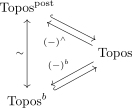
The functor \(L_*\colon \Topos \to \lim_n \Topos_n\) admits fully faithful adjoints on both sides.

  • A topos \(T\) lies in the image of the left adjoint if and only if it is Postnikov complete.

  • A topos \(T\) lies in the image of the right adjoint if and only if it is bounded.

Proof
The right adjoint sends a compatible system \((T_n)_n\) to \(\lim_nT_n\). By Lemma 6.65,
\[L_m\bigl(\lim_nT_n\bigr)\iso\lim_nL_mT_n\iso T_m.\]
Thus the right adjoint is fully faithful, and its essential image consists precisely of the bounded topoi. In particular, the bounded reflection of an arbitrary topos is
\[T^b:=\lim_nL_nT.\]
We next identify the left adjoint. For arbitrary topoi \(T\) and \(S\), the universal properties of truncation and localic reflection give \begin{align*} \Geom(\widehat T,S) &\iso \lim_n\Fun^{\lex,\colim}(S_{\leq n},T_{\leq n}), \\ \Geom(T,S^b) &\iso \lim_n\Geom(T,L_nS) \\ &\iso \lim_n\Fun^{\lex,\colim}(S_{\leq n-1},T_{\leq n-1}). \end{align*} Reindexing gives a natural equivalence \(\Geom(\widehat T,S)\iso\Geom(T,S^b)\). Thus Postnikov-completion is left adjoint to bounded reflection.The Postnikov-completion \(\widehat T\) is Postnikov-complete and has the same truncated objects as \(T\). Conversely, if \(T\) is Postnikov-complete, then \(T\iso\widehat T\iso\widehat{T^b}\). Hence the essential image of the fully faithful left adjoint is exactly \(\Topos^{\post}\), while the essential image of the right adjoint is \(\Topos^b\).

We may summarize this in the following diagram:
Commutative diagram generated from the LaTeX source

Let us emphasize the distinctions among the completion conditions. Hypercompletion forces every \(\infty\)-connected morphism to be an isomorphism. Convergence of Postnikov towers says that each existing object is recovered from its truncations. Postnikov-completeness additionally says that every compatible system of truncated objects is realized by an object. Boundedness reconstructs the topos from the same truncated data through the opposite adjoint, by taking the inverse limit of its localic reflections.

References

  1. Clark Barwick, Saul Glasman, Peter Haine. Exodromy. 2018.
  2. Jacob Lurie. Higher topos theory. Ann. Math. Stud. 170, Princeton, NJ: Princeton University Press. 2009.
  3. Jacob Lurie. Spectral Algebraic Geometry. under construction (version dated February 2018), www.math.ias.edu/~lurie/papers/SAG-rootfile.pdf. 2018.